How to Balance a Full-Time Job With Online Classes (a Realistic Weekly Plan)
Real study-hour estimates, sample schedules by shift, and course-load advice

Key Points
- Budget about nine hours weekly for each three-credit online course.
- Two courses per 8-week term is a sustainable pace for most workers.
- Log one week in 30-minute blocks before choosing your course load.
Can You Really Work Full Time and Take Online Classes?
Online enrollment has made part-time degree work routine for adults with jobs, but the arithmetic has not changed: a single three-credit course typically demands about nine hours a week, and a 40-hour job leaves far fewer free hours than most people assume.
The honest answer is yes, you can do both, but only if the plan is built around the hours you actually have rather than the hours you hope to find. Most advice stops at habits and motivation. Very little of it deals with the logistics of fitting coursework around a fixed work week, a commute, and a household.
That gap is where many working students stall, and it shows up in completion data: students who work full time have historically finished at much lower rates than those working part time.
How Many Hours a Week Do Online Classes Really Take?
Plan on roughly nine hours a week as a baseline for a three-credit online course, and treat that number as a starting point rather than a promise. The figure comes from a widely shared credit-hour standard: about one hour of instruction and at least two hours of out-of-class work per credit, each week, over a semester of roughly 15 weeks.1 The U.S. Department of Education uses that framework, and schools such as Utah State, UConn, and UW-Madison Online4 apply it to online courses.
The Simple Formula
Credits x 2-3 hours = weekly class time plus study time.
A 3-credit course lands between 6 and 9 hours a week. Utah State’s guide on how many hours online classes take each week describes about 9 hours as typical for a 3-credit online course. In an asynchronous course, there may be no scheduled lecture, so the instruction hour gets folded into the same weekly total. UConn’s credit hours and workload guidance treats it as a combined minimum rather than a fixed meeting time.
What Shorter Terms Do to the Math
The credit-hour standard measures total effort across a term, not a weekly cap. Rochester, for example, counts 45 hours of work per credit,2 and RIT uses the same figure,3 which means 135 hours for a 3-credit course. Spread 135 hours across 15 weeks and you get about 9 a week. Squeeze the same course into 8 weeks and the weekly load is often estimated at 9 to 12 hours. The compressed calendar still changes the pace, and an 8-week course can feel like a different animal while carrying the same credit.
How Reported Expectations Compare
Schools do not all agree. ASU Online’s page on the weekly number of hours online students study suggests planning for about 6 hours per credit each week, or 18 hours for a standard 3-credit class. Its guidance puts two or three courses at 36 to 54 hours a week. The sources do not explain whether that reflects shorter sessions, a conservative estimate, or a different reading of the guideline. No survey data, such as NSSE results, gives a verified average for online or working students, so the 3-hour rule is best read as an institutional expectation and not a measured average.
Where Your Course Falls in the Range
Course content moves you around inside that range:
- Reading-heavy courses: History, literature, and social science classes often push toward the high end because of page counts.
- Writing-heavy courses: Drafting and revising can spike hours in weeks when papers are due.
- Quantitative courses: Time varies with how fast you work problems, and struggling with a concept can stretch a week well past the guideline.
Check the syllabus for the first two weeks, then adjust your estimate.
- Program Integrity: Credit Hour and Clock HourU.S. Department of Education
- Credit Hour Policy and ComplianceUniversity of Rochester
- Time on Task in Online CoursesRochester Institute of Technology
- What Does a Credit Hour Mean?UW–Madison Online
Run a One-Week Time Audit to Find Your Real Study Hours
A time audit is a written record of how you actually spend a week, logged in 30-minute blocks from the moment you wake up until you go to sleep. It replaces guesses about free time with evidence, and it is the quickest way to learn how many study hours you can truly count on.
How to Log the Week
For seven days, write down what you did in every half hour. Include work, commute, sleep, meals, household tasks, time with family, and screen time such as scrolling, streaming, and gaming. Log as you go or at set points during the day, because reconstructing a week from memory tends to flatter you.
Sort Hours Into Three Buckets
At the end of the week, label each block:
- Fixed: Paid work, commuting, sleep, and caregiving you cannot hand off.
- Flexible: Errands, exercise, social plans, and chores that can move or shrink.
- Recoverable: Time that slipped away without much value, such as unplanned phone use or television you did not enjoy.
The flexible and recoverable buckets are where your study time will come from.
Find Windows You Can Protect
Scan for stretches of 45 minutes or longer. Shorter gaps rarely allow real focus once you account for getting settled. Then be strict about which windows count. A lunch break that gets interrupted twice a week, or an evening slot that depends on a child falling asleep on time, is a maybe, not a window. Count only the blocks you can reasonably defend.
Audit a Typical Week
Do not choose a quiet week, a vacation, or a stretch when a coworker is out and the schedule is light. A best-case audit produces a best-case plan, and it will fall apart the first time life gets normal. If your week turned out unusual, run it again.
The Number You Are After
Add up your protected windows. That total is your realistic weekly study-hours figure. Keep it handy, because the next step is to compare it against the workload math for the courses you are considering.
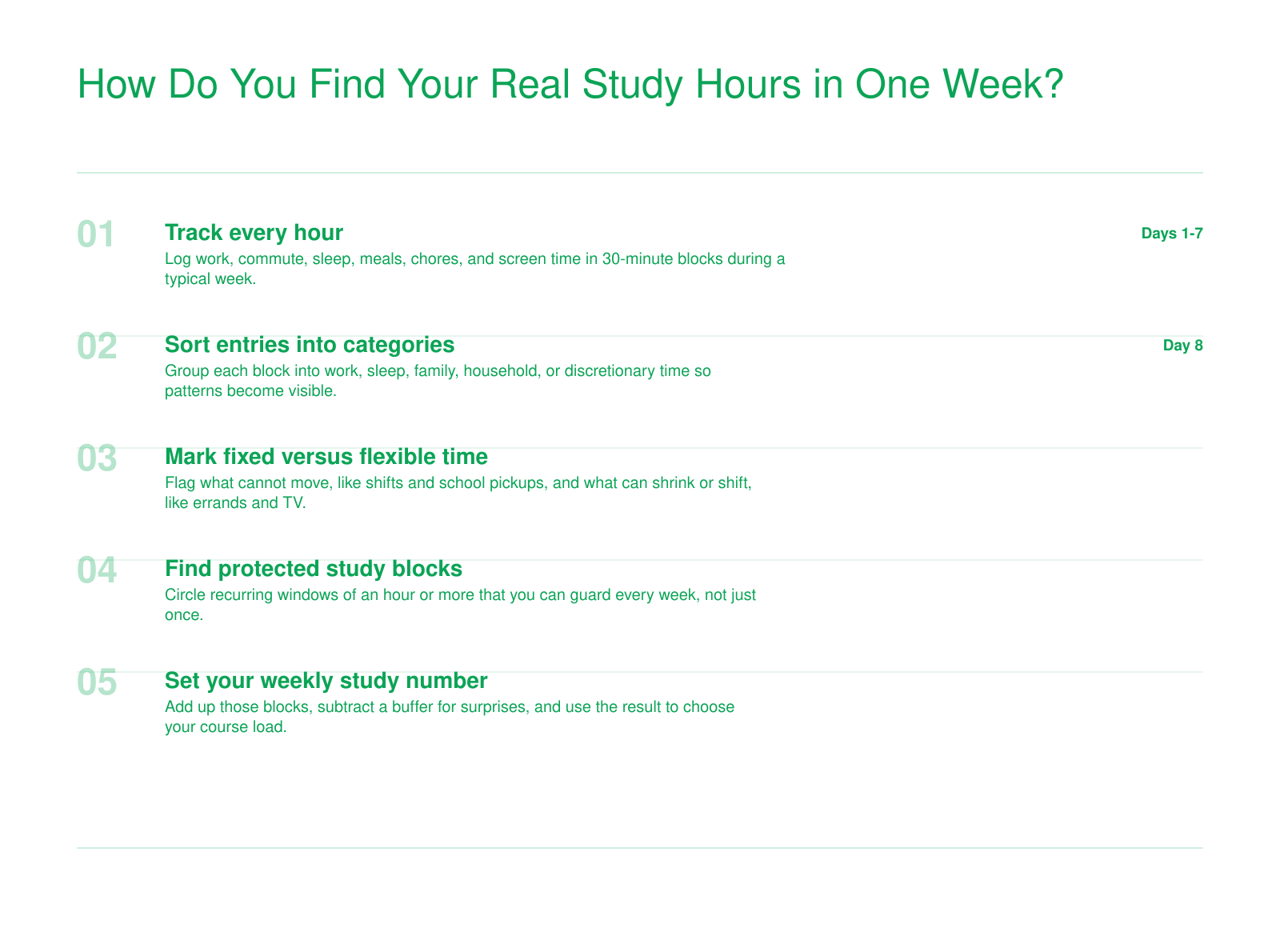
Your 7-Day Time Audit in Five Steps
A time audit replaces guesswork with evidence. Spend one ordinary week logging where your hours actually go, then use these five steps to turn that log into a study number you can defend.
How Many Courses Should You Take per Term While Working Full Time?
For most working adults, two courses per 8-week term (roughly 18 to 24 hours a week of class and study) is the pace most consistently linked to finishing the degree while keeping a livable quality of life, and one course is the better fit if your job or home situation is especially demanding. Federal undergraduate aid treats 6 to 8 credits per standard term as half-time, 9 to 11 as three-quarter-time, and 12 or more as full-time, and the same course counts produce the same enrollment status whether your terms run 8 or 16 weeks. Confirm with your school's financial aid office how your specific credit load is classified before you register, since enrollment status can affect your aid eligibility.
| Courses per term | Approx. weekly hours (class + study) | Typical enrollment status | Approx. time to finish a 120-credit degree |
|---|---|---|---|
| 1 course per 8-week term | 9 to 12 hours | Less than half-time if the course is 3 credits | About 6.67 years (roughly 18 credits per year) |
| 2 courses per 8-week term | 18 to 24 hours | Half-time if the term load is 6 credits | About 3.33 years (roughly 36 credits per year) |
| 3 courses per 8-week term | 27 to 36 hours | Full-time if the term load reaches 12 credits | About 2.22 years (roughly 54 credits per year) |
- Review Your Current Course Enrollment for Financial Aid EligibilityUniversity of Denver
- Pell Grant Enrollment Intensity and Cost of AttendanceFederal Student Aid Partners
Sample Weekly Schedules for Day Shift, Night Shift, Rotating Shifts, and Caregivers
Your study plan should start with your work pattern, not a generic calendar. Treat these templates as starting points: plug in the hours you found in your time audit, then adjust the blocks to fit your course load and deadlines.
| Work pattern | Best study windows | Sample weekly study blocks | Watch out for |
|---|---|---|---|
| Day shift (standard weekday hours) | Early mornings before work, lunch breaks for light review, two or three weekday evenings, and one weekend morning | Mon and Wed, 7 to 9 p.m.: readings and discussion posts. Tue and Thu, 6 to 6:45 a.m.: review and notes. Sat, 8 a.m. to noon: major assignments and quizzes. Sun, 30 minutes: plan the coming week | Evening fatigue after long workdays, and weekend deadlines piling up if weeknight blocks get skipped |
| Night shift | The first hours after you wake up and before your shift, plus your days off | Workdays: 60 to 90 minutes shortly after waking for reading and posts. Days off: two longer blocks of 2 to 3 hours for assignments and exams. Short review on breaks, if your workplace allows it | Trying to study right after a shift when you are exhausted, course deadlines that land in the middle of your shift, and live sessions scheduled during your sleep hours |
| Rotating shifts | Your days off and any workday mornings or afternoons that stay free once your schedule posts | Each time a new schedule posts, map your shifts first, then place three or four blocks of 2 to 3 hours on off days. Add 20 to 30 minutes of review on workdays to keep momentum | Quick turnarounds between shifts, courses with fixed live meeting times, and assignments due in a week when your schedule flips (submit early when you can) |
| Working full time plus caregiving | After dependents go to bed, early mornings before the household wakes, and time covered by a partner or family member | Four weeknights, roughly 9 to 10 p.m.: readings and posts. One weekend block of 2 to 3 hours with childcare or care coverage arranged. Small pockets during school pickup lines or activities for reading on your phone | Sick days, school closures, and care emergencies that wipe out planned blocks, so build in a backup study window each week |
| Compressed week (four longer workdays) | Your extra weekday off, plus one weekend block | Off day: a morning block of about 4 hours for assignments, plus a shorter afternoon block for discussion replies. One weekend block of 2 to 3 hours. Minimal study on long workdays beyond a quick check of course announcements | Cramming the whole week into one day, and midweek deadlines that fall on your longest workdays |
Use Asynchronous Course Design to Your Advantage
Asynchronous courses let you work through material on your own schedule; synchronous courses require you to be logged in at a set time. Plenty of programs mix the two, which is where working students get caught: a course can advertise "online" and still expect you on Zoom Tuesday at 7 p.m. Cornell's continuing education materials describe exactly this blend, with pre-recorded lectures paired with required live videoconference sessions.
What to Verify Before You Register
Flexibility is a course-level fact, not a program-level promise. Before the add/drop window closes, confirm four things with the department or the instructor:
- Mandatory live sessions: Ask whether attendance is required or optional. Some institutions draw a hard line. Long Island University defines fully asynchronous coursework as having no required synchronous meetings1, and Alabama State's policy says faculty cannot require asynchronous learners to attend live sessions2. Sam Houston State's course delivery definitions separate on-demand courses from live ones, where real-time participation is the point.
- Recorded lectures: Common, but not universal. Alabama State requires that supplemental live meetings be recorded and made available2; Florida State's online course recording policy says courses with live components may be recorded. Ask rather than assume.
- Proctored exams: These can exist even in asynchronous courses. Long Island University allows online proctoring in fully asynchronous sections1, Old Dominion notes proctoring requirements vary by course3, and the University of Hawaii uses a service that proctors exams around the clock within windows the instructor sets4.
- How deadlines land: Weekly due dates still apply. Old Dominion's eight-week online format for fall 2026 has no required live meetings3, but the compressed calendar tightens every deadline.
When a Live Session Hits Your Shift
Raise it before the term starts, not after you miss week two. Ask for a recording, an alternate section at a different hour, or a standing office-hours slot that substitutes for live attendance. Instructors accommodate far more readily in August than in October.
Asynchronous design is the natural fit for night-shift and rotating-schedule workers, since nothing requires you to be awake at a fixed hour. The trade is self-discipline: no class meeting means no external nudge, so the structure has to come from your calendar.
- Long Island University Asynchronous Coursework PolicyLong Island University
- Alabama State University Online and Facilitation PolicyAlabama State University
- Old Dominion University Taking Classes OnlineOld Dominion University
- University of Hawaiʻi Honorlock Proctoring Privacy and Data ProtectionUniversity of Hawaiʻi
Talk to Your Employer About Flexibility and Tuition Support
Asking your employer for help can feel like announcing you might leave, yet staying silent often costs you money and flexibility you could have had for free.
How Common Tuition Help Is
A 2024 Society for Human Resource Management survey found that 57% of responding organizations offer tuition assistance.1 That figure reflects the organizations surveyed, not every US employer, so check your own. Under IRS Section 127, an employer can pay up to $5,250 per employee per calendar year without it counting as taxable wages.2 That limit applies for 2025 and 2026 and is scheduled to be adjusted for inflation after 2026.2 It covers tuition, fees, books, supplies, equipment, and qualified student loan payments, and the course does not have to relate to your job.2 It is one combined cap, it does not roll over, and you cannot also claim the same expenses for the Lifetime Learning Credit.34
A Short Script for Your Supervisor
Lead with what the company gains, then make one specific request and offer a trial:
"I'm starting an online degree in [field], and I expect to use what I learn here. The coursework is flexible, but I'd like to start at 7 a.m. on Tuesdays and Thursdays so I can study before evening deadlines. Could we try it for one term and review how it's going?"
A defined ask and an end date make it easy to say yes.
Check HR Before You Enroll
Policies vary widely, so get the written plan and look for:
- Grade requirements: Many plans reimburse only for a B or C and above.
- Approved programs: Some limit coverage to certain fields or accredited schools.
- Reimbursement timing: You may pay up front and be repaid weeks or months after grades post.
- Clawback clauses: You may owe money back if you leave within a set period after being paid.
Ask for More Than Money
Even if there is no tuition benefit, other support can matter just as much:
- Shifted hours: An earlier start, a later start, or a compressed week on heavy class days.
- Protected exam days: Time off or a guaranteed no-meeting window for finals and proctored tests.
- A quiet room: A private space at work for proctored exams if home is unreliable.
Put any agreement in an email so it survives a change in managers.
- IRS Publishes Guidance on Educational Assistance ProgramsPwC
- IRS Updates FAQs About Section 127 Educational Assistance ProgramsIRS
- IRS Publication 5993: Educational Assistance ProgramsIRS
- IRS Updates FAQs on Section 127 Educational Assistance Programs: What Employers Need to KnowBryan Cave Leighton Paisner
When a Busy Season at Work Collides With Finals
Reacting to a collision in week 12 and planning for it in week one lead to very different finals seasons. The second approach costs a little effort up front and saves a lot of panic later.
Map the Collisions in Week One
During the first week of the term, put your syllabus deadlines and exam dates on the same calendar as your known work crunches: quarter-end close, inventory, holiday retail, tax season, annual audits. Flag every major deadline that lands inside a heavy work stretch. A conflict spotted ten weeks out gives you options. One spotted the night before gives you none.
A Three-Tier Contingency Plan
- Front-load the work: For each flagged week, finish readings, discussion posts, and drafts one to two weeks early, while your schedule still has slack.
- Protect exam days: Request PTO or arrange a shift swap for proctored exams and final project due dates as soon as you know them.
- Message instructors early: If a deadline still looks impossible, email your instructor before it passes. Briefly explain the conflict, note what you've completed, and propose a new date.
Extensions and Incompletes
A short extension fits a one-off crunch. An incomplete, which lets you finish coursework after the term ends, makes sense when you've completed most of the course in good standing and a sustained disruption blocks the rest. Eligibility and completion deadlines vary by school, so check your syllabus and student handbook first. Keep the request factual: the situation, your progress, and a specific plan, without lengthy apologies.
Your Minimum-Viable Study Week
When work swallows everything, do the least that keeps you on track: log in daily for ten minutes, submit anything graded, skim the week's key material, and jot down what you'll catch up on later. Small and consistent beats a missed week.
Line up Backup Before You Need It
Ask a family member to cover dinners or childcare during finals, trade favors with a coworker who can take a shift, and pair up with a classmate who will share notes. Support arranged in advance is far easier to lean on than support requested in a panic.
You don't find time for online classes while working full time. You plan around the hours you actually have, then protect those hours like a shift you cannot miss.
degreecompletion.com
Signs You've Taken on Too Much (and How to Adjust)
Support for online students has shifted toward around-the-clock access, though what any one school offers still varies widely. That matters because burnout rarely arrives at a convenient hour.
Warning Signs
The American Psychiatric Association lists chronic fatigue, irritability, loss of motivation, and sleep changes among early burnout signs.1 In a job-plus-school routine, they tend to look like this:
- Chronic sleep loss: You run on short nights and still fall behind.
- Skipped assignments: Missed deadlines become routine instead of rare.
- Double dread: You dread both your shift and your coursework.
- Irritability: Small requests from coworkers, family, or instructors set you off.
- Declining performance: Grades or work quality slip despite more effort.
Mayo Clinic offers yes/no self-check questions.2 It notes that any "yes" may indicate burnout and suggests consulting a health care professional.2
The Adjustment Ladder
Start with the smallest fix and climb only as far as needed:
- Step one: Talk to your instructor about pacing or deadlines.
- Step two: Use tutoring and writing center support.
- Step three: Reduce to part-time enrollment next term.
- Step four: Drop a course before the deadline.
Help Outside Business Hours
Several schools run services that work around a job. The University of Tennessee offers 24/7 tutoring through Brainfuse across 150+ subjects, with up to five free hours per semester.3 Husson University provides Tutor.com tutoring in 250+ subjects.4 Tennessee and Arizona State both offer 24/7 mental health support through TELUS Health Student Support,35 and UT San Antonio and Cincinnati use TimelyCare.67 Cincinnati's version is for distance-learning students residing outside Ohio, so check eligibility and any session limits before counting on a service.7 If you need immediate help, Crisis Text Line is reachable by texting 741741.6
When Dropping Is Smarter Than Pushing Through
A workable rule: if you have already talked to your instructor and used tutoring, and you still cannot find enough protected hours to reach a passing grade before the term ends, drop. Before you do, look up the refund deadline and your financial aid requirements. A late withdrawal may cost tuition, and falling below certain enrollment levels may affect aid. A dropped course you retake next term costs less than a failed one.
- Preventing Burnout: Protecting Your Well-BeingAmerican Psychiatric Association
- Job Burnout: How to Spot It and Take ActionMayo Clinic
- Vols Online Student ResourcesUniversity of Tennessee
- Online Student Support ServicesHusson University
- ASU Online Student ServicesArizona State University
- Guidance and Support ResourcesUT San Antonio Online
- Distance Learner Counseling and Support ServicesUniversity of Cincinnati