Switching Careers as an Adult: Choosing a Bachelor's Degree That Pays Off
Reverse-engineer your major from real jobs, count your credits, and test the switch first

Key Points
- Georgetown CEW puts a bachelor's 40-year median net return near $1.8 million.
- Among 25-plus starters, just 36.6% earned a credential within six years.
- Lawrence Tech caps four-year transfer credit at 90, so check limits early.
Introduction: Choosing a Degree You Can Actually Finish and Use
Most adults pick a major first and look for a job second. The order that protects your money is the reverse. Students who start college at 25 or older finish at much lower rates than younger starters: National Student Clearinghouse data show 36.6% earned any credential within six years, against 63.8% of younger starters.
For a 30-something whose current path has stalled, the wrong major costs years of evenings and tens of thousands of dollars. The filter is simple: name the target role, read what its postings actually require, then confirm how many of your credits a school will accept and what the remaining ones cost.
Many employers still screen on the bachelor's itself, so a finished degree in a sensible field often matters more than a perfect major.
Do You Actually Need a Bachelor's Degree to Switch Careers?
Not always. A short credential can raise your income sooner, but a bachelor's degree tends to pull ahead over a full career: Georgetown's Center on Education and the Workforce reports a 40-year median net return of roughly $1.8 million for public bachelor's-granting institutions versus about $1.37 million for certificate-granting institutions. The right path depends on how quickly you need income relief and whether your target job or license requires a degree.
| Path | Typical cost and time | Best for | Main catch |
|---|---|---|---|
| Bachelor's degree | Georgetown CEW assumes about five years to finish. A typical dollar cost was not reported in the source data. | Full career changes, jobs with licensure requirements, and long-term earnings and advancement | The longer timeline means certificate holders may log more years of work and pay during the first 10 to 20 years after enrolling. Bachelor's earnings generally catch up and surpass certificate earnings later. |
| Post-baccalaureate certificate | 3 months to 2 years; roughly $1,000 to $20,000 | Learning a specific skill, getting a fast income boost, or adding a credential on top of a degree you already hold | Certificate holders earn less on average than bachelor's holders, so the degree path usually wins on lifetime earnings. |
| Master's degree in a new field (unrelated to your first degree) | Total investment of about $140,000 to $180,000, with an 8 to 12 year repayment period. Completion time was not reported in the source data. | Workers aiming for outcomes tied to graduate education; 84 percent of graduate-degree holders meet the earnings threshold used in the cited report | The estimated median earnings premium of $15,000 to $20,000 a year is workable but not a windfall outside business and technical fields. |
| Industry credential | One cited example: a six-month program costing $5,000. A general cost range was not reported. | Adults who need income relief faster than a two-to-four-year degree allows; a credential that leads to a job change or promotion within 6 to 18 months may deliver a better 5-to-10-year financial result | Lower cost and faster entry can win in the short and medium term, but bachelor's-granting institutions show a higher 40-year median return. |
- Ranking 4600 Colleges by ROI (2025)Georgetown University Center on Education and the Workforce
- Is a Degree Worth It? CalculatorFind The Norm
- Success Beyond Completion: How Can We Best Measure Student OutcomesStrada Institute for the Future of Work
How to Reverse-Engineer a Major From a Target Job Posting
Many employers have loosened degree requirements in recent years, yet most postings still ask for a bachelor's, so the real question is which one. Job postings answer it more reliably than a college catalog does.
Build a Posting Sample
1. Collect 10 to 15 postings for the exact role you want, from different employers and at least two regions. Save them as text or screenshots, since listings disappear. 2. Mark required versus preferred. Highlight "required" or "minimum" qualifications in one color and "preferred" or "a plus" in another. Only the first group can block you. 3. Tally what repeats. Keep a simple count of degree fields named, software, certifications, and skills such as budgeting, SQL, or project management.
Sort Broad Options From Narrow Ones
Split your postings into two piles. One says "bachelor's degree in any field" or "or equivalent experience." The other names a major, such as nursing, accounting, or computer science. The first pile matters most for adult learners, because it opens up completion-friendly options like applied studies, organizational leadership, or general studies, where your existing credits are more likely to carry over. The second pile tells you where a specific major is truly necessary.
Flag Deal-Breakers Early
Before you compare a single school, scan for requirements that can rule a path in or out:
- Licenses: Roles in nursing, teaching, accounting (CPA), and social work often require a state license that depends on an approved program.
- Prerequisite courses: Some fields expect particular math, science, or accounting classes that you may need to add.
- Clearance or background checks: Government and defense roles can require eligibility that no degree can supply.
- Accreditation conditions: Some licensing boards accept only specific accreditors or program types.
If a posting lists one of these, confirm it with the licensing board or hiring manager first. Skipping this check is how people finish a degree that still leaves them ineligible.
The Decision Rule
If most of your postings accept any bachelor's, choose the cheapest, fastest accredited route that uses your existing credits.
Completion-Friendly Majors That Map to Growing Fields
Management analysts, project management specialists, and general and operations managers all typically require a bachelor's degree, and employers often draw from many academic backgrounds. That makes these roles a natural fit for career changers finishing a BA, BS, BAAS, applied studies, or business administration degree on top of prior work experience. The pay figures below are approximate 2025 Bureau of Labor Statistics wages for everyone working in each occupation, not earnings for graduates of any one major, and the growth projections cover slightly different 10-year periods depending on the occupation.
Occupation
Completion-friendly degree paths
Median annual pay (2025)
Middle 50% pay range (25th to 75th percentile)
Projected job growth
Average annual openings
Typical entry requirements
General and Operations Managers
BA or BS in business administration, BAAS, or applied studies with a management or leadership concentration
$105,770
$72,320 to $167,280
4.4% (2024 to 2034)
308,700
Bachelor's degree typical; BLS lists 5 or more years of related work experience as typical, so prior supervisory experience matters
Management Analysts
BA or BS in business administration, BAAS, or applied studies with a business, operations, or analytics focus
$101,860
$77,950 to $133,370
8.8% (2024 to 2034)
94,100
Bachelor's degree typical; BLS notes several years of related work experience is also common
Project Management Specialists
BS or BA in business, project management, or a related field; BAAS or applied studies with a project management focus; some employers prefer a technical degree such as computer and information technology or engineering
$102,320
$78,440 to $133,100
7% (2025 to 2035)
76,500
Bachelor's degree typical; professional certification may help but is not always required
- Occupational Outlook Handbook: Management AnalystsBureau of Labor Statistics
- Occupational Outlook Handbook: Project Management SpecialistsBureau of Labor Statistics
- Occupational Outlook Handbook: Management OccupationsBureau of Labor Statistics
- Occupational Employment and Wage Statistics (OEWS) (2025)U.S. Bureau of Labor Statistics
Do Employers Take BAAS and Applied Studies Degrees Seriously?
What the Research Does and Doesn't Show
No 2026 employer survey settles whether hiring managers treat a Bachelor of Applied Arts and Sciences (BAAS), applied studies, or professional studies degree differently from a BA or BS. The major studies measure degree level, skills, and delivery format instead. A 2026 Lumina Foundation, Gallup Employer Survey on Higher Education found that about three-quarters of employers prefer candidates with a degree even when a job doesn't formally require one. A 2026 Ithaka S+R study of employer perceptions of online credentials found that work experience and skills mattered far more than whether a bachelor's was earned online or in person. That's encouraging for career changers, but it isn't proof about your specific degree title.
Run Your Own Check
- Job postings: Search listings for your target role and note whether they ask for "a bachelor's degree in any field," name specific majors, or specify BA/BS only.
- Employers and recruiters: Ask directly whether an applied studies degree meets their requirement.
- Alumni profiles: Search LinkedIn for graduates of the program you're considering and see where they work now.
- Public sources: Use BLS.gov for typical entry education and job outlook, NACE Job Outlook 2026 and SHRM for hiring practices, Strada and Lightcast for labor-market outcomes, and your field's professional association for credential expectations.
Ask the Program for Evidence
Contact admissions advisors and career services about the specific BAAS or applied studies program, not the university as a whole. Request published graduate outcomes, employer partnerships, and internship placements. A program that can't produce them is telling you something.
Triangulate Before You Commit
No single source answers this question. When postings, recruiters, alumni paths, and association guidance all point the same way, you have a reliable answer for your field.
Will Your Existing Credits Count in a New Major?
At Lawrence Technological University, no more than 60 transfer credits can come from a community college and no more than 90 from four-year schools. Each course needs at least a C to transfer.1 Those limits belong to one school, but they show how much past coursework can be capped before anyone checks it against your new major.
Where Your Credits Can Come From
- Prior college coursework: Courses from community colleges and universities, evaluated from official transcripts. MSU Denver's transfer student information says it won't evaluate unofficial copies and wants transcripts from every school, even ones already transferred elsewhere.
- Military training: Usually reviewed from a Joint Services Transcript listing ACE-evaluated learning, or a CCAF transcript for Air Force members. James Madison University's military transfer credit evaluation covers these only for admitted, enrolled degree-seeking undergraduates.
- Prior-learning assessment: Exam credit such as CLEP, AP, or IB, plus portfolio credit at some schools. The University of Oregon's Credit for Prior Learning accepts CLEP, AP, and IB but not portfolio credit. The Community College of Allegheny County does allow portfolio-based credit.2
The Rules That Shrink Your Total
Beyond caps and minimum grades, most schools require a set number of residency credits earned at the institution itself. The bigger surprise for career changers is that credits can transfer yet count only as general electives, not toward the new major. A decade-old business course may land as an unassigned elective in a health administration program. Military credit often needs extra review rather than automatic equivalency. Ohio State's military credit prior learning assessment guides students to locate the ACE identifier, search the ACE Military Guide, then contact the Transfer Credit Coordinator.
How to Get an Evaluation Before You Commit
1. Ask admissions whether they offer a preliminary review. Some schools evaluate only after admission (Lawrence Tech takes about two weeks after acceptance, MSU Denver up to 30 days once records arrive), so confirm the timeline.1 2. Gather official transcripts from every college, your JST or CCAF transcript, and exam score reports. Keep syllabi handy, since Dartmouth requires a detailed syllabus for each course.3 3. Ask in writing: How many credits apply to the major versus electives? How many residency credits remain? Which courses can be appealed? 4. Review the evaluation, flag unassigned credits, and request a department or coordinator review where no direct match exists.
Compare at Least Three Programs
Credits accepted is the largest hidden cost driver in a completion degree. Run the same records through at least three programs and compare credits remaining to graduation, not just the per-credit price. A cheaper school that accepts fewer of your credits can easily cost more overall.
- Transfer Student CreditsLawrence Technological University
- Transfer Credit and Prior LearningCommunity College of Allegheny County
- Incoming Transfer StudentsDartmouth College Office of the Registrar
What a Career-Change Degree Really Costs and How Long It Takes
The sticker price of a career-change degree is rarely what you will pay, because transferred credits and fees move the total more than anything else.
The Cost Formula
Start with credits remaining, multiplied by per-credit tuition. Add mandatory fees and books, then add lost income if you plan to cut work hours. Most bachelor's degrees require 120 credits1, so your transcript audit sets the first number in the formula.
No single national per-credit rate exists for public universities, and many charge flat full-time term rates. Published program rates are better inputs than averages.
One Worked Example
Take Maryland's public four-year rate of $278 per credit plus a $161.39 per-credit fee, or $439.39 combined.2 The published total for 60 credits is $26,363.40. A student starting from zero would owe roughly $52,727 for 120 credits at the same rate. Sixty transferred credits cut about half the bill. Confirm with the school whether that combined rate applies to your program.
Online adult-completion pricing runs differently:
- UMass Amherst University Without Walls: $470 per credit, or $28,200 for 60 credits, with some fees excluded.
- SNHU: $354 per credit in 2026, or $21,240 for 60 credits3, though sources disagree on the exact rate.
These are tuition-only figures. Online schools can add technology, registration, or graduation fees, and one 2026 estimate puts them at $500 to $2,000 or more per year.4
Realistic Timelines
Sixty remaining credits is a planning baseline. Major requirements, upper-division rules, and residency minimums can push it higher. Many adult programs accept up to 90 transfer credits, while traditional four-year schools often cap transfers between 60 and 90.1 Here is the pace math, assuming 3-credit courses:
- 6 credits in fall and spring only: 12 credits a year, about five years.
- 6 credits including summer: 18 credits a year, about three and a third years.
- One course per 8-week term, six terms a year: also 18 credits a year.
- Two courses per 8-week term, six terms a year: 36 credits a year, under two years, if your job and family can absorb it.
Check Net Price, Not Sticker Price
Ask each school for the full per-credit cost with every mandatory fee, plus an estimate of course materials. Then subtract grants, scholarships, and employer tuition benefits to find the net price after aid. Loans are not aid in this calculation, since you repay them. Two programs with similar tuition can differ by thousands once fees and aid are counted, so compare net price and the total time to finish before you commit.
- Best Online Bachelor's Programs for 60 Transfer CreditsThe Degree Audit
- Maryland Public Four-Year College Tuition and Fee ScheduleMaryland Department of Rehabilitation Services
- Online Degree Completion Per-Credit Pricing ComparisonUPI Study
- NCES Digest of Education Statistics: Tuition, Fees, Room and BoardNCES
How Long Working Adults Actually Take to Finish
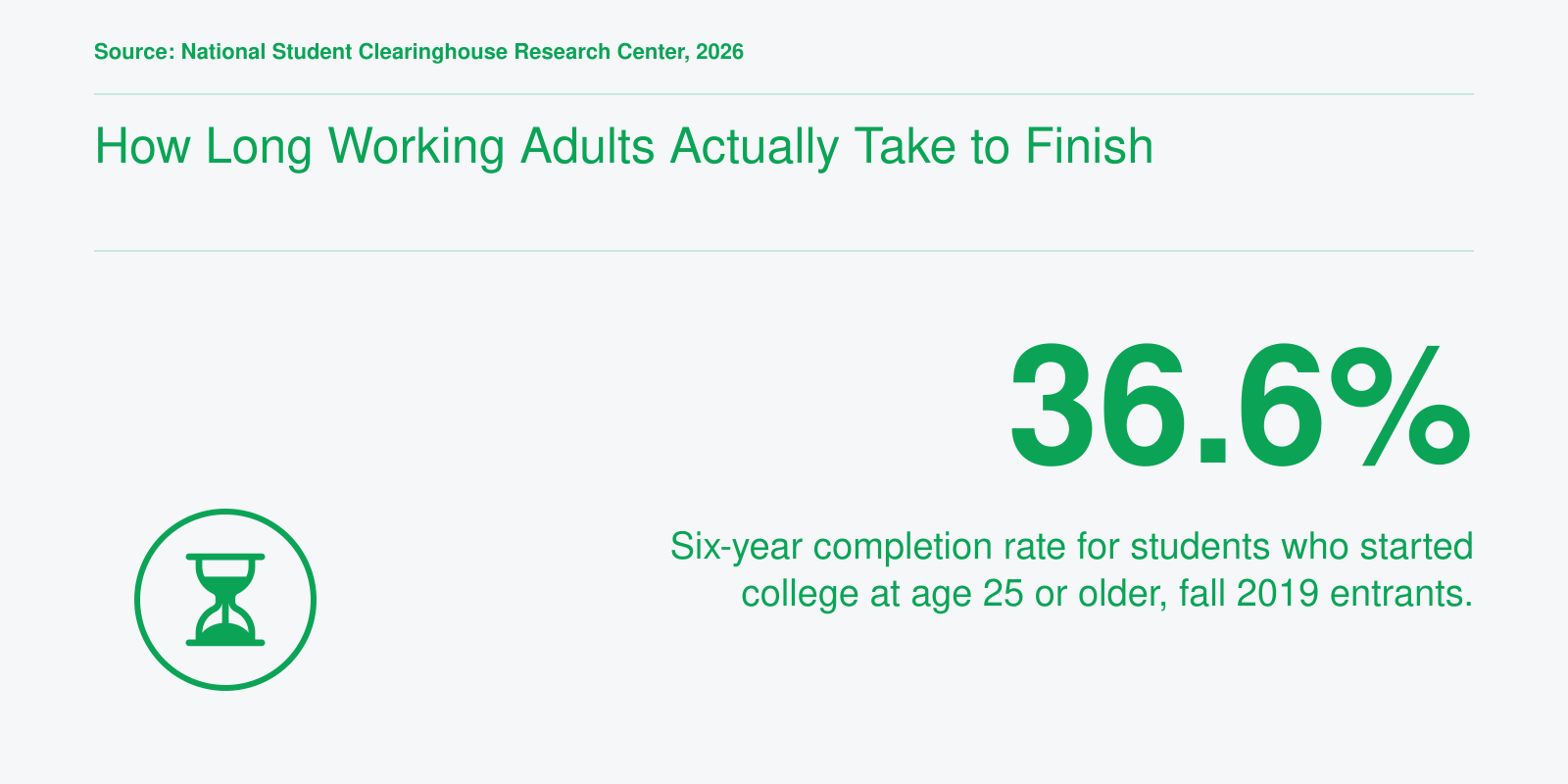
Among students who started college at 25 or older in fall 2019, National Student Clearinghouse Research Center data show that only 36.6% had earned any credential (certificate, associate, or bachelor's) six years later, compared with 63.8% of those who started at 20 or younger. Stopping out is the bigger risk: 51.7% of part-time starters in that cohort had left school by year six, and among bachelor's earners the median time to degree rises from 3.7 years with no stopouts to 5.1 years with one and 7.3 years with two. When credit loads, jobs, and family obligations collide, choose a program with flexible terms and proactive advising so that a hard semester becomes a lighter load instead of a break in enrollment.
- Most College Degrees Are Earned in Four Years or LessNational Student Clearinghouse
- College Completion Rates Hold Steady at Recent HighsNational Student Clearinghouse
- NSC Research Center PublicationsNational Student Clearinghouse Research Center
Balancing a Passion Major With Earnings Reality: How Pay Varies by Metro Area
A passion major can still pay off if you pair it with a marketable role such as operations management, management analysis, or project management, and where you work can shift your pay more than the major you chose: the median for management analysts runs from $82,990 in Sacramento to $135,640 in Boston, while general and operations managers range from $93,140 in St. Louis to $157,000 in New York. The figures below are approximate 2025 occupation-level wages from the U.S. Bureau of Labor Statistics Occupational Employment and Wage Statistics survey, showing the 25th percentile, median, and 75th percentile pay in each metro area. They reflect what people in these jobs earn regardless of their degree, not the outcomes of any single program or major, and the higher-paying metros usually come with higher living costs.
Occupation
Metro Area
25th Percentile
Median
75th Percentile
General and Operations Managers
New York-Newark-Jersey City, NY-NJ
$100,040
$157,000
$226,350
General and Operations Managers
Dallas-Fort Worth-Arlington, TX
$71,040
$111,010
$173,250
General and Operations Managers
Washington-Arlington-Alexandria, DC-VA-MD-WV
$99,840
$156,460
$201,010
General and Operations Managers
Phoenix-Mesa-Chandler, AZ
$64,830
$98,610
$157,230
General and Operations Managers
St. Louis, MO-IL
$61,400
$93,140
$134,690
General and Operations Managers
San Francisco-Oakland-Fremont, CA
$98,890
$149,990
$220,200
Management Analysts
New York-Newark-Jersey City, NY-NJ
$94,490
$124,390
$168,320
Management Analysts
Washington-Arlington-Alexandria, DC-VA-MD-WV
$101,400
$126,830
$156,750
Management Analysts
Boston-Cambridge-Newton, MA-NH
$104,210
$135,640
$168,800
Management Analysts
Sacramento-Roseville-Folsom, CA
$72,360
$82,990
$92,110
Management Analysts
San Francisco-Oakland-Fremont, CA
$87,910
$126,730
$163,380
Management Analysts
Miami-Fort Lauderdale-West Palm Beach, FL
$71,240
$94,290
$129,500
Project Management Specialists
New York-Newark-Jersey City, NY-NJ
$96,370
$126,660
$164,800
Project Management Specialists
Dallas-Fort Worth-Arlington, TX
$76,740
$98,900
$131,250
Project Management Specialists
Washington-Arlington-Alexandria, DC-VA-MD-WV
$95,150
$127,030
$163,550
Project Management Specialists
Seattle-Tacoma-Bellevue, WA
$97,410
$130,380
$168,460
Project Management Specialists
San Francisco-Oakland-Fremont, CA
$102,510
$135,040
$167,410
Project Management Specialists
Miami-Fort Lauderdale-West Palm Beach, FL
$76,400
$98,720
$128,980
- Occupational Employment and Wage Statistics (OEWS) (2025)U.S. Bureau of Labor Statistics
Questions to Settle Before You Choose Passion Over Pay
Can you name two job titles, not just a subject, that your passion major leads to?
A subject is not a career. If you cannot name two real roles and find current postings for them, the major may be a hobby you are paying tuition to pursue, and the degree will not open the doors you expect.
Would the 25th-percentile salary in that role still cover your loan payments and household costs?
Plan around the low end of pay, not the median or the best case. If entry-level pay cannot support your loan payments, rent, and dependents, a cheaper or higher-earning major may protect your finances better.
Does your passion work as a minor, certificate, or side project instead of the major?
Pairing a practical major with your interest as a minor, a short certificate, or freelance work can keep the passion alive while the degree carries the earning power. Compare that combination against the passion major alone.
Test the Switch Before You Enroll: Informational Interviews and Low-Risk Trials
A new career should be tested for free or close to it before you pay a dollar of tuition. Most regrets about a degree come from a mismatch with the daily work, and that mismatch is cheap to detect early.
The Validation Ladder
Work up through these steps in order, from least to most commitment:
- Informational interviews: Short conversations with people already doing the job.
- Job shadowing: A day or half-day watching the work happen.
- A short online course: A few weeks of real coursework in the core skill.
- A volunteer or freelance project: Actual deliverables for an actual client or cause.
A Script That Gets Replies
Keep the request small and specific: "Hi Dana, I'm a logistics supervisor exploring a move into data analysis, and your path caught my eye. Could I borrow 20 minutes this month to ask about your work? I'll keep it short and come prepared."
Then ask three questions:
- What does a typical week actually look like, hour by hour?
- Which degree or credential mattered when you were hired, and which did not?
- What do people underestimate about this job before they start?
The second question is the most valuable. It tells you whether a bachelor's degree, a certificate, or a portfolio opened the door.
What to Watch For
Pay attention to the tasks, not the title or salary. If someone describes eight hours of spreadsheets, client calls, or documentation and you feel dread instead of curiosity, believe that reaction. Notice which parts of the week you would enjoy repeating for years.
Set a Decision Gate
Commit tuition only after at least three conversations and one hands-on trial. If you cannot get through the gate, you have lost a few evenings, not a semester of loans. If you clear it, you enroll with a clear target, a sharper major choice, and contacts who may later vouch for you.
Test the career before you buy the credential: read the job postings, talk to people doing the work, then enroll in the degree those conversations point to. The degree confirms a decision you have already stress-tested.
degreecompletion.com
Stacking Certificates With a Completion Degree for a Faster Pivot
Stacking a certificate means pairing a shorter industry credential with your bachelor's completion program so a resume can show a specific, testable skill before the diploma arrives. The idea is not to collect credentials; it is to match what target job postings already name.
When Stacking Helps
Stack credentials only when target posts request one by name or when the degree alone would leave a skill unproven. For project roles, that often means PMP or CAPM. For entry-level project coordination or data analytics, a Google Career Certificate can signal applied training without a graduate degree.
Common Costs and Prerequisites
- PMP: Requires roughly three to five years of project leadership experience and 35 contact hours of education.12 The exam costs about $425 for PMI members or $675 for nonmembers, with membership around $129 to $164 a year and training often $200 to $3,000.31 Study time commonly runs 200 to 300 hours over three to six months after you become eligible.4
- CAPM: Requires no project experience, but 23 hours of education.21 The exam runs about $225 for members and $300 for nonmembers; renewal is five years later at roughly $150 to $200.45
- Google Project Management Certificate: No prerequisites. It is delivered through Coursera at $49 per month, roughly $147 to $294 total if you finish in three to six months.7 Google estimates about 240 hours.
- Google Data Analytics Certificate: Also no prerequisites, $49 per month, with a typical total of $150 to $300 and about 180 hours over three to six months.2
Sequencing the Stack
Start an entry credential while finishing the degree. CAPM or a Google Career Certificate can be completed during a single term or over a summer, letting you apply for coordinator or analyst roles while still enrolled. PMP is different: you cannot finish it from scratch until the experience requirement is met, so plan it as a post-degree step if mid-level project roles are the goal.
Skip Certificates That Do Not Appear in Your Target Posts
Before paying for any credential, search the exact job titles you want. If a cert never shows up in the listings, it is optional. A credential that repeats across posts is worth the money and time; one that only feels impressive is usually not.
- Google Project Management Certificate vs PMPSimplilearn SimpliAxis
- Best Project Management Courses and Certifications 2026Kurums
- Top Project Manager CertificationsSimplilearn SimpliAxis
- Best Project Management Certifications 2026CertSelect
- PMI Certifications List and RoadmapSimplilearn SimpliAxis
- Is PMP Certification Worth It 2026?CertSelect