Adult Learners Want More Than Flexibility: What Completion Programs Miss
How to spot real advising, deadlines, and human support before you enroll

Key Points
- Most prospects, 59 to 66 percent, prefer supported over self-guided programs.
- In the 2026 DeVry/MGT survey, 49 percent of graduate prospects need deadlines.
- Accepted transfer credits, not sticker price, drive your real completion cost.
Why Flexibility Alone Isn't Enough for Adults Finishing a Degree
Degree completion marketing has settled on one word: flexible. Study anytime, no set class times, finish at your own pace. A March and April 2026 survey of 600 prospective students ages 20 to 59, conducted by MGT for DeVry University, suggests that pitch is only half right. Among graduate prospects, 86 percent said they could manage their time without strict deadlines. Yet 49 percent said they need deadlines to stay on track, and 58 percent preferred structured, instructor-led weekly classes.
That contradiction is the decision adults returning to school actually face. The format that looks easiest to fit around a job is not always the one that produces a diploma, and self-paced coursework has a long record of stalling without someone watching.
What the 2026 DeVry/MGT Survey Says: Flexibility and Structure Go Together
Adult learners are not asking schools to remove structure. They are asking schools to move it, so that deadlines, instructor contact and human help fit around a job and a family instead of a campus calendar. That distinction is the whole argument of a survey published this fall, and it should change how you read marketing copy that promises "learn whenever you want."
What "More Than Flexibility" Actually Means
In plain terms, it means three things stacked on top of a schedule you control: real due dates that create momentum, regular contact with an instructor who knows your name, and one identified person (an advisor, success coach, or program manager) you can reach when life goes sideways. Flexibility is the delivery mechanism. Structure is what gets you to the final transcript.
The Headline Numbers
The research, conducted by MGT and commissioned by DeVry University, surveyed 600 prospective undergraduate and graduate students ages 20 to 59 who said they planned to enroll or return to school within two years. Fieldwork ran in March and April 2026, and Inside Higher Ed reported the results on September 30.1
The central contradiction sits with graduate prospects: 86 percent said they could manage their time without strict deadlines, yet 49 percent of the same group said they need deadlines to stay on track, and 58 percent preferred structured, instructor-led weekly classes. Across both groups, a majority (59 percent of undergraduate prospects and 66 percent of graduate prospects) said they responded better to messaging describing a supported experience rather than a fully self-guided one. DeVry's president, Elise Awwad, framed the tension bluntly: it is not an either/or, and flexibility matters alongside having someone there to catch you.1
Read It With the Caveats Attached
This is sponsored research. DeVry paid for it and has a commercial interest in the finding that prospective competency-based education learners want 'structured flexibility'. The published excerpts do not establish the recruitment method, weighting, or margin of error, and subgroup sizes are not disclosed. The sample is prospective students, not enrolled or graduated ones, so the figures capture what people say they want before enrolling, not what actually carried anyone to a diploma.
Still, the directional signal is useful. Treat "someone there to catch me" as a selection criterion you screen programs against, not a bonus you hope shows up after you sign the enrollment agreement.
- Adult Learners Want More Than FlexibilityInside Higher Ed
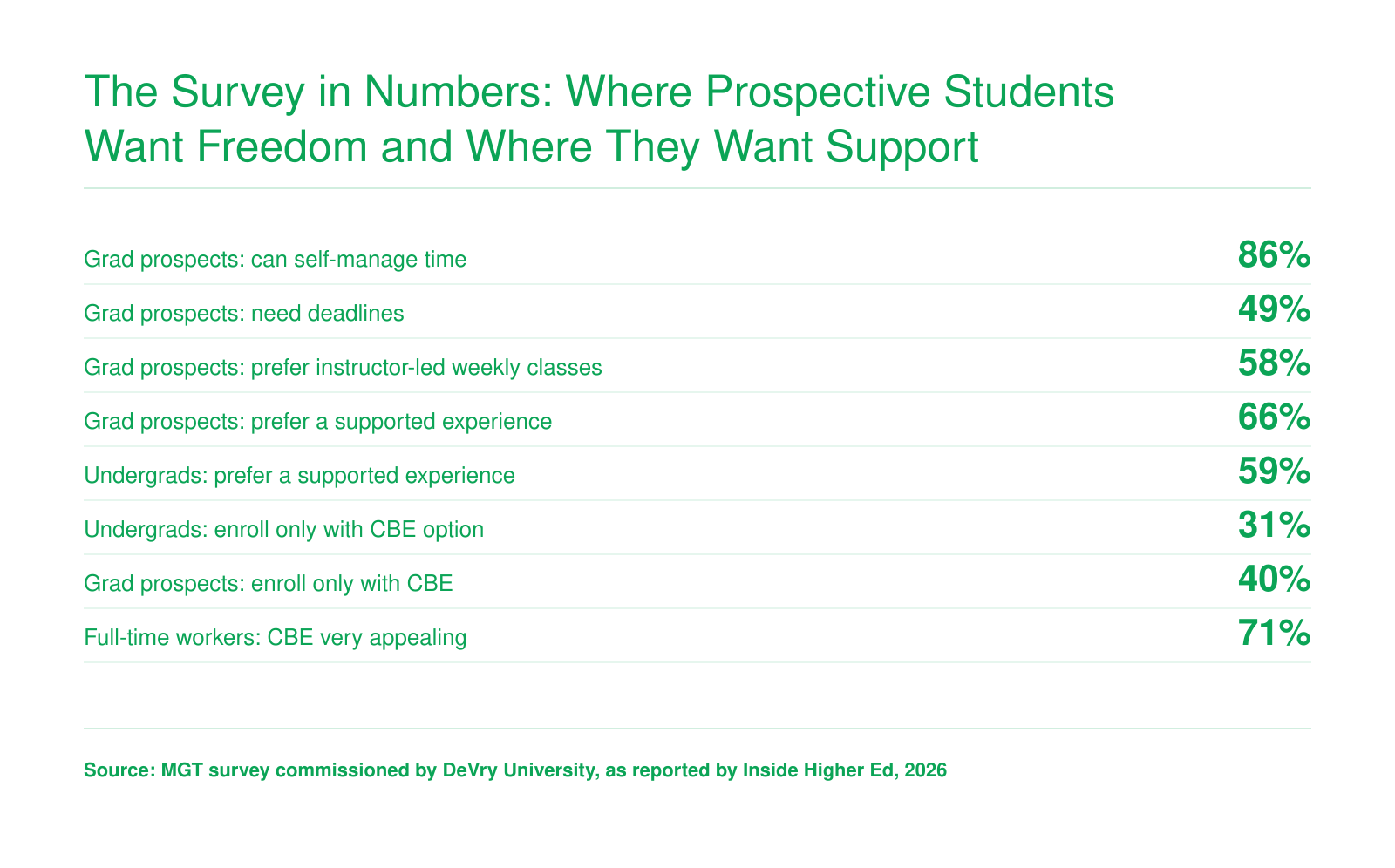
The Survey in Numbers: Where Prospective Students Want Freedom and Where They Want Support
A national survey of 600 prospective undergraduate and graduate students ages 20 to 59, conducted by MGT in March and April 2026 and commissioned by DeVry University, shows the same respondents asking for both freedom and structure. Graduate prospects say they can manage their own time, yet many also want deadlines, weekly instructor-led classes, and a supported experience. Keep in mind that these figures are stated preferences from a sponsored survey, not measured completion outcomes.
The Competency-Based Paradox: Self-Paced Isn't Always Finish-Line Ready
Competency-based education lets you advance by proving you know something rather than by sitting through a set number of weeks. Instead of earning credit for attendance and a semester calendar, you pass an assessment, submit a project, or demonstrate a skill, and you move on. For someone who already manages payroll at work, the accounting course that would take sixteen weeks might take three.
The Paradox Buried in the Demand Data
The appetite is real. In the 2026 survey of prospective students commissioned by DeVry University, 71 percent of full-time workers called competency-based options "very appealing," compared with 58 percent of part-time workers, and 63 percent of adults age 50 and older said they would be more likely to pursue a degree if a competency-based path existed. Roughly a third of undergraduate prospects said they would enroll only if that option were on the table. Yet the same group asked for deadlines, weekly instructor-led sessions, and messaging that promised a supported experience. People are asking for the freedom to go fast and the scaffolding to keep going.
Who Tends to Do Well, and Who Struggles
In Postsecondary CBE and Learner Self-Direction, the American Institutes for Research found that students who choose competency-based programs already score well on self-direction measures like identifying learning resources and setting their own learning goals, and those scores rose modestly during enrollment. That is an association, not proof the format causes success. The profile that fits: substantial prior credits or work experience in the subject, a predictable weekly block of study time, and comfort working alone. The profile that struggles: a long gap since your last course, shifting shift work, or low confidence reading dense material without someone to ask.
Check the Practical Terms, Then Apply This Test
Confirm the institution holds recognized accreditation, since that is what makes federal aid possible at all.1 Ask how the program handles aid disbursement under a non-term or direct-assessment structure. Ask whether competencies convert to transcript credit hours that other schools will accept. Then apply the simplest test: does the program give you pacing targets, named faculty contact, and a coach who notices when you stall, or does it just hand you a login and wish you well?
- 2026-2027 Federal Student Aid Handbook, Vol. 2 Ch. 1: Institutional EligibilityFederal Student Aid (U.S. Department of Education)
What Advising, Coaching, and Cohorts Actually Do for Adult Persistence
The choice isn't just flexible versus structured. It's whether the structure a program offers actually reaches out to you, or waits for you to raise your hand. The research on support services tilts toward the former.
What the Strongest Evidence Shows
The clearest results come from CUNY ASAP, evaluated by MDRC. Its bundle of proactive advising, structured scheduling, financial support, and consistent staff contact nearly doubled three-year associate graduation, lifting it from 22.9 percent to 40.7 percent, an 18 percentage point gain.1 An Ohio replication produced a similar 18 point increase. Across MDRC's postsecondary research portfolio, advisers worked best when they contacted students frequently and each adviser stayed with the same group of students rather than waiting for problems to surface.
The one-on-one coaching model studied in InsideTrack's research was tested in a randomized trial of 13,555 students. It raised 12-month retention by roughly 5 percentage points (from a control rate of 43.5 percent) and degree completion by about 4 points (from 31.2 percent), with effects persisting after coaching ended.
Real Support Versus Passive Support
The common thread is initiative. Real support means a named, consistent contact who reaches out before you fall behind. Passive support, a help desk, an FAQ page, a form you have to find, puts the burden on the student who is already stretched thin. For adults juggling work and family, that difference decides whether a rough week becomes a dropped course.
Honest Limits
Much of this evidence is correlational or program-specific. The What Works Clearinghouse found only one of ten InsideTrack studies met its design standards and rated completion effects as uncertain.2 ASAP's bundle makes it hard to isolate which piece drives results, and findings vary by population. These programs also cost money: ASAP ran about $16,300 per student, InsideTrack about $1,000.1
The takeaway: look for support that reaches out to you first, not help you have to go hunting for.
- College Support Programs: Costs and EffectsBrookings Institution
- Adult Learner Full Final ReportJFF
Questions to Ask Any Program About Advising, Coaching, and Completion Support
Before you enroll, put these questions to an admissions counselor or advisor. Specific, confident answers suggest a program built to help adults finish. Vague replies or a quick pivot back to "study anytime" convenience suggest support may be thin once classes start.
- How many students does each advisor handle, and will I keep the same one?Ask about the typical caseload for advisors who work with adult and transfer students. Ask whether you'll have one consistent advisor from enrollment to graduation or a rotating help desk.
- Who contacts me if I fall behind, and how soon?Find out whether anyone reaches out when you miss a deadline or stop logging in. Ask who that person is and how many days pass before they make contact.
- Can I reach my instructors in real time?Ask whether courses include live sessions or office hours. Ask what response time instructors are expected to meet for messages and questions.
- Are the courses I need offered every term?Confirm that required and capstone courses run often enough that you won't sit out a term waiting for one to open.
- Will I get a written degree plan with a graduation date?After your transfer credits and any prior learning are evaluated, request a term-by-term plan that shows every remaining course and a projected finish date.
- What are completion rates for students like me?Ask for completion and persistence figures for transfer students, part-time students, and learners age 25 and older, not just overall averages.
Red Flags in Programs That Sell Only Asynchronous Convenience
Flexibility is a real need, but in the 2026 DeVry/MGT survey 49 percent of prospective graduate students said they need deadlines to stay on track, and most prospects preferred a supported experience over a fully self-guided one. When a program's pitch leans only on convenience, treat each promise as a prompt for a sharper question. The table below translates common marketing lines into what they may leave out and what to ask before you enroll.
| Marketing Claim | What It May Hide | What to Ask Instead |
|---|---|---|
| Work entirely at your own pace with no deadlines. | Without pacing guidance, it is easy to drift for weeks before anyone notices you have stalled. | Is there a recommended weekly pace, and who contacts me if I fall behind it? |
| Support is available whenever you need it. | There may be no named advisor, only a general help desk or ticket queue that you must chase yourself. | Will I be assigned a named advisor or success coach, and how often will we be in touch? |
| Start any time you like. | Flexible start dates can come with no published course schedule, so required courses may not be open when you need them. | Can I see when each required course in my program runs over the next year? |
| Bring in your past credits and finish faster. | Credits may be accepted only as general electives that do not count toward your major, which you may learn only after enrolling. | Can I get an official written credit evaluation showing which degree requirements my credits fulfill before I commit? |
| Join thousands of successful graduates. | Graduation rates may be vague, missing, or not broken out for adult and transfer students like you. | What share of adult and transfer students in this specific program finish, and how long does it typically take? |
| Fully online and completely self-guided. | Instructor contact may be minimal, leaving you to work through difficult material largely alone. | How often do instructors interact with students, and are there any instructor-led weekly sessions or check-ins? |
Balancing Work and Family With Structured Deadlines
Open-ended freedom or a predictable weekly rhythm: for most working adults, the second is easier to live with. When every assignment is due "whenever," each week starts with a negotiation about when to study, and that negotiation tends to lose to overtime, sick kids, and fatigue. A fixed weekly deadline removes the decision. You plan around it the same way you plan around a standing meeting.
How Much Time a Course Really Takes
A common rule of thumb comes from the federal credit-hour standard: about one hour of instruction plus roughly two hours of outside work per credit, each week, across a standard 15-week term. Treat it as an estimate, since programs and subjects vary. By that math, a single three-credit course runs about nine hours a week.
Accelerated eight-week courses cover the same material in about half the time, so the weekly load for one class can climb toward 15 to 18 hours. Two accelerated courses at once can resemble a part-time job on top of your actual job.
Cohort Pacing vs Fully Self-Paced
- Cohort or instructor-led weekly pacing: Fixed due dates, regular instructor contact, and classmates moving with you. Best for adults returning after a long gap, those who have stopped out before, or anyone who knows open schedules tend to slide.
- Fully self-paced: You set the tempo and can move quickly through familiar material. Best for disciplined learners with stable schedules and strong prior knowledge of the subject.
Accountability Moves That Work
- Block recurring study time: Put the same two or three windows on your calendar every week and treat them as appointments.
- Tell someone: Share your schedule with a manager, partner, or family member so protected time stays protected.
- Start with one course: If it has been years since your last class, take a single course first and add load once the routine holds.
Before enrolling, ask each program for a typical weekly hours estimate per course, in writing. A vague answer like "it depends on you" is a signal to keep asking.
Match Support Levels to Your Completion Risk Factors
Use this table as a quick self-assessment before you compare programs. Count how many of these risk factors apply to you: if you have one or two, work through the advising and coaching checklist questions with every program you consider. If you have three or more, prioritize programs that offer proactive coaching and cohort-based structure rather than fully self-guided study.
| Risk Factor | Why It Raises Stop-Out Risk | Support to Look For |
|---|---|---|
| Older or scattered credits | Credits earned years ago or at several schools may not all transfer, which can mean surprise course requirements and a longer, more expensive path than you planned. | A transcript evaluation before you enroll, a written degree plan showing exactly which credits apply, and an advisor who can explain credit for prior learning options. |
| Long time away from school | Study habits, academic writing, and comfort with online learning tools can fade, so early courses may feel harder than expected and early struggles often lead to quiet withdrawal. | An orientation or onramp course, access to tutoring and writing help, and an advisor or coach who checks in during the first term. |
| Heavy caregiving or work load | When family or job demands spike, coursework is usually the first thing to slip, and fully self-paced formats offer no built-in signal that you are falling behind. | Paired flexibility and accountability: weekly deadlines with reasonable extension policies, instructor-led sessions, and a coach who reaches out when you miss work. |
| Tight or uncertain finances | An unexpected bill or a gap in employer tuition assistance can force a pause, and pauses frequently become permanent stop-outs. | Clear total-cost estimates after transfer credit, financial aid counseling, payment plan options, and help using employer tuition benefits. |
| Low confidence about succeeding | Self-doubt makes it easier to disengage after a low grade or missed deadline, especially without anyone noticing or following up. | A named success coach, small cohorts or peer groups, and regular instructor interaction so someone is there to help if you start to slip. |
Check Yourself Before You Choose
When you last fell behind in a class or at work, what actually got you back on track: a deadline, a person, or willpower?
If a deadline or a person pulled you back, a program with flexible pacing but no coaching may look appealing yet leave you stalled. Name that pattern before choosing.
Could you realistically sustain this program's weekly hours during your busiest work month?
Most adults budget for an average week, then hit a caregiving or work crunch. If the answer is no, ask how the program handles late work, planned pauses, or adjusted deadlines.
If your credits are evaluated and some are rejected, would you still finish on the new timeline?
Credit evaluations can exclude some courses you counted on. If a longer timeline would change your decision, compare that risk before enrolling.
What a Completion Program Really Costs After Transfer Credit and Prior Learning
The sticker price of a completion program and what you will actually pay can sit far apart, and the gap depends mostly on how many credits a school agrees to accept. Published tuition is only the starting point.
How the Math Works
The basic formula is simple: remaining credits times the per-credit price, plus fees, minus any aid. The remaining credits are what is left after transfer credit and credit for prior learning are applied. One online completion example lists $580 per credit, or $13,920 for 24 credits.1 There is no reliable national median, so treat that as a single data point, not a benchmark. Net price also shifts with income, enrollment intensity, residency, and employer benefits.
Prior learning assessment usually carries its own charge, and the structure varies. Lumina and CAEL describe four models: fees based on credits, fees based on assessment services, variable fees, and no fee.2 One college's Transfer Credit and Prior Learning Assessment Fees page lists a $600 portfolio assessment fee. No defensible national typical fee exists, so compare portfolio, exam, transcript evaluation, and per-credit charges side by side with tuition.
Why Credit Policy Matters
CAEL's 2025 CPL and Regional Accreditors Policy Review found one regional accreditor allows credit for prior learning up to 25% of degree credits, and that this is not universal. Some institutions cap or reject such credit, or apply it only as electives, not toward your major. Check the transfer, residency, and prior learning policies in the catalog before assuming anything counts.
Aid for Returning Adults
- Pell Grant: The 2026-27 maximum is $7,395, prorated by enrollment (nine of twelve credits is 75%).1 It generally covers a first bachelor's degree, so a prior bachelor's can block it.
- State grants: Rules vary by residency, income, intensity, prior degree, and deadlines. No universal amount exists.
- Employer benefits: Under Section 127, as detailed in IRS Publication 5993, employers can provide up to $5,250 per employee yearly tax-free in 2026, with inflation indexing starting in 2027. The employer must have a written plan, and participation is not automatic.
A Worked Example (Illustrative Only)
Suppose you need 40 credits at $580 each: $23,200. A school accepts 12 prior learning credits through a $600 assessment, leaving 28 credits, or $16,240. Add $600 and the total is $16,840. An employer benefit of $5,250 would bring it to $11,590, before any Pell or state grant. These figures are invented to show the arithmetic, not predict your bill.
Before you apply, request a written credit evaluation and a net-price estimate. Those two documents turn a marketing number into one you can plan around.
- Best Online Degrees for Working AdultsDegreeSources
- Recognition of Prior LearningLumina Foundation
Are Adult Degree Completion Programs Worth It?
Usually yes, with two conditions: the program accepts most of your existing credits, and you actually finish. When both hold, the payoff is well documented. When you stop out a second time with new debt, the math turns against you quickly.
What the Labor Data Shows
Bureau of Labor Statistics figures for 2025 (adults 25 and older) put median usual weekly earnings at $1,578 for bachelor's degree holders and $1,062 for people with some college and no degree. That is a gap of $516 a week. Unemployment tells a similar story: 2.8 percent for bachelor's holders versus 3.8 percent for the some-college group.1 The 2024 annual averages show the same pattern ($1,543 and 2.5 percent versus $1,020 and 3.8 percent).2
Census Bureau data on full-time, year-round workers shows a broader attainment gap, with a median of $49,050 for those with a high school diploma and no college versus $85,810 for those with a bachelor's degree or higher.3 That comparison does not isolate the some-college group, so the BLS numbers are the closer fit for your situation. These are national medians, not guarantees for any one person or field.
Will Employers Discount an Online Degree?
The evidence here is more limited. Strada and Gallup-style employer research suggests hiring managers are more receptive to online-degree candidates than many job seekers assume. Employer concern tends to center on program quality, reputation, and institutional trust rather than on the online format itself. In practice, the school's name and accreditation matter more than the delivery mode.
Support Quality Is a Cost Variable
A cheaper program with thin advising can end up costing more. If weak support leads you to stop out again, you pay tuition for credits that never become a credential, and you may still carry the loan. A somewhat pricier program with coaching, structured deadlines, and responsive instructors can be the lower-risk purchase.
A Simple Decision Rule
Pick two or three programs and compare them on four points:
- Net cost: What you will pay after transfer credit, prior learning credit, and aid.
- Credit accepted: How many of your credits count toward the degree, not just as electives.
- Support model: Who advises you, how often, and what happens if you fall behind.
- Projected finish date: A realistic timeline given your work and family load.
The program that wins on the combination, not on any single line, is usually the one you will finish.
The Bottom Line
Finishing is where the value sits. Choose the program most likely to get you across the line, then let price break any ties.
- Education Pays: Data on DisplayBureau of Labor Statistics
- Educational Attainment in the United States (CPS)Bureau of Labor Statistics
- Education and IncomeUS Census Bureau