How to Compare Online and Asynchronous Degree Completion Programs
Judge transfer credit, cost per credit and completion odds before you apply

Key Points
- Asynchronous doesn't mean self-paced: UVA's BIS uses weekly deadlines.
- Texas State caps transfer and prior-learning credit at 90 of 120 credits.
- UVA's BIS reports 73 percent graduation and 88 percent fall-to-fall retention.
Degree Completion for Working Adults in 2026: What Changed and How to Choose
A degree completion program lets adults with prior college credit, often 36 to 60 credits from a community college, finish a bachelor's degree without starting over. The University of Virginia's School of Continuing and Professional Studies has added an asynchronous pathway to its Bachelor of Interdisciplinary Studies, with classes starting in January, the Cavalier Daily reported.1
Unpredictable shifts and family obligations rule out fixed class times, and many online programs look alike. Five checks separate them: format, credit transfer, total cost, completion odds and red flags.
Demand is real: 60 percent of UVA's 350 enrolled students said they were interested in the asynchronous option.1
What a Degree Completion Program Is and Who It's Built For
Starting a bachelor's degree from scratch and finishing one with the credits you already have are two very different commitments. A degree completion program is built for the second path: a bachelor's pathway for people who already hold college credits, often 30 to 60 or more, and want to finish without starting over.
Who These Programs Serve
The typical student is a working adult, a career changer, or someone in the "some college, no credential" group. The University of Virginia's Bachelor of Interdisciplinary Studies (BIS) is one concrete example. It launched in 1999 for working adults and non-traditional students, offers 13 concentrations (from psychology and history to cybersecurity and public safety management), and enrolls about 350 students. Applicants must arrive with 36 to 60 credits earned elsewhere.
The Stakes
The pool of people who could benefit is large. The National Student Clearinghouse Research Center's Some College, No Credential research reports 37.6 million working-age adults (ages 18 to 64) with some college and no credential as of July 2023. Returning is the exception: about 2.7 percent of them, just over 1 million people, re-enrolled in 2023-2024. NSC counts re-enrollment as coming back after a stopout of at least three consecutive terms. Among those who re-enrolled from the 2023 cohort, an Outcome Trends of Some College, No Credential Adults in America report from Texas A&M shows 145,501 earned a first credential within two years.
The Credit Entry Point
Most programs expect transfer credits from a community college or a previous school, and the number you need to enter varies. UVA's 36 to 60 range is one model. Others set different minimums, so your existing transcript shapes which programs are open to you.
Price matters, but the delivery format (asynchronous, synchronous or hybrid) often determines whether a working adult can finish at all, so it deserves equal weight.
Asynchronous vs. Synchronous vs. Hybrid: What the Labels Actually Mean
"Online" tells you where a class happens, not when you have to show up. One practical test sorts the labels: is there any scheduled live session I must attend? If the answer is yes, the program is not fully asynchronous, whatever the brochure says.
The Three Formats at a Glance
- Synchronous: Live online classes at set times each week. Deadlines follow the class calendar, and a missed shift can mean a missed session.
- Asynchronous: No required meeting times. Work is due by weekly deadlines, so live-session risk is low or nonexistent.
- Hybrid: A blend of online work and required live or in-person meetings. Scheduling is the least predictable, and the attendance risk is highest.
A Case Study: UVA's Bachelor of Interdisciplinary Studies
The University of Virginia's degree completion program shows how a format evolves. The Bachelor of Interdisciplinary Studies (BIS) began in person, meeting one night a week for about three hours. It moved to a synchronous online format in 2017. Now it adds a new asynchronous pathway, where students meet weekly deadlines instead of attending scheduled class sessions.
Per UVA's Bachelor of Interdisciplinary Studies program page, a spring term starts in January (application deadline November 1), and a fall term starts in August (deadline May 15). Admission requires at least 36 transferable credits with grades of C or better, including the full college English-composition sequence, plus a 2.0 minimum GPA.
Read the fine print on live sessions. UVA's materials describe live online engagement as optional, and the Bachelor of Interdisciplinary Studies FAQ says each course includes a brief scheduled live session that is encouraged but not required, with recordings for those who can't attend. The sources don't say how often these sessions run or what follow-up activities they carry, so ask.
How the Async Format Works
According to the Cavalier Daily, classes average about 20 students. Instructors break material into short video segments and use discussion forums and Hypothesis, an annotation tool for commenting on readings. Program director David Corlett said 60 percent of enrolled students expressed interest in the asynchronous option.
Who Async Suits, and Who May Struggle
The format fits shift workers in health care and public safety, parents, and anyone on a rotating schedule, because you can do the work at 5 a.m. or midnight. It can be harder for people who rely on live class meetings for motivation and accountability.
Asynchronous does not mean self-paced. You still owe work every week, and falling behind compounds quickly.
Asynchronous means flexible timing within weekly deadlines, not no deadlines.
From this guide
How Schools Count Your Prior Credits, ACE Recommendations and Work Experience
Texas State University caps combined transfer and prior-learning credit at 75 percent of a program's graduation requirements.1 On a 120-credit bachelor's degree, that works out to 90 credits. Rules like this decide how much of your history carries over, and they differ from school to school.
Transfer Caps, Residency and Credit Age
Three kinds of rules shape the answer to "How many credits can I transfer?"
- Transfer caps: Some schools set a ceiling on total outside credit. Others publish limits only for specific categories, so a missing cap on a policy page is not the same as no cap.
- Residency requirements: These are credits you must earn at the degree-granting school. The Texas State admissions catalog requires 24 of your last 30 semester hours there. The Georgia State transfer admissions page requires 39 hours of upper-division (3000-level and above) coursework with at least a 2.0 GPA, plus a minimum number of major courses taken on campus: half, or 11 hours, whichever is less.
- Age-of-credit limits: Some programs question or exclude older coursework, especially in fast-changing fields such as technology and health care. Ask about this directly if your credits are a decade or more old.
The University of Virginia's School of Continuing and Professional Studies asks Bachelor of Interdisciplinary Studies applicants to arrive with 36 to 60 credits from elsewhere. Check the official policy page to confirm the current transfer limits.
Accepted Is Not the Same as Useful
A school can accept a credit and still not apply it to your degree. Credits that fill major or core requirements shorten your path. Credits that land as general electives may simply fill space, leaving the required courses still to take. Two programs can both accept 60 credits and leave you with very different amounts of remaining work.
Work Experience, ACE and Military Credit
Work experience can count, but usually through a formal process. Prior learning assessment includes portfolios, challenge exams and standardized exams such as CLEP and DSST. Texas State treats prior-learning credit as a type of transfer credit and limits it to 25 percent of program requirements.1 UNC-Chapel Hill accepts CLEP only for a few subjects (French, Spanish, Precalculus and College Algebra, per its 2025-26 data).2
ACE recommendations translate training and military learning into suggested college credit, but they are recommendations. The receiving school decides. UNC-Chapel Hill allows up to 75 semester hours of ACE-evaluated military education.2 That figure is specific to military credit, not an overall transfer limit. Texas State adds up to 12 semester hours of military credit for electives, with conditions on service and discharge.1 Georgia State evaluates Joint Services Transcripts case by case and, according to the Georgia State catalog, does not award GED, USAFI or service-school credit.
Three Steps Before You Apply
- Ask for an unofficial credit evaluation. Send transcripts and any training or military records before you commit.
- Get the remaining credits in writing. You want a number for credits left to graduate, not an estimate from a phone call.
- Ask which credits fill major requirements. Request a list showing what applies to the major, the core and general electives.
Policies are revised often, and no ACE recommendation guarantees acceptance. Check each school's current transfer and prior-learning pages, and treat the written evaluation as the answer that counts.
- Texas State University Transfer Credit and Prior Learning PolicyTexas State University
- UNC-Chapel Hill Common Data Set 2025-26UNC Office of Institutional Research and Assessment
Comparing Cost per Credit Across Online Completion Programs
Only two of the programs we researched publish verifiable per-credit rates, fees and transfer limits, so this table is a starting template rather than a full market survey. Rates for Georgia State, a Cal State Online campus, UNC and a private nonprofit could not be confirmed and are left out, so check each school's current tuition page directly. Add per-credit fees to tuition before comparing: by that math, UVA SCPS runs about $511 per credit and Texas State online courses about $457, while Texas State's higher transfer cap could shrink the number of credits you pay for in the first place.
| Program | Per-Credit Tuition (In-State / Out-of-State) | Typical Fees | Transfer Credit Cap | Source/As-Of Year |
|---|---|---|---|---|
| UVA School of Continuing and Professional Studies, Online Bachelor Completion Programs (including the Bachelor of Interdisciplinary Studies) | $499 per credit hour, listed as the same rate regardless of location or residency (news coverage has cited a broader $499 to $1,683 range that varies by course type and residency, so confirm the rate for your specific courses) | $12 per credit hour; course materials and other fees may apply | Up to 60 semester credits | UVA SCPS program pages and University of Virginia 2025-26 Tuition and Fee Rates |
| Texas State University, Bachelor of Applied Arts and Sciences (Online) | $407 per credit hour; separate in-state and out-of-state rates are not stated in the published information we found | $50 electronic course fee per credit hour for courses taught online or in a hybrid format | Up to 90 credits | Texas State University Online and Student Business Services pages, dated 2026 (not explicitly labeled 2025-2026) |
- Online Bachelor Completion Programs | UVA SCPSUniversity of Virginia School of Continuing and Professional Studies
- Online Bachelor of Interdisciplinary Studies Degree | UVA SCPSUniversity of Virginia School of Continuing and Professional Studies
- 2025-26 Tuition and Fee RatesUniversity of Virginia
- Tuition and Fee DefinitionsTexas State University Student Business Services
- Tuition and FeesTexas State University Distance Learning
Completion Odds: Graduation, Retention and Time to Finish
A program's finish rate tells you more about your odds than its brochure does, so ask for it before you apply. Request two numbers: the graduation rate and the retention rate, along with how each one is defined and which student group it covers.
What UVA Reports
The University of Virginia's School of Continuing and Professional Studies reports that its Bachelor of Interdisciplinary Studies has averaged a 73 percent graduation rate since 2020, and an 88 percent fall-to-fall retention rate, as reported by the Cavalier Daily. These are the school's own figures, and they describe students who entered with 36 to 60 transfer credits already earned.
A Directional Benchmark
National Student Clearinghouse Research Center 2025 completion data gives context, though not a clean match. The most recent six-year graduation rate for all bachelor's-seeking students (fall 2019 cohort) is 61.1 percent. In the 2025 Snapshot of Postsecondary Completion Gaps, the fall 2012 cohort shows exclusively part-time bachelor's students completed at 35.1 percent, mixed enrollment at 48.8 percent, and exclusively full-time at 88.5 percent. Community college students who transferred to a four-year school and finished a bachelor's within six years did so at 48.7 percent (fall 2018 cohort).1
Treat these as directional only. The cohorts, time windows and definitions differ, and no national table measures adult, transfer-in, part-time bachelor's students the way a single program does. A strong program number is a reason to ask more questions, not proof that you will finish.
Estimating Your Time to Finish
Time depends mostly on the credits you bring. A bachelor's degree typically requires 120 credits, so a student entering with 60 has about 60 left. Then use this quick method:
- Step 1: Subtract your accepted transfer credits from the degree total.
- Step 2: Divide the remainder by the credits you can realistically take each term.
- Step 3: The result is the number of terms.
For a full-time worker, a realistic load is often one or two courses per term, roughly 3 to 6 credits in many programs. At 6 credits per term, 60 remaining credits take 10 terms. At 3 credits, they take 20. Check how many terms the school offers each year, since summer sessions change the math.
Questions to Ask
- What are the graduation and retention rates, and how does the school define each?
- Do the figures cover students who started with transfer credit, part-time students, or everyone?
- How many credits did students typically transfer in, and how long did finishing take?
A school that answers plainly, and shows its definitions, is easier to evaluate than one that offers only a headline percentage.
- NSC Research Center Signature ReportsNational Student Clearinghouse Research Center
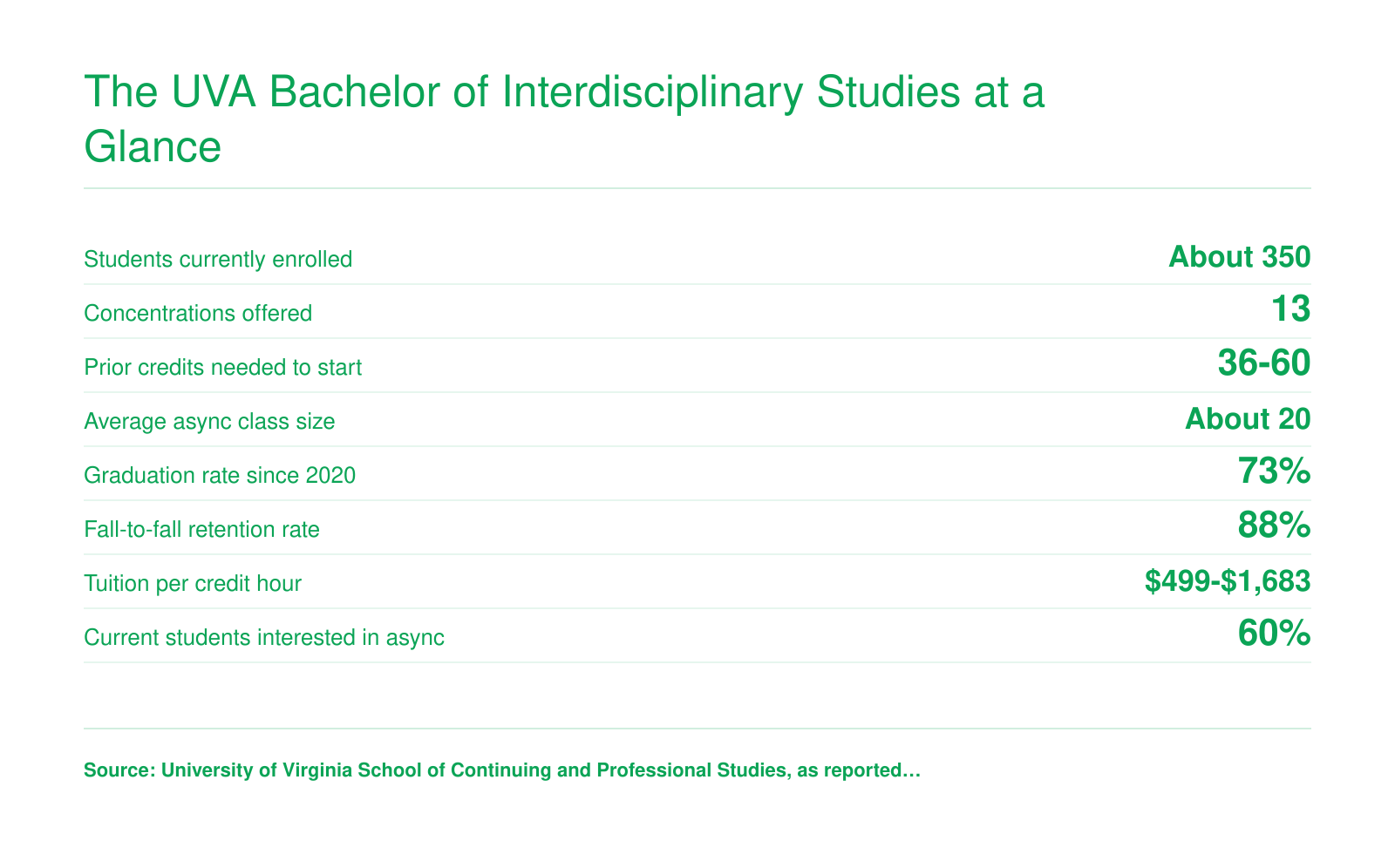
The UVA Bachelor of Interdisciplinary Studies at a Glance
Here is one real program, with its reported numbers, to show what to look for. The University of Virginia's School of Continuing and Professional Studies adds an asynchronous pathway for its Bachelor of Interdisciplinary Studies starting in January. It is an example to benchmark against, not a ranking or an endorsement.
Red Flags: Low Credit Caps, Long Paths and Vague Pacing
Every completion program promises flexibility. The real question is the gap between how fast a school says you can finish and how many terms you'll actually pay for once your transcripts are evaluated. These warning signs help you spot that gap early.
Six Warning Signs and a Quick Test for Each
- Low transfer-credit caps: Accepting only a small share of your prior credits can quietly add a year or more. Test: ask for the maximum transfer and residency rules in writing.
- No written remaining-credit estimate: Hearing "most of your credits should count" is not a plan. Test: request an unofficial degree audit before paying a deposit.
- Hidden live sessions: Some "online" programs still require scheduled video classes, which can collide with rotating shifts. Test: ask whether any course, orientation or capstone has mandatory real-time meetings.
- Excessive fees: Technology, assessment and graduation fees can stack on top of per-credit tuition. Test: ask for the full fee schedule for one typical term.
- Unclear pacing or pause policies: Life interrupts. Test: ask how many terms you can sit out before reapplying, and whether your degree requirements change when you return.
- Accreditation you can't verify: Test: look the school up in the U.S. Department of Education's accreditation database or CHEA's directory, and confirm the accreditor itself is recognized.
Why a Long Path Is the Real Cost
A lower per-credit rate looks cheaper until you count terms. Each extra semester adds tuition, fees and another stretch of juggling work and family while enrolled. It is also another point where a job change, a sick parent or a new schedule can push you to stop out. A program that accepts more of your credits at a higher rate can end up both cheaper and more finishable than a bargain that starts you over.
One Flag Isn't a Dealbreaker
Treat these as prompts for questions, not verdicts. A required live orientation may be a one-time event, and a modest fee may come with strong advising. What matters is whether admissions answers clearly and in writing. Vague or shifting answers across several flags are the stronger signal.
Ask Yourself Before You Apply
Can I meet weekly deadlines if my shift schedule changes, or do I need live class sessions to stay on track?
Asynchronous coursework still has due dates, usually weekly. If rotating shifts make a fixed Tuesday night class impossible, async wins; if you tend to drift without a scheduled meeting, a synchronous cohort may protect your completion odds.
How many of my existing credits will count toward my major rather than just general electives?
A school can accept 60 credits and still leave you three years from graduation if most land as free electives. Ask for a major-specific credit evaluation before you deposit.
If I need to pause for a month or a full term, what happens to my enrollment and tuition rate?
Shift work, deployments and family emergencies interrupt plans. Find out whether a leave of absence preserves your admitted catalog year and locked per-credit rate, or whether you reapply at current prices.
Have I priced the full degree, not just the per-credit rate?
Per-credit pricing varies widely by course type and residency, and fees, required residencies and repeated courses add up. Multiply the rate by your actual remaining credits to get a real number.
Questions to Ask Admissions About Pacing, Workload, Support and Accreditation
Bring these questions to your first admissions call, and ask for key answers in writing.
- Are deadlines weekly, and are any sessions live?Ask which day assignments are due, whether you can work ahead, and whether any courses require scheduled meetings or proctored exams.
- How many hours per week does a typical course take?Ask for a realistic estimate and how many courses working students usually take at once.
- Who helps me when I get stuck?Ask about advising, tutoring and tech support hours that fit shift schedules, typical instructor response times and average class size.
- Who is your institutional accreditor, and what is your status?Search the accreditor's own directory using the school's exact legal name. Confirm the accreditation is institutional, not just programmatic, and check for probation or warnings. Then cross-check CHEA, which covers 80+ accrediting organizations, and the U.S. Department of Education's accreditation database (DAPIP). CHEA recognition is not the same as Department of Education recognition.
- Are you authorized to enroll students in my state?What matters is the state where you live, not the campus state. Ask whether the school participates in NC-SARA. SARA does not guarantee professional licensure, and internships or clinical placements may follow separate rules, so confirm eligibility with your state's licensing board.
- Can my employer pay you directly?In 2026, employers can provide up to $5,250 per calendar year tax-free under a written Section 127 plan. That limit includes any student loan repayment, and unused amounts don't carry over. Confirm the details with HR.
- IRS Publication 5993: Section 127 Educational Assistance ProgramsInternal Revenue Service
- IRS Updates Frequently Asked Questions About Section 127 Educational Assistance ProgramsInternal Revenue Service
- 26 U.S. Code Section 127 - Educational Assistance ProgramsU.S. House of Representatives (US Code)
- CHEA Search AccreditorsCouncil for Higher Education Accreditation (CHEA)
- CHEA DirectoriesCouncil for Higher Education Accreditation (CHEA)
- SARA Policy Manual 26.1NC-SARA
- IRS Updates FAQ on Section 127 Educational Assistance Programs: Key Changes Employers Should NoteBDO
A Reusable Side-by-Side Checklist for Comparing Online Completion Programs
Use this table to line up any two programs on your shortlist. Program A is filled in with the University of Virginia's Bachelor of Interdisciplinary Studies as a worked example, and Program B is left open for the school you are weighing against it. Where a detail was not available for UVA, the cell says so, which is your cue to ask admissions directly.
| Criterion | What to Look For | Where to Verify | Program A | Program B |
|---|---|---|---|---|
| Delivery format | Whether classes are asynchronous with weekly deadlines, live (synchronous) sessions, or a mix | Program page and course schedule; confirm with an advisor | Asynchronous pathway with weekly deadlines starting in January; synchronous online option since 2017 | Fill in |
| Credits needed to enter | Minimum and maximum prior credits required before admission | Admissions requirements page | Must enter with 36 to 60 college credits from elsewhere, such as a community college | Fill in |
| Transfer credit acceptance | How many prior credits count toward the degree, not just toward admission | Unofficial transcript evaluation from the registrar or admissions office | Not reported; request a credit evaluation | Fill in |
| ACE and work experience credit | Whether military, workplace training, or prior learning can earn credit | Prior learning or transfer credit policy; admissions advisor | Not reported; ask admissions | Fill in |
| Cost per credit | Published per-credit rate by residency and course type | Tuition and fees page; bursar's office | $499 to $1,683 per credit hour, varying by course type and in-state or out-of-state status | Fill in |
| Pricing model | Per-credit billing versus a flat semester rate, plus added fees | Tuition and fees page; billing office | Charged per credit hour rather than a flat rate per semester | Fill in |
| Graduation rate | Program-level completion, not only the university-wide figure | Program director or institutional research office; College Navigator for campus-wide data | 73 percent average since 2020, per the program director | Fill in |
| Retention rate | Share of students who return from one fall to the next | Program office or dean's office | 88 percent fall-to-fall, per the school's dean | Fill in |
| Class size | Average section size in the format you would take | Advisor or faculty contact | About 20 students on average in the asynchronous pathway | Fill in |
| Course design and engagement | How instructors deliver content and keep online students interacting | Sample syllabus, demo course, or faculty conversation | Short video segments, discussion forums, and the Hypothesis annotation platform | Fill in |
| Concentrations offered | Majors or concentrations that match your career goals | Program curriculum page | 13 concentrations, including psychology, history, cybersecurity, and public safety management | Fill in |
| Program track record | How long the program has run and how many students it serves | Program history page; admissions office | Running since 1999 with 350 students currently enrolled | Fill in |
| Typical time to finish | Realistic completion timeline for someone with your credits and course load | Advisor-built degree plan | Not reported; ask for a sample plan based on your transcript | Fill in |
| Accreditation | Institutional accreditation from a recognized accreditor | U.S. Department of Education accreditation database or the accreditor's directory | Confirm through the accreditor's directory | Fill in |