Back in the Classroom After Years Away: How to Re-Enroll Online and Actually Finish
Re-entry steps, old-credit rules, and study routines built around adult life

Key Points
- About 43.1 million U.S. adults have some college but no credential.
- Compare written credit evaluations from two or three schools before enrolling.
- A 3-credit, 16-week course needs roughly 6 to 9 weekly hours.
Introduction: Coming Back After Six Years Is More Common Than You Think
The National Student Clearinghouse Research Center counts tens of millions of U.S. adults with some college but no credential, and many of them are weighing the same decision: finish a degree online after years away. The practical tension is rarely motivation. It is uncertainty about which old credits still count, whether online coursework will feel unfamiliar, and how to fit classes around a job and a household.
Adults in communities like r/BackToCollege regularly describe online returns after gaps as long as six years, including a Reddit thread about going back online after six years among many.
What tends to decide the outcome is a school's credit policy and the first term's workload, not the length of the gap.
What Actually Changes When You Return to Online College After a Long Break
Yes, you can go back to college online after many years away, and you will have plenty of company. The National Student Clearinghouse Research Center's Some College, No Credential report counted 43.1 million U.S. adults with some college but no credential as of the start of the 2023-24 academic year. Just over 1 million working-age adults from that group re-enrolled during 2023-24, according to the Texas A&M University Data Science re-enrollment trends analysis. For those who return, the outlook is encouraging. A National Student Clearinghouse Research Blog summary finds that about 60% of re-enrolled students are still enrolled or have earned a credential within two years.1 Among the 2023 cohort, 145,501 returning adults earned a first credential within two years of re-engaging with higher education.2
What Has Changed Since You Left
After a long break, three shifts tend to stand out:
- Tools: Nearly everything runs through a learning management system, which holds assignments, discussion boards, exams, and grades in one portal.
- Expectations: Many online programs use accelerated terms. Deadlines come quickly, and falling behind for a single week can be costly.
- Classmates: Your peers are likely to include working parents, career changers, and other adults who once stepped away.
What Stays the Same and What You Relearn
Your transcript does not disappear. The credits you earned remain on record, although how many a new school accepts depends on its policies. Your reasons for wanting a degree come back with you, and they are often clearer after a few years of work and life. What you need to relearn is the mechanics: finding your way around the course portal, tracking deadlines across several classes, and pacing yourself when no one is taking attendance.
The Order That Works
Re-entry goes more smoothly when you handle it in sequence:
- Audit your credits: Find out what your old coursework is worth before you commit anywhere.
- Pick a program: Choose an accredited online option designed for returning adults.
- Handle policies and money: Check academic standing, re-entry rules, and completion grants.
- Build habits: Set up routines that hold up under real deadlines.
Work through the steps in this order.
- National Student Clearinghouse Research BlogNational Student Clearinghouse
- Outcome Trends of Some College, No Credential Adults in AmericaTexas A&M University Data Science
Your Re-Entry Roadmap: From Old Transcript to First Day Back
Re-entry goes more smoothly when you handle each piece in order instead of all at once. Use this roadmap to move from "I think I want to go back" to a registered first term without surprises.
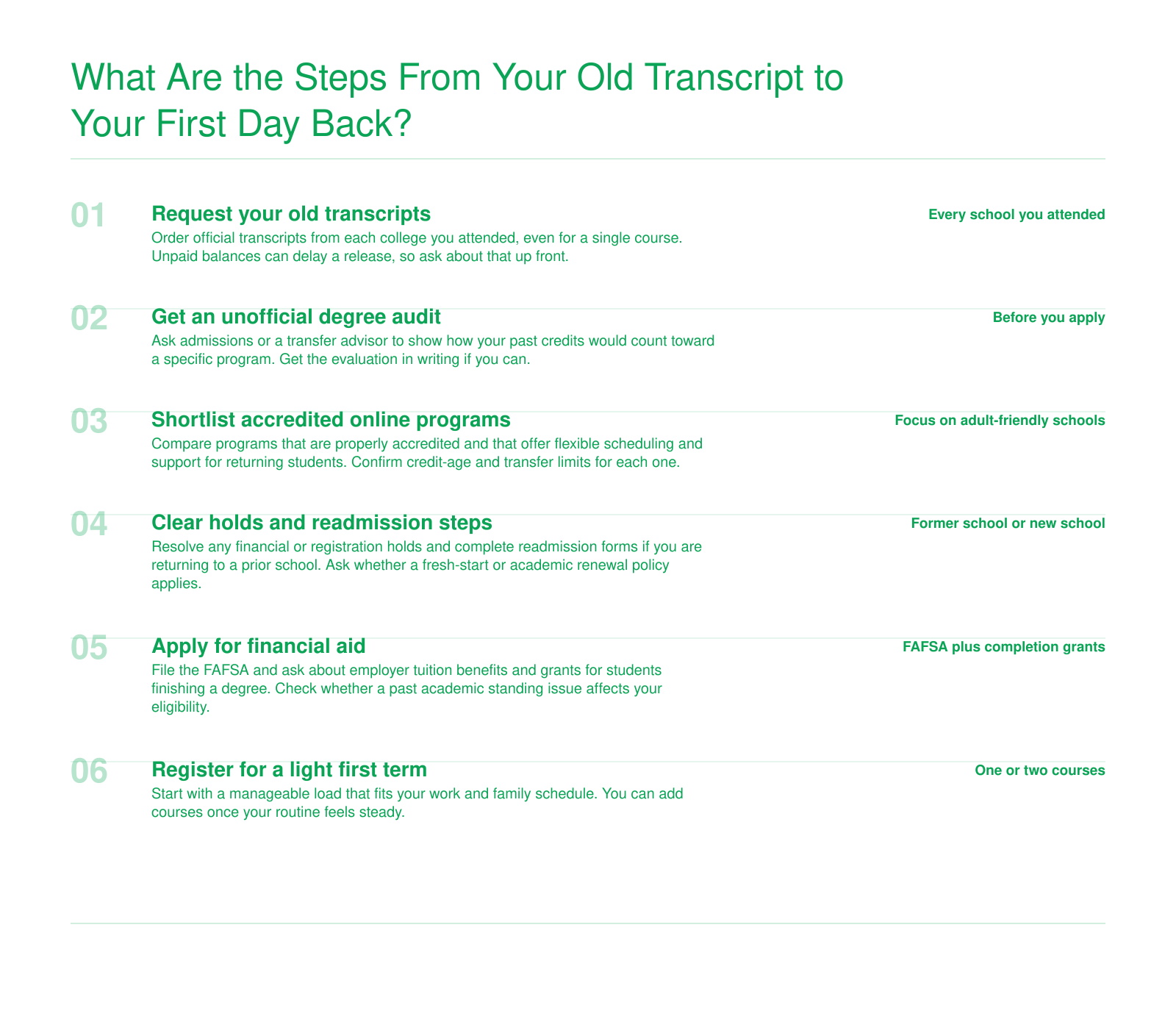
Step One: Find Out What Your Old Credits Are Worth
Before you pay for a single new course, settle the question that decides how much time and money a return actually costs you: how much of your old work still counts. Some of those credits may slide right into a new transcript; others may be too old or too specialized to survive the review. You will not know which until you gather the paperwork and ask the right questions.
Request Every Transcript and Ask for an Evaluation
Order an official transcript from every school you attended, not just the one where you earned the most credits. If a school closed or merged, its records usually transfer to a successor institution or to the state's higher education agency, which can tell you where to send your request. Once you have an admissions offer or an application in motion, ask the registrar directly for a transfer-credit evaluation or a degree audit. That audit maps your old courses against the new program's requirements and shows you exactly where the gaps are.
How Many Credits Transfer, and Whether They Expire
There is no universal cap, and every school decides for itself. National University, for example, accepts up to 90 semester credit hours and generally requires a C- or better, with no stated age limit on courses.1 Many schools instead set a minimum grade of C and apply time limits to specific courses rather than the whole degree. At the University of Arkansas for Medical Sciences, transfer credit is normally honored within seven years; older coursework needs program approval.2 The University of Wollongong will not grant credit for learning over ten years old unless you can show it is still current.3 General education credits (English, history, basic math) rarely expire, while major, STEM, or health courses age out fastest.
Recover Time With Prior Learning Credit
Prior-learning assessment can rebuild some of what the clock took away. Standardized exams like CLEP, portfolio reviews, and credit for work or military training all count at many schools, though each sets its own ceiling. The University of New Hampshire allows up to 60 prior-learning credits toward a bachelor's degree;4 UA-Pulaski Technical College caps it at 30 credit hours and requires you to apply before your final semester.5 Berklee Online awards up to 30, with a $150 registration fee and $75 per credit granted.6
When you reach an advisor, ask one precise question: "Does the time limit apply to individual credits or the whole degree, and does my old GPA carry over?" The answer shapes everything that follows.
- National University Transfer Credit and Prior Learning Credit PoliciesNational University
- UAMS Transfer Credit PolicyUniversity of Arkansas for Medical Sciences
- University of Wollongong Credit for Prior Learning PolicyUniversity of Wollongong
- UNH Prior Learning Assessment PolicyUniversity of New Hampshire
- UA-Pulaski Technical College PLA Credit PolicyUA-Pulaski Technical College
- Berklee Online Undergraduate Prior Learning CreditBerklee Online
Choosing an Accredited Online Program Built for Returning Adults
Some programs are built around a fixed weekly rhythm, and others let you log in whenever your shift ends. Before comparing formats, though, confirm the school is legitimate, because accreditation shapes both credit transfer and financial aid eligibility.
Verify Accreditation in Order
Start with the school's full legal name, not a nickname or marketing name1. Search it in the U.S. Department of Education's DAPIP database, and note the accreditor and status exactly as shown. Next, look up that accreditor in the CHEA directory. Finally, open the accreditor's own directory and confirm the school or program is listed.
DAPIP relies on information reported by accrediting agencies and state approval agencies, and it is not audited. If DAPIP and CHEA disagree, or the status is unclear, contact the accrediting agency directly. Treat the school as unverified until that agency confirms it. Recognized institutional accreditation matters because other colleges generally weigh it when deciding whether to accept your old credits, and it is tied to aid eligibility.
Asynchronous vs. Synchronous
Asynchronous courses let you complete work on your own schedule within deadlines. They suit shift workers and anyone with unpredictable hours. Synchronous courses meet at set times online, which gives you live discussion and built-in accountability. If you tend to drift without a deadline, that structure may help. Many programs mix both, so ask how each course is delivered.
Check Residency Requirements
Most schools require a minimum number of credits to be completed at the degree-granting institution. That rule can limit how much of your old coursework counts, even when every credit is accepted. Ask for the residency requirement in writing and compare it with your transcript.
Warning Signs of a Low-Quality Program
- Unrecognized accreditor: The accreditor is missing from CHEA's directory or is not recognized.
- Not in DAPIP: The school cannot be found, or its name does not match official records3.
- Pressure to enroll: Advisors push you to sign up fast or stress getting a degree with little work4.
- Vague promises: Credit transfer or graduation guarantees come with no written evaluation.
- Hidden fees: Costs appear only after you commit, or accreditation claims show up only on the school's own website.
- A Guide to Legitimate Online Education ProgramsGovFacts
- Higher Ed U Review FAQHigher Ed U Review
- A Guide to Legitimate Online Education ProgramsGovFacts
Re-Entry Policies, Fresh Starts, and Completion Grants: Barriers That May Be Smaller Than You Think
The central tension for many returning adults is whether a clean academic record is worth losing old credits. In practice, schools now offer more tools than you would expect to reduce that trade-off, but the rules are local and time-sensitive.
Readmission After Dismissal or Withdrawal
If you left on probation or after dismissal, readmission usually follows a predictable path: a waiting period, an appeal or petition, and often an academic plan. Kansas State University, for example, requires dismissed students to sit out two semesters and gain approval from its Academic Standards Committee before returning on academic warning, per its University Handbook Section F. Colorado State University allows some dismissed students to return through guest, summer, or continuing education status when their GPA is at least 2.000, then gives them two semesters to raise the cumulative GPA back to that threshold, per its Scholastic Standards and Academic Fresh Start policy. The first call should be to the re-enrollment or registrar office, which can outline the exact sequence for your record.
Academic Fresh Start and GPA Forgiveness
Many colleges let returning students exclude old grades from the GPA calculation, but the trade-off is real: the credits may be forfeited. At the University of Louisville, students readmitted after at least two years away can request a Fresh Start under the Student Success and Fresh Start Policy, but they must complete 30 credits after readmission before graduating and can use the policy only once. Kansas State's Fresh Start requires 12 credits after readmission with at least a 2.200 GPA and covers up to five terms and 60 credits. Stark State College's forgiveness policy, effective June 1, 2026, removes D and F grades from the GPA if they are not required in the current program, but the original grades remain on the transcript and the student must complete 12 credits after returning with a 2.0 GPA.1 These policies are typically irreversible, so weigh whether a higher GPA is more useful than saved coursework.
Stop-Out Grants, Federal Aid, and Employer Benefits
Re-entry and completion grants are often quieter than scholarships. Many schools administer small last-dollar awards or debt-clearing grants through the adult-learner or re-enrollment office, so ask directly rather than searching only the financial aid page. State programs also exist, such as the Kansas Adult Learner Grant for adults 25 and older in specified bachelor's fields, though funding and eligible fields shift by year.2
Federal aid restarts with the FAFSA, but eligibility depends on your school's satisfactory academic progress policy, which is school-specific3 and includes both qualitative and quantitative measures.4 A long gap does not automatically block aid, but a defaulted federal loan or an enrollment hold will. Resolve a default through rehabilitation or consolidation, and clear any bursar or registrar holds, before the aid office can package your offer. Finally, employer tuition assistance is worth checking early: under Section 127, up to $5,250 per calendar year can be excluded from income, and the IRS may adjust that limit after 2026.5 Ask HR during enrollment or benefits elections, and keep records because tax-free assistance can reduce other education tax benefits.6
- Ohio Administrative Code Rule 3357:15-13-22 (Stark State College Academic Forgiveness)Ohio Administrative Code
- Kansas Adult Learner GrantKansas Board of Regents
- Staying Eligible for Federal Student Aid (Satisfactory Academic Progress)Federal Student Aid (U.S. Department of Education)
- 2026-2027 Federal Student Aid Handbook, Volume 1Federal Student Aid (U.S. Department of Education)
- IRS FAQs on Educational Assistance Programs (Section 127)Internal Revenue Service
- IRS Publication 970: Tax Benefits for EducationInternal Revenue Service
Catching up on Tech and the Learning Management System
What should you actually get comfortable with before the first online module opens? For most returning students, the coursework is the manageable part; the tooling around it causes early stress.
Before Week One: Run a Basic Readiness Check
- Laptop: a reliable, fairly recent computer, not a phone or tablet as your only device.
- Internet: stable broadband with a backup option, such as a phone hotspot, for days when home service drops.
- Email: use the school email address you are issued and check it daily; instructors and financial aid offices will send time-sensitive messages there.
- Audio and ID: a headset with a microphone is helpful for recorded discussions, and a webcam may be required for identity verification.
Learn Where Deadlines, Grades, and Announcements Live
Most schools offer an LMS orientation or a sandbox course before term starts. Spend 30 minutes clicking through it. Find the calendar view, the announcements feed, the gradebook, and the module checklist. Then add each due date to your phone calendar with a reminder one day ahead. Set the LMS notification preferences so assignment comments and instructor announcements reach your email or phone instead of sitting unseen inside the course.
Expect Identity Verification on Exam Day
Online proctoring often includes a photo ID check, a webcam room scan, and a browser lockdown that blocks new tabs or copy-paste during the test. Run the school's proctoring system check at least a day before the first exam so a driver update or permission prompt does not eat into your time.
Refresh Math and Writing Before It Counts
If the course starts with college algebra or a written analysis, use free placement-prep modules or the writing center's pre-assessment help during the first week. That is faster than recovering from a failed first assignment.
Sample First-Term Course Loads for Working Adults
Most colleges plan on about 2 to 3 hours of work per credit hour each week, so a standard 3-credit course takes roughly 6 to 9 hours a week on a 16-week calendar and closer to 8 to 12 hours in an accelerated 8-week term. Real workloads can run heavier than planned: one university study found estimated workloads of 15 to 33 hours a week for a course expected to take 9. Treat your first term as a trial run. Start lighter than you think you need, track your actual hours, and add a course next term once you know what your week can hold.
| Situation | Suggested First-Term Load | Estimated Weekly Study Hours | Main Trade-Off |
|---|---|---|---|
| Full-time job plus children or other caregiving (about 8 to 12 free hours a week) | 1 course per 8-week term | 8 to 12 hours for one accelerated 3-credit course | Lowest burnout risk and an easier way to rebuild confidence, but progress is slower (about 18 credits a year). Ask whether a one-course load affects your financial aid or required program pacing. |
| Full-time job, fewer outside obligations (15 to 20 truly free hours a week) | 2 courses per 8-week term (a standard adult-learner pace) | 15 to 22 hours for two accelerated courses | Roughly doubles progress to about 36 credits a year, but needs about twice the weekly time and carries moderate burnout risk in a first term back. |
| Part-time job | 2 to 3 standard-length courses per term | About 18 to 27 hours (roughly 9 hours per 16-week, 3-credit course) | Faster completion, but a heavier first term raises overload risk while you are still relearning how to study. |
| Irregular or rotating shifts (hours hard to predict week to week) | 1 course to start | About 6 to 9 hours for a 3-credit course, with more needed in an 8-week format | A single course gives you room to absorb unpredictable weeks, but it extends your timeline compared with taking several courses at once. |
| Semester-based program while working full-time | 6 to 9 credits per semester (2 to 3 courses) | About 12 to 27 hours, based on 2 to 3 hours per credit | Many working adults do well at this pace, but the top of the range can rival a second part-time job. |
- Time on Task in Online CoursesRochester Institute of Technology
- Considering Student WorkloadUniversity of Florida Center for Instructional Technology and Training
- Course Credit GuidelinesUniversity of Illinois Liberal Arts and Sciences
- HCU Instructional Equivalencies ToolHouston Christian University
- Best Accredited Online Universities for Working AdultsCustom University Papers
- How to Balance a Full-Time Job and Online ClassesCollege Values Online
Ask Yourself Before You Register
Which evenings or weekend blocks can you protect every week even when work runs long?
Online courses have real weekly deadlines, not just a final exam. If you can only study after 10 p.m. on Tuesdays, pick a course load that fits that fixed window rather than hoping for spare time.
If a course needs 9 to 12 hours a week, what would you drop or delegate to make room?
Most returning adults underestimate weekly coursework because school was once their main job. Naming the tradeoff now, such as fewer family obligations or meal prep, helps you register for a realistic first term.
What happened last time that pushed you out: schedule, money, a bad term, or life events? Does your plan address it?
If one crisis derailed an entire semester, look for programs with shorter terms, course drops, or completion grants. Repeating the same enrollment pattern without a buffer can lead to another stop out.
Rebuilding Study Routines Around Work, Family, and Real Online-Term Deadlines
Most online programs now run on weekly cycles with fixed midnight cutoffs, which means the study habits that got you through a lecture-and-final course years ago no longer match how the work is graded. The rhythm is smaller and more frequent: a discussion post due Wednesday, replies due Sunday, a quiz that closes at the end of the module, a paper that sits quietly in week six until it doesn't.
Match Short Blocks to What the Course Actually Asks For
Study sessions of 25 to 40 minutes work well for adults, but only if each block has a named output. Instead of sitting down to "study," assign the block a deliverable: draft the discussion post, read the two assigned chapters for the quiz, outline the paper's argument, revise the draft you wrote Tuesday. Two focused blocks on a weeknight can clear an entire week's discussion requirement. Vague study time tends to become rereading, which feels productive and retains almost nothing.
Use Retrieval Practice for Proctored Exams
If your program uses proctored exams, cramming is the worst possible fit, because remote proctoring gives you one scheduled window with no second chances. Self-quizzing beats rereading: close the book and write down what you remember, then check. Build flashcards as you go through each module rather than at the end, and cycle back through older decks a few minutes at a time across the week. Spacing the same material over five short sessions produces far better recall than one long night.
Plan the Week on Day One, and Build a Fallback
On the first day of every term, open the syllabus for each course and put every due date into one calendar you actually check. Then work backward: a paper due in week six gets an outline date in week four and a draft date in week five. Front-load discussion posts, since replying to classmates requires their posts to exist.
For weeks that fall apart, decide in advance what a minimum viable study day looks like: 20 minutes, one deliverable, nothing else. And set a hard personal rule to email the instructor before a deadline passes, not after. Online faculty extend deadlines for students who ask early far more often than for students who go silent and resurface a week later.
Returning adults rarely finish because they studied harder than everyone else. They finish because they showed up for the same few hours every week, even when the week was hard.
degreecompletion.com
Using Academic Coaches and Adult-Learner Offices, and Spotting Another Stop-Out Early
Struggling quietly and asking for help early lead to very different outcomes. Most returning students try the first. The evidence favors the second.
What Support Offices Actually Do
Academic coaches work on planning, time management, and motivation rather than course content. Adult-learner or re-entry offices pull advising, orientation, financial planning, technical help, and referrals (counseling, childcare) into one place. Online tutoring centers cover the content itself. Many offer evening or weekend hours, and disability services can arrange accommodations remotely. Jobs for the Future's Adult Learner Full Final Report names academic advising and extended faculty availability as priorities for people coming back.
The persistence evidence is encouraging but uneven. In one matched online sample, coached students were 2.66 times more likely to remain enrolled.1 In another, 53 of 75 students (70.6%) who sought coaching early persisted into their fourth course.2 InsideTrack's retention solutions report an 18% retention gain and a 77% two-year completion gain, though those are vendor figures. One study found that a coaching benefit seen in online graduate students did not last through completion, so treat coaching as a useful tool, not a guarantee.3
Early Warning Signs of Another Stop-Out
- Missed discussions: Two discussion deadlines gone by.
- Silent logins: A full week without opening the course.
- LMS dread: Putting off the platform because opening it feels heavy.
- Reading debt: Falling a full module behind on assigned material.
- Avoided email: Leaving instructor messages unopened.
In an ERIC study of struggling online graduate students, nearly half of those first flagged as eligible for help were still active two years later.3 The sooner someone reaches out, the better the odds.
A Three-Step Recovery Plan
- Within 48 hours: Email the instructor, say what happened, and propose a specific plan.
- This week: Meet your advisor or coach to review the load and any options below.
- Next: Build a catch-up calendar that works backward from the remaining deadlines, with fixed blocks for the missed work.
Exits That Are Not Quitting
- Incomplete grade: Gives extra time to finish, usually by agreement with the instructor. Aid generally continues, but the work must be finished by the deadline.
- Reduced load: Dropping one course can lower aid, especially below half-time, so confirm with financial aid first.
- Leave of absence: An approved leave can protect your place and, in some cases, loan status. Terms differ by school.
- Late withdrawal: Keeps a failing grade off your record, but it may trigger aid repayment and count against satisfactory academic progress.
Ask financial aid for the consequences in writing before you decide.
- Academic Coaching Research ProspectusCleveland State University
- Choose Coaching: Academic Coaching ResourcesNorthwestern University
- Early Intervention for Struggling Online Graduate StudentsERIC