Where Do Your Old Credits Go? Using Your College's Adult Learner Office
Find the right office, ask about credit review, and walk into your first meeting prepared

Key Points
- Wayne State merged its transfer and adult learner teams in 2026.
- Credits that transfer may still not count toward your degree.
- Get every transfer evaluation, degree audit, and appeal outcome in writing.
Introduction: One Office for Your Old Credits and Your Next Steps
The question that stalls most returning adults isn't whether to go back. It's where their old credits land, and who actually helps map them to a finish line. A transcript from a school you left years ago can sit untouched because no one can tell you what it's worth.
That's the gap a combined transfer and adult learner office is built to close. Wayne State, which counts students 25 and older as adult learners and enrolls more than 5,000 transfer students, launched its Office of Transfer & Adult Learners in 2026 to put credit review, advising, and re-entry support under one roof.
The practical problem is coordination: credit evaluation, financial aid holds, and advising often live in separate offices that don't talk to each other.
What a Transfer and Adult Learner Office Actually Does
More colleges are folding transfer help and adult learner help into a single office, and Wayne State's 2026 launch of its Office of Transfer & Adult Learners is one recent example. The logic is simple: most returning adults arrive with credits earned somewhere else, so their two biggest questions overlap. Where do my old credits go, and who helps me finish?
The Model in Plain Language
A combined office is meant to be a single point of contact. Typically it covers outreach to prospective students, credit review and mapping, advising, help with the transition back into class, and student engagement such as events and peer connections. The office should know both the transfer rules and the realities of balancing school with work and family.
What It Does and What It Routes
The office usually handles the guidance itself:
- Credit mapping: Explaining how earlier coursework may apply to a specific degree and what is likely left to complete.
- Advising: Building a realistic plan around your schedule and goals.
- Referrals: Connecting you to the right people when the question is outside its lane.
Other decisions typically belong elsewhere. The registrar generally makes the official credit determination. Financial aid handles awards and eligibility. The bursar manages billing, payment plans, and holds. A good office does not replace those departments, but it knows who to call and can help you sequence the conversations.
Names Vary
Don't search for one exact title. The same work may sit under a transfer center, an adult learner team, returning student services, or a center for adult learning. Some schools split transfer and adult services into separate offices, and others house them inside advising. What matters is whether a named person can review your history and point you to the next step.
Case Study: How Wayne State Combined Transfer and Adult Learner Support
At Wayne State University's Office of Transfer & Adult Learners (TAL), students bringing credits from elsewhere and adults 25 and older can find out what their past coursework is worth and how to finish.1 Wayne State announced in September 2026 that it built TAL by merging its Transfer Student Success Center with its Adult Learner Team.6 The university describes the new office as a single point of support for recruitment and outreach, transition assistance, advising, partnerships and student engagement.6
What the Merger Means for a Returning Student
An adult with scattered credits gets fewer handoffs. You no longer have to decide whether you count as a "transfer student" or an "adult learner" before asking for help. Wayne State's Adult Learner Success Team works with students 25 and over who are pursuing a first bachelor's degree.1 It helps them build a success plan and a return pathway, whether their earlier coursework happened at Wayne State or another college.1
Two programs target common obstacles. Warrior Way Back offers debt forgiveness for returning students with an outstanding Wayne State balance.4 The Phoenix program lets undergraduates who left on academic probation or exclusion petition for a second start.4 Detailed eligibility rules and deadlines are not posted, so ask the team directly.
How Credit Review Works
Wayne State encourages anyone with prior college work, even a few courses, to contact TAL.3 The university accepts credit from regionally accredited institutions.3 An online tool called TESS gives an unofficial preview of how courses may transfer, and major-specific community college transfer plans list which community college courses fit a given program.3 Send questions to transfercredit@wayne.edu and official transcripts to Transfer Credit Evaluation, P.O. Box 02759, Detroit, MI 48202-0759.3 Adult learners still submit a regular university application.5
Ways to Reach the Office
- In person: David Adamany Undergraduate Library, 5155 Gullen Mall, Detroit, with drop-in Transfer Tuesdays from 1 to 4 p.m.12
- Virtual: Biweekly Friday information sessions and one-on-one advising on Monday through Saturday mornings.2
- Community college sites: Advisors visit Schoolcraft (Thursdays), Henry Ford (Fridays) and Washtenaw (first Monday monthly).2
- Phone and email: 313-577-2487, transfer@wayne.edu or adultlearners@wayne.edu.1
Schedules can change, so confirm before you go.
Missed the Open House?
TAL hosted a public open house on Sept. 30, and that date has passed.6 Ask when the next event is scheduled, or skip the wait and request a one-on-one appointment.
- Adult Learners - Transfer & Adult LearnersWayne State University
- Adult Learner AdvisingWayne State University
- Transfer PortalWayne State University
- Community College TransferWayne State University
- Adult Learner Steps to ApplyWayne State University
- New Office of Transfer & Adult Learners Strengthens SupportWayne State University
Wayne State's Transfer and Adult Learner Numbers at a Glance
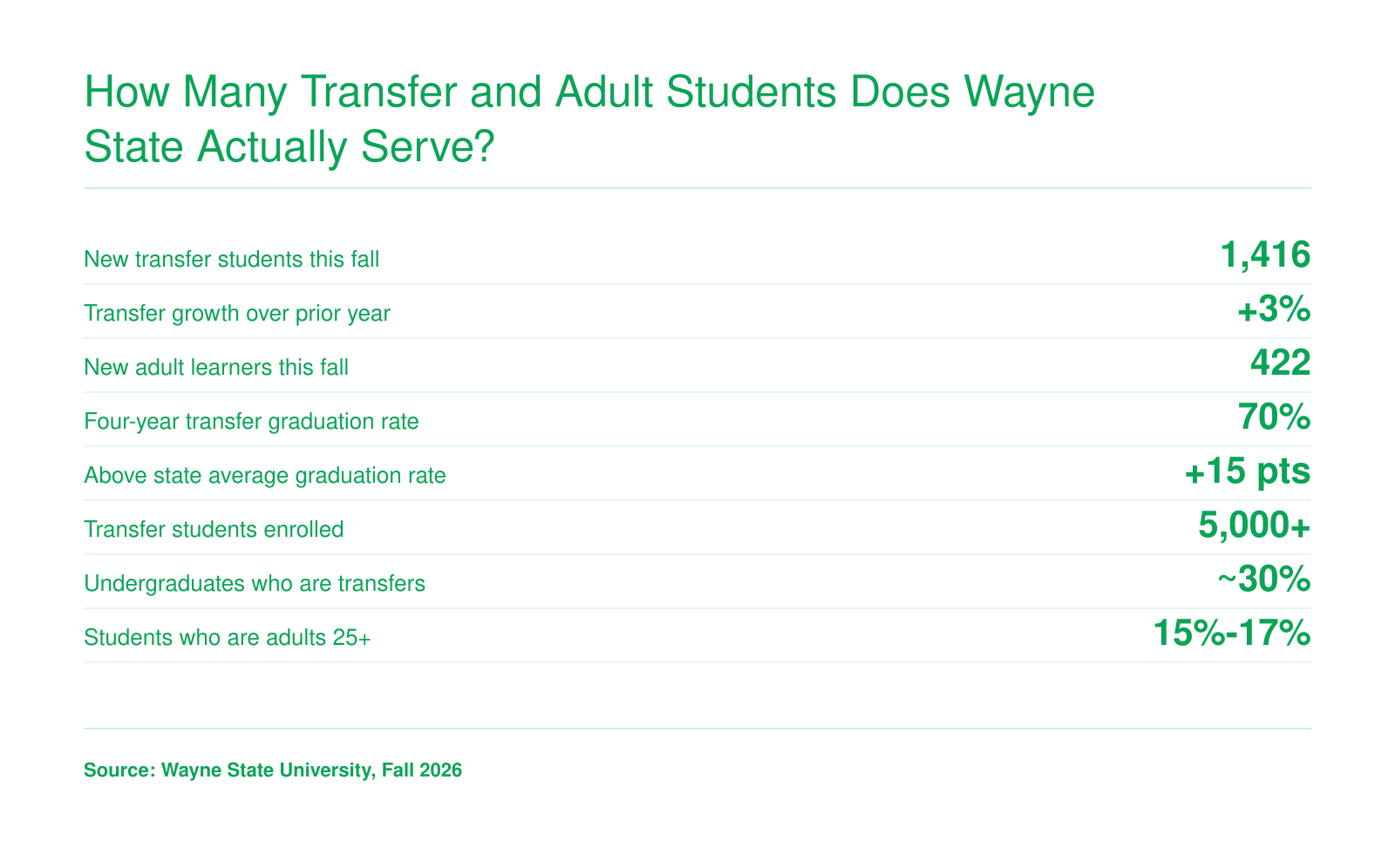
If you are worried about being the oldest person in the room or the only one bringing credits from somewhere else, Wayne State's own figures say otherwise. Most of the university's 422 new adult learners this fall also arrived as transfer students, so credit evaluation and re-entry support are routine work there. Returning adults are a normal, large share of the student body, not an exception.
How to Find Adult Learner Support on Campus
Where is the adult learner office on a college website, and what is it even called? Names vary widely, so search the right terms and check a few predictable places before deciding a school has nothing.
Search Terms That Surface the Right Office
Type each of these into the school's site search, or into a search engine followed by the college name:
- adult learner
- returning student
- transfer student success
- re-entry
- degree completion
- center for adult learning
One term may return nothing while another lands on exactly the page you need. Wayne State, for example, now uses "Office of Transfer & Adult Learners" for a unit that merged its transfer center and adult learner team.
Where to Look on the Site
If search results are messy, check three spots. The A-Z index (often linked in the footer) lists offices alphabetically, so scan under A, R, T, and D. The admissions menu usually has separate tabs for transfer, adult, or returning applicants. The registrar's "returning students" or readmission page explains re-enrollment steps and often names the office that helps with them.
Find a Person, Not an Inbox
A general admissions address puts you in a queue. Look for a staff directory on the office page that lists a named adult learner advisor or transfer coordinator with a direct email, phone number, or online booking link. A real name and a scheduling tool are early signs the support is staffed, not just described.
Using These Offices Online
Many adult learner offices know their students work and live off campus. Check for virtual appointments by video or phone, email intake forms that collect your history before a first meeting, and recorded information sessions you can watch after work. Submitting an intake form with your old transcripts attached can save a full meeting's worth of back-and-forth.
If Nothing Turns Up
Call the main admissions line and ask: "Who handles students who stopped out?" That phrasing points staff toward readmission and re-entry rather than first-year recruiting, and it usually gets you transferred to the right desk or handed a specific contact.
Which Office to Contact First: A Quick Decision Guide
Your starting point depends on where your credits came from and what might stand in the way of re-enrolling. Use this guide to pick a first contact, but confirm eligibility before you rely on a specific office: Wayne State, for example, defines adult learners as students aged 25 and over, and other colleges set different age, enrollment, or time-away rules.
| Your Situation | Contact First | What to Ask For | Typical Next Handoff |
|---|---|---|---|
| Transferring with credits from another college | Transfer and adult learner office, or the transfer center if the school has a separate one | An unofficial transfer credit review, a breakdown of which courses count toward degree requirements versus electives, and instructions for sending official transcripts | Academic advisor in your intended major to build a degree plan |
| Returning to the same school after stopping out | Adult learner office, or the readmission contact in admissions or the registrar | Readmission steps, whether your original degree requirements still apply, whether older courses still count, and whether any holds are on your record | Student accounts if a balance is listed, then an academic advisor |
| First-time college student with workplace or military experience | Adult learner office or adult learner admissions counselor | Credit for prior learning options such as exams, portfolio assessment, or review of military training, plus any fees and credit limits | Prior learning assessment coordinator or veterans services office, then financial aid |
| Degree-completion student close to finishing | Adult learner advisor or academic advisor in your major | A current degree audit listing every remaining requirement, any residency rules, and evening or online course availability | Department advisor for course substitutions, then the registrar for the graduation application |
| Student with a hold or on academic probation | The office named on the hold, or the adult learner office if it offers triage | What the hold is, who placed it, exactly what clears it, payment plan options, and the process for appealing academic standing | Student accounts for payment plans, financial aid for academic progress questions, or the dean's office for standing appeals |
Getting Old Credits Evaluated: Transfer Review, Credit Age Limits, and Appeals
Credits that transfer and credits that count toward your degree are two different things, and confusing them is the most common way returning students lose a semester. A course can arrive on your new transcript as general elective credit and still leave a major requirement unfilled. Ask about both outcomes separately, every time.
The Sequence, in Order
Evaluation almost always starts with official transcripts sent directly from every institution you attended, not copies you hold. From there the receiving college produces a transfer credit evaluation: a list showing which courses map to direct equivalents, which land as general education or elective credit, and which were denied. Some schools run this automatically on admission; others require a petition or form, so confirm which applies. Next, get a degree audit, which shows those accepted credits against your chosen major and tells you what remains. Do not accept the evaluation alone as your finish-line map.
Whether Old Credits Still Count
There is no universal U.S. rule that credits expire, and coursework generally stays on your transcript indefinitely.1 Institutional policy is what varies. In a 2026 survey of 383 responding institutions with age-limit policies, only 4.4% set a limit under five years, 30.0% set a limit in the five-to-ten-year range, and 15.1% set a limit above ten years. Half reported some other arrangement entirely. Illinois State treats credits more than six years old at first degree-program registration as non-transferable;2 one institution documented by AACRAO caps computer science credit at seven years.3 Excelsior allows courses older than five years to be appealed through a time-limit form, and its BS in Liberal Arts carries no time limit at all, accepting up to 113 transfer credits with 16 to be completed in residence.4 Humanities and social science coursework is often treated more generously than major-specific work; fast-moving fields like computing, lab sciences, and health programs draw stricter scrutiny.
Appeals and Readmission
Ask four questions up front: How do I appeal a denied or misapplied course? What documentation do you need? What is the deadline? How long does review take? Appeals typically require a syllabus, catalog description, and learning outcomes, sometimes assignments or instructor credentials.3 Illinois State takes challenges in writing to the Registrar.2 USC requires pre-matriculation courses to be challenged by the end of your first semester and charges a nonrefundable $150 per class for late appeals regardless of the result.5 Also ask whether stopping out means reapplying, and whether readmission triggers a fresh credit review under current catalog rules.
- Do College Credits Expire?Notre Dame de Namur University
- Illinois State University Transfer Credit PolicyIllinois State University
- AACRAO Transfer Evaluation Policy Report AppendicesAACRAO
- Excelsior University Transfer Credit GuidelinesExcelsior University
- USC Transfer Credit ServicesUniversity of Southern California
Real Infrastructure vs. A Marketing Page: 8 Signs to Look For
A polished landing page doesn't guarantee real support. Before you commit, check the college's website, or ask an admissions contact, for these signs of an office that is staffed and accountable.
- A named adult learner advisorLook for a real person with a title, email and phone number, not just a general inbox or web form.
- A published definition of adult learnerStrong programs say who qualifies. Wayne State, for example, defines adult learners as students aged 25 and over.
- Stated response timesA promise such as replying within a set number of business days shows the office tracks its workload.
- A clear prior learning assessment policyIt should spell out how credit for prior learning is earned, the maximum credits allowed and any fees.
- Evening or virtual appointmentsOffices built for working adults offer meetings outside standard business hours.
- A written transfer credit appeal processYou should be able to find the steps, deadlines and contact for contesting a credit decision.
- Published outcomesLook for transfer or adult completion rates. Wayne State reports a 70% four-year graduation rate for transfer students.
- Dedicated aid, family or emergency resources, plus eventsLinks to adult-focused aid, childcare or emergency funds, along with open houses for returning students, signal ongoing investment.