Finish Your Degree Faster by Proving What You Already Know
How CBE works, what it costs, who accepts it, and how to know if it fits you

Key Points
- Competency-based degrees award credit for passing assessments, not logging seat time.
- WGU undergraduate business tuition runs $3,850 per six-month term, not per credit.
- Federal student aid covers CBE only when the specific program is approved.
Introduction: Finish Your Degree by Proving What You Already Know
Competency-based education lets you earn credit by passing assessments that prove you already know the material, rather than by sitting through a fixed number of weeks. For adults with years of work experience and a stack of old transcripts but no diploma, that distinction matters: the barrier is rarely ability, it's the 16-week semester calendar that assumes you have nothing else to do.
The tension is practical. CBE can be fast and cheap for someone whose job already overlaps the coursework, yet pace, accreditation quality, transfer-credit limits, and financial aid eligibility vary sharply between programs. Western Governors University reports median completion times well under four years for many degrees, but published, independent outcome data across the field remains thin.
What Is a Competency-Based Degree and How Does It Work?
A traditional course measures learning by the clock: sixteen weeks of lectures, discussion boards, and due dates. A competency-based degree measures it by what you can actually do. Instead of logging seat time, you earn credit by passing an assessment that proves you've mastered a specific skill, whether or not you sat through a class to get there.
The Building Blocks
A competency-based program breaks a degree into a map of individual competencies: write a business plan, build a database query, interpret a financial statement. Each one has a fixed standard of mastery. You either demonstrate it or you don't, and there is no partial credit for effort or attendance.
A Typical Learner Path
Most programs follow a predictable rhythm:
- Pre-assessment: A diagnostic shows which competencies you've already got and where the gaps are.
- Targeted learning: You're pointed to readings, videos, and practice tasks that cover only what you still need.
- Mentor or coach: A faculty member or success coach helps you plan, troubleshoot, and stay on pace.
- Final assessment: You prove mastery to earn the credit.
The key difference from a semester course: your time is flexible, but the bar for passing is not. Spend one week or ten on a competency, the standard stays the same.
Common Assessment Formats
- Proctored exams test objective knowledge under monitored conditions.
- Projects ask you to produce real deliverables, like a marketing plan or a coded application.
- Papers demonstrate analysis and written reasoning.
- Portfolios collect work samples that show a skill across several tasks.
A Quick Example
Consider a working adult who has managed project timelines and budgets for years but never finished a degree. In a competency-based program, she might pass the project management assessment on her first attempt, skip the coursework entirely, and bank the credit in a weekend, then spend her study hours on the subjects she hasn't lived through yet.
CBE vs. Prior Learning Assessment vs. Self-Paced Online Courses
Prior learning assessment (PLA) turns learning you have already done into credit, competency-based education (CBE) measures your mastery of the degree requirements in front of you, and self-paced online courses are still built around courses and deadlines. Because accredited CBE programs can separate prior-learning credit from newly earned competency credit, PLA and portfolio credit often stack with CBE, up to whatever cap a school sets. The caps below are examples from individual institutions, not industry standards, so confirm the policy at any school you consider.
| Factor | Competency-Based Education (CBE) | Prior Learning Assessment (PLA) | Self-Paced Online Courses |
|---|---|---|---|
| How credit is earned | By demonstrating mastery of competencies instead of logging semesters or seat time; programs set credit-hour equivalencies so completed competencies count as credit | By proving college-level learning gained outside a classroom, such as work and life experience, military training, independent study, or volunteer work | By completing a conventional course with set assignments; flexibility applies to when you study, not how credit is structured |
| What it measures | Mastery of current degree requirements, including new academic content you learn in the program | Learning you already have before you enroll | Completion of course work within a set course structure |
| Who assesses it | The institution's own competency assessments, often embedded in courses or modules | The college, using exams such as CLEP, AP, IB, or institutional tests, or portfolio review matched to similar catalog courses | The course instructor, through graded assignments and exams |
| Pace and deadlines | You move forward as soon as you demonstrate mastery | One-time evaluation, usually early in your degree plan | Course-based with deadlines, even when you control your weekly schedule |
| Credit caps or limits (examples) | Under Higher Learning Commission guidance, new competency credit is awarded only after you complete the program's tasks, units, or modules | Examples: Morgan State allows up to 50% of a degree from PLA and external assessments; CSU Global accepts up to 60 PLA and credit-by-exam credits toward online bachelor's degrees; Empire State's graduate school allows up to six credits | Follows the school's standard transfer and residency rules |
| How it stacks with the others | Davenport University's competency-based MBA, profiled in a CAEL case study, lets students start with up to 18 credit hours of prior learning (including no more than 9 transfer credits) before CBE work | Competencies shown at program entry are recorded as prior-learning credit; some credits may count as electives rather than specific required courses | Can usually be combined with transfer credit, but there is no competency-based shortcut once you enroll in a course |
| Transferability | Completed CBE learning can transfer to other schools as traditional credit hours when equivalencies are documented | May transfer as electives rather than satisfying specific course requirements | Transfers like any traditional course credit |
- Credit for Prior Learning Term DefinitionsEastern Oregon University
- Policy on Credit for Competency-Based Education and Prior LearningMorgan State University
- A Guide to Degree Program Planning & Prior Learning AssessmentEmpire State University
- Competency Based Education & Credit for Prior LearningLas Positas College
- Equity Framework for Competency-Based EducationAcademic Senate for California Community Colleges
- Competency-Based Education ProgramsHigher Learning Commission
- Enrollment Management & Competency-Based Education: Best Practices HandbookCompetency-Based Education Network / Mid Michigan College
- Who enrolls in competency-based education? An examination of the role of student characteristics and institutional factorsWiley Online Library
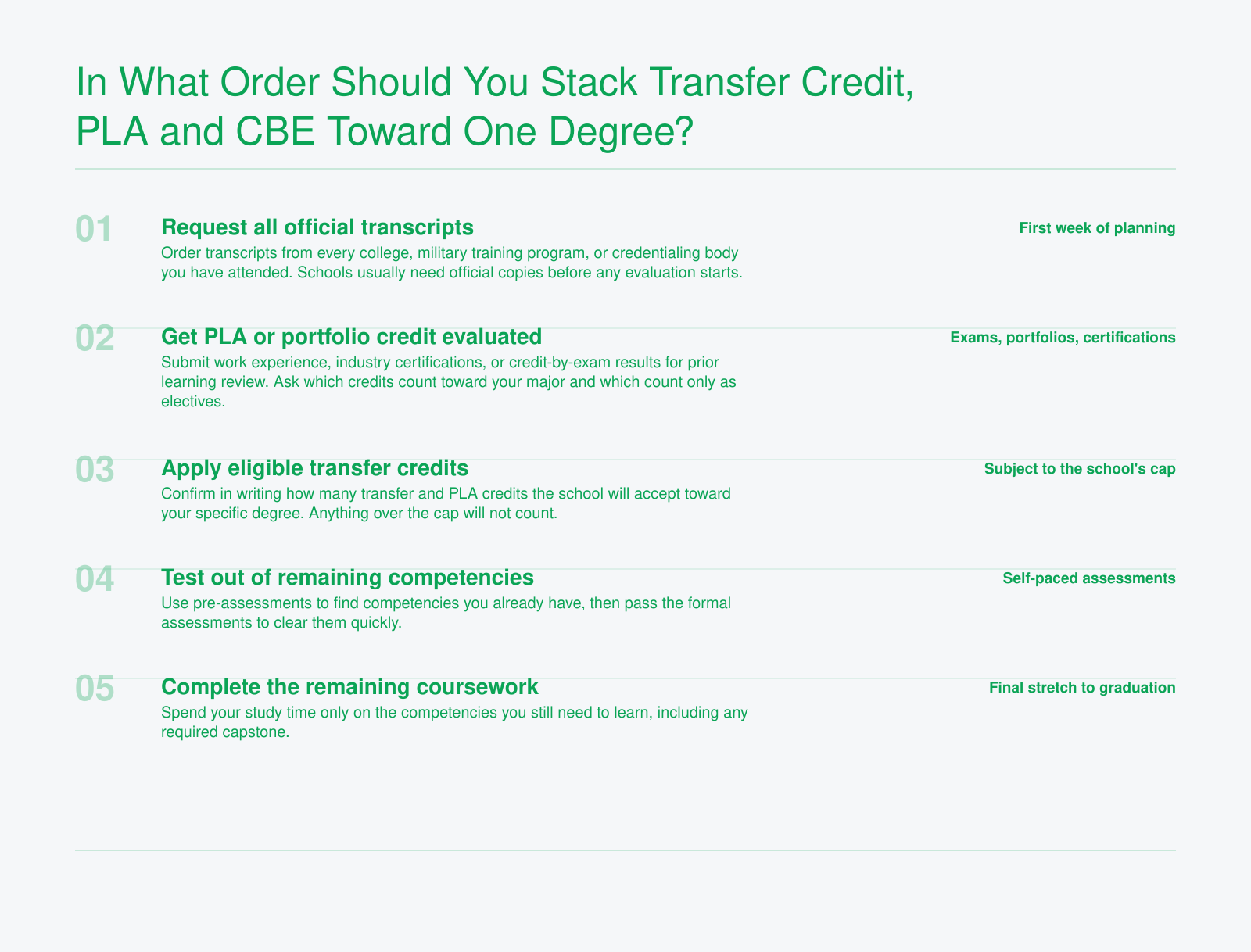
How Transfer Credit, PLA and CBE Stack Toward One Degree
Sequence matters because most schools cap how many transfer and prior-learning credits can count toward a degree, and those limits apply before any competency assessments begin. Getting existing credit evaluated first shows you exactly what is left to prove.
Which Degree Fields Offer CBE for Adult Learners?
Western Governors University, accredited by the Northwest Commission on Colleges and Universities, offers competency-based degrees at both the bachelor's and master's level in business, information technology, teacher education, health professions, and nursing. That five-field spread is a useful map of where competency-based education actually lives, because the model clusters in disciplines with well-defined skills frameworks rather than spreading evenly across the catalog.
Business, IT and Health Administration
These are the deepest CBE fields. Business administration and IT appear at both the undergraduate and graduate level in WGU's online degree programs, and the health professions side includes health information management, healthcare administration, and healthcare management. The common thread is that competence is demonstrable: you can build a financial model, configure a network, or map a coding workflow, and an assessor can score the result. IT programs often fold industry certifications into the degree, which is part of why they adapt so cleanly to assessment-based progression.
Education and Nursing: The Licensure Complication
Teacher education and nursing are available in competency-based form, but with limits. WGU's 2026 catalog identifies its M.S. in Nursing Leadership and Management and its M.S. in Nursing Informatics as competency-based, alongside concentrations in nursing education and nursing management. What you cannot test out of is supervised clinical hours or student teaching. State licensure boards require documented practicum time, so expect a hybrid structure: assessments for the theory, a scheduled field placement for the rest. Pre-licensure nursing in particular is the least flexible corner of CBE.
Fields outside this cluster, including most lab sciences, engineering, and fine arts, have thin to nonexistent competency-based options. If a discipline depends on equipment, studio time, or sequenced labs, seat time is doing real work and the model does not transfer.
One Question to Ask
Before you enroll, ask the admissions office directly whether the program is fully competency-based or a hybrid that mixes assessments with conventional term-based courses. The answer changes your pace, your billing, and how much of your existing experience you can actually convert into credit.
Accredited Competency-Based Bachelor's Programs Compared Side by Side
Self-paced, competency-based bachelor's programs bill differently from traditional online degrees. Most charge a flat rate per session or term instead of per credit, so the faster you show mastery, the less you tend to pay. The table below covers programs whose pricing, transfer rules and financial aid conditions were confirmed on official 2026 tuition and program pages. Other well-known flexible or competency-based options, such as Western Governors University, Southern New Hampshire University, the University of Wisconsin Flexible Option and Northern Arizona University's Personalized Learning, were not included because their current terms could not be verified from official sources. Check those schools' tuition pages directly before comparing them. Published totals are best-case figures. Your actual cost depends on how much credit you transfer in, the current per-session rate and how quickly you finish.
Program
Pricing model
Billing period
Published cost (2026)
Transfer and prior learning credit
Federal financial aid
Watch for
Capella FlexPath (Capella University)
One flat fee per billing session, no matter how many courses you complete
12-week billing sessions. Each course must be finished within 12 weeks, and you can start your next course without waiting for a new session.
Capella says a bachelor's can be completed for under $19,000 in about 19 months. Actual cost varies with transfer credit, per-session tuition and completion speed.
Prior college credit may cover up to 75% of select bachelor's degrees. Prior learning assessment is available, but all transfer and prior-learning credit must be completed before you start FlexPath.
Conditional. Eligible students must take a unique course each 12-week session and complete the minimum program points for their degree and enrollment level by the end of the session.
Finish your credit evaluation and portfolio work first. Credit can't be added after you begin.
Purdue Global ExcelTrack (Purdue University Global)
Flat rate per term, not per credit
Term length was not confirmed on the official pages reviewed. Confirm it with admissions.
$2,500 per term, excluding fees, for ExcelTrack bachelor's programs in analytics, business administration, cloud computing and solutions, cybersecurity, health care administration and IT
Up to 75% of undergraduate requirements can transfer in. Prior academic, work and military experience can count toward the degree.
Conditional. Requires a minimum number of credits per term, and the exact minimum is not stated on the official pages reviewed.
Not eligible for VA educational benefits or Federal Tuition Assistance because of its self-paced, nontraditional structure
- Purdue Global ExcelTrack Bachelor's in Business AdministrationPurdue Global University
- Purdue Global Tuition and FeesPurdue Global University
- Purdue Global Personalized LearningPurdue Global University
- Purdue Global ExcelTrack Bachelor's in Business Administration (PDF)Purdue Global University
How Much Does a Competency-Based Degree Cost?
Many competency-based programs now bill by the term rather than the credit, which changes how adult learners should budget for a degree. At Western Governors University (WGU), undergraduate business programs cost $3,850 in tuition per six-month term for terms beginning January 1, 2026, plus a $200 e-books and resources fee.1 That tuition covers every course you complete in the term, and finishing more of them does not raise the bill.
Flat-Rate Terms vs. Per-Credit Pricing
Per-credit tuition is easy to predict: credits times rate. Flat-rate pricing is predictable per term but not per degree, because pace sets the total. Undergraduates taking 12 or more competency units count as full-time and pay the flat rate. Those taking fewer have tuition prorated.1 WGU business degree tuition is usually $3,000 to $4,000 per term, but the $3,850 figure applies to business programs specifically, so check the rate for your own major.2 No reliable industrywide average total cost for a competency-based bachelor's exists, so compare each school's published numbers against your own transfer credits.
Fees Beyond Tuition
WGU says assessment fees apply only after two failed attempts.2 One of the Western Governors University reviews on ConsumerAffairs cites $60 for a third attempt in some classes, but that comes from a review site, not WGU's tuition page, so confirm the current amount before relying on it. WGU's materials list no routine proctoring fee and no additional per-class fees. Other schools may bill assessments, proctoring, or technology separately, so ask what is bundled into tuition.
An Illustrative Scenario
This math is illustrative only, using the published business rate and the $200 resources fee, which is assumed here to be charged once per term:
- Four terms: 4 x ($3,850 + $200) = $16,200.
- Six terms: 6 x ($3,850 + $200) = $24,300.
Saving two terms saves about $8,100, assuming you complete the same required coursework either way. Your own figure will shift with transfer credit and how many courses you finish each term.
The Cost of Stalling
The same logic cuts the other way. A term in which work or family pulls you off course costs the full $3,850 whether you pass one course or six. Flat-rate pricing rewards steady momentum. If your schedule is unpredictable, a per-credit program may be the safer financial fit.
- WGU Accelerators PricingWGU Accelerators
- WGU Accelerators About UsWGU Accelerators
How Fast Can You Finish? Pace, Workload and Reality Checks
How fast you finish a competency-based degree depends far more on your prior knowledge and weekly pace than on a fixed academic calendar.
What Published Completion Data Shows
Western Governors University, a large CBE provider, reports a median time to bachelor's completion of 24 months in its FY26 annual report, with undergraduate programs ranging from 90 to 120 credits. Its online business bachelor's programs describe an average completion around 2.5 years. Those figures normalize for students entering with zero to 60 or more transfer credits, so they are not a promise for every learner. By comparison, general 2026 estimates put a traditional online bachelor's at about four years full time and five to six years part time, while accelerated or competency-based formats may fall in a two to three year range for motivated students.
Federal graduation data is harder to apply to CBE adults. The six-year window follows only full-time, first-time students in the IPEDS graduation rate table. One GradeToGrad 2026 WGU review reports a six-year rate around 51 percent for Western Governors University in 2022-2023, with first-year retention near 63 percent, but that cohort misses most transfer and part-time students. Other summaries have published lower six-year figures, which is why a single rate should not be read as the answer. The Competency-Based Education Network notes that semester-based measures fit CBE poorly and recommends tracking persistence, pace and competency completion over time.
Workload When You Work Full Time
Working adults should expect the intensity to shift by course. Prior professional experience can compress writing, management, business or IT foundations into a few days or weeks, while unfamiliar quantitative or technical competencies may require sustained weekly study. Published CBE materials do not set one standard hourly commitment because progress is measured by assessments rather than seat time.
What Happens When You Do Not Pass
When mastery is not demonstrated, competency-based programs generally require remediation before a retake, often with an instructor or mentor reviewing the missed competencies. Retake limits and policies vary by institution and program, so ask for them in writing before enrolling.
Reality Check Before You Trust Speed Claims
Some of the fastest completion claims appear in marketing pages, not outcomes reports. Treat a finish-in-under-two-years promise as a possibility, not a baseline. Look for completion data by student profile, transfer credits and part-time status. Self-paced formats reward learners who can set their own deadlines. Students who rely on external structure sometimes stall without weekly due dates, so a faster format can become slower in practice if momentum drops.
Red Flags: Accreditation, Transfer Credit and Employer Recognition
Accreditation is the first screen, not the last. For a direct assessment competency-based program rather than seat time, confirm that the school itself has a recognized institutional accreditor, typically a regional accreditor for degree-granting colleges. Start with the U.S. Department of Education's Database of Accredited Postsecondary Institutions and Programs (DAPIP) and the Council for Higher Education Accreditation (CHEA) directory. Check the exact school name, listed accreditor, status dates, and scope. An institution-level record does not by itself prove a specific CBE or direct assessment program was separately reviewed, so request written accreditor action showing that the program is included in the accreditation and that any credit-hour equivalencies were approved.2
Why Direct Assessment Approval Matters for Financial Aid
Accreditation and Department approval are separate steps. A school may hold regional accreditation but still lack approval for its first direct assessment program. Under Department of Education program eligibility rules, the first direct assessment program and the first program at each credential level require Department approval before students can receive federal student aid based on enrollment.1 Additional equivalent or lower-level programs may be reported within the 10-day reporting deadline instead of requiring another approval, but a program at a different level still requires approval. If an advisor says a program is "aid eligible," ask whether that specific program, not just the institution, has cleared the direct assessment review. Checking DAPIP and CHEA confirms institutional recognition, but direct assessment approval is a separate program-level step.
Accreditation Is Not a Transfer Guarantee
Receiving colleges make their own transfer decisions. There is no national rule requiring traditional colleges to accept CBE or direct assessment credits, and Title IV participation or Department approval does not guarantee transfer acceptance. A CBE transcript may show competencies or credit equivalents, not familiar course numbers, so a receiving school may evaluate it case by case. Some traditional colleges may accept only certain competency areas or require additional documentation, so a written transfer policy matters more than a verbal assurance. Get transfer policies in writing before enrolling, especially if you may continue to a master's program later.
Employer Recognition and Red Flags
Employers often understand regionally accredited degrees, but direct assessment and competency transcripts can require explanation. Watch for these signs: - No recognized accreditor, or an accreditor not recognized by the U.S. Department of Education or CHEA. - Vague or verbal-only transfer promises. - Pressure to enroll quickly before you can verify aid, accreditation, or transfer. - No published completion or outcome data. - Statements that accreditation "guarantees" transfer or employer acceptance.
Three Questions Before You Pay
Ask an admissions advisor: - Which recognized accreditor reviewed this specific competency-based program and approved the credit equivalencies? Can I see the written action? - Has this direct assessment program received Department approval at this credential level, or is it still pending? - How will competencies appear on my transcript, and can you provide a written transfer policy or examples of recent transfer outcomes?
- FSA Handbook 2026-2027 Vol 2 Ch2 Program EligibilityFederal Student Aid
- FSA Handbook 2026-2027 Vol 2 Ch2 Program Eligibility PDFFederal Student Aid
Can You Use Financial Aid for Competency-Based Programs?
The 2026-2027 Federal Student Aid Handbook makes the core point clear: competency-based education can be eligible for federal student aid, but eligibility is conditional on how the program is structured and approved.1
Federal Aid Depends on Program Structure
Competency-based programs that use conventional credit hours and regular terms generally follow standard federal aid rules. They must provide regular and substantive interaction between students and instructors, except for correspondence programs, and aid covers only learning the school provides or oversees. Direct assessment programs, which measure progress by assessing knowledge and skills rather than seat time, do not receive automatic eligibility. They require separate U.S. Department of Education approval through an updated E-App, as explained in FSA Handbook Publication 2971, plus an approved equivalency methodology using credit-hour, clock-hour, or hybrid measures. Schools must document that the accrediting agency approved the equivalencies and that the methodology aligns with accreditor and state requirements, as the Department's Dear Colleague Letter on applying Title IV eligibility to direct assessment programs explains.
Pell Grants, Loans and Flat-Rate Pricing
Pell Grants and federal loans remain conditional rather than guaranteed for direct assessment.1 Approved programs may offer them if the student meets ordinary eligibility rules, but no special Pell or loan formula exists for direct assessment. Subsidized and unsubsidized loan eligibility depends on the same federal aid approval and enrollment-status rules.1 In subscription or flat-rate CBE models, disbursement depends on how the school defines payment periods and enrollment intensity. Ask the aid office to explain how a flat-rate term affects your Pell calculation and loan period.
Employer, Military and State Options
Employer tuition assistance, GI Bill benefits, and state grants may be added on top of federal aid, but policies vary. Confirm directly with the employer, Veterans Affairs, or state agency that the specific CBE format is covered.
What to Do Next
Submit the FAFSA and then ask each school two questions: Is this exact CBE program approved for federal aid, and if it is direct assessment, what equivalency methodology is in place? The financial aid office, not marketing materials, is the place to verify aid eligibility before you enroll.
- 2026-2027 Federal Student Aid Handbook, Vol. 2, Ch. 2: Program EligibilityU.S. Department of Education, Federal Student Aid
A Four-Step Vetting Checklist Before You Enroll
Run every competency-based program through the same four checks, in order: verify the accreditor, confirm financial aid eligibility for that specific program, get your transfer and prior learning credit evaluated in writing, then ask for completion and outcome data. Do all four before you pay a deposit or share any financial information.
Are Competency-Based Degrees Worth It? What Employers and Outcome Data Say
A competency-based degree is worth it when it gets you to an accredited credential you could not otherwise finish. The evidence behind that judgment, however, is thinner than marketing suggests.
What Employers Actually Report
No large independent study has measured how employers view competency-based degrees as a category. The most cited figure comes from a 2024 WGU Employer Perception Survey of 300 employers, as summarized in the WGU Employer Perception and Outcomes Summary. All of them said WGU graduates were prepared, and 86% called them "very" or "extremely" prepared. The full methodology, response rate and questionnaire are not publicly documented. The result also covers only WGU graduates, not CBE in general.
The more practical point is simpler. At a regionally accredited school, the diploma and transcript typically show the institution and the degree earned, not whether you proved competencies or sat through 16-week terms. Hiring managers rarely see the delivery format unless you mention it.
Debt and Earnings at the Largest CBE School
College Scorecard figures for WGU are encouraging but need careful reading:
- Nursing bachelor's: 7,786 graduates in 2022-23 had median earnings of $97,114 four years after completion and median federal debt of $9,470.1
- IT administration and management bachelor's: 2,736 graduates had median earnings of $129,303 and median debt of $14,104, which includes borrowing at earlier schools, according to Western Governors University Outcomes Data.
- All graduates: One compilation reports $87,445 four years after completion against $11,116 in median federal loan debt1, about 13% of earnings2.
Measures that count everyone who enrolled, including students who never finished, look lower: $69,572 six years after entry and $60,615 ten years after entry.1 WGU separately estimates its median total cost for a bachelor's at $16,600.3 That is the school's own cost estimate, not a debt figure. Because these programs serve working adults, strong earnings may partly reflect experience students already had, not the degree alone.
Who Benefits Most
CBE pays off for experienced, self-directed adults who can move quickly through material they already know. If you need firm deadlines and instructor pacing, or you are new to the field, a structured program may serve you better.
- Western Governors University Scorecard CompilationCampusGuide
- WGU College Scorecard Affordability AnalysisWestern Governors University
- WGU Annual Report FY26Western Governors University
Competency-Based Degrees: Advantages and Trade-Offs
Competency-based education rewards adult learners who already have real-world skills, but the same flexibility that speeds some students up can slow others down. Weigh these advantages and trade-offs against your schedule, budget and career goals before you enroll.
Pros
- You move forward as soon as you prove mastery, so years of work experience can shorten your path to a finished degree.
- Many programs charge a flat rate per term, which can lower total cost for disciplined learners who complete more courses each term.
- No fixed class meeting times means coursework can fit around full-time jobs, shift work and family obligations.
- Assessments tied to clearly defined competencies show exactly which skills you have demonstrated, which can be useful when talking with employers.
- CBE often stacks with transfer credit and prior learning assessment, letting you combine several routes toward one degree.
Cons
- Self-paced study demands strong self-discipline, and flat-rate tuition can cost more overall if you progress slowly or stall.
- Some colleges and graduate programs may not accept CBE credits as easily as traditional credit hours, so confirm transferability early.
- Program availability is concentrated in fields like business, IT, health administration and education, with fewer options in lab-heavy or licensure-track majors.
- Less scheduled faculty contact and no fixed cohort can leave some learners feeling isolated without built-in peer support.
- Financial aid rules can differ for some competency-based formats, so verify eligibility with the school's aid office before enrolling.