Going Back to College Is About More Than Money: Are You Ready?
A readiness checklist that weighs personal goals, family support, and real costs

Key Points
- Cost is cited by 81% of adult learners in CAEL research (2026).
- Employers can provide up to $5,250 a year in tax-free tuition aid.
- Start your first term back with one or two courses.
Introduction: The Decision to Go Back Is Bigger Than Tuition
Is it too late, or is it worth it? Adults weighing a return to college usually ask both, and cost dominates the first pass. CAEL research reported in 2026 found 81% of adult learners cite it as a barrier.
Yet the reasons people re-enroll run deeper: identity, a promise to their kids, a career stalled without a credential. Marybeth Gasman made that case in Forbes on October 13, 2026, in "For Adult Learners, Returning To College Is About More Than Money."
Tuition can be estimated in an afternoon. Whether your reason and your household hold up through a full term is harder to measure, and it usually decides who finishes.
What Really Motivates Adults to Go Back to College
An adult learner's motivation is the specific reason they are willing to trade evenings, weekends, and savings for a degree. Marybeth Gasman's October 13, 2026 Forbes piece, "For Adult Learners, Returning To College Is About More Than Money," argues that the choice to return involves more than financial aid or expected earnings. It features Morgan State University's $800,000 Crankstart Foundation grant to continue its Crankstart Reentry Scholarship Program. The excerpt available to us does not lay out a full list of motivators, so the examples below are our own, drawn from general knowledge of adult learners, not from her text.
A motivation is not just a feeling. You can name it, write it down, and test it against a hard week. Vague reasons tend to fade when coursework competes with work and family.
Personal Motivators
- Finishing something unfinished: Years of "some college" can feel like an open loop, and closing it is reason enough for many adults.
- Identity and self-belief: Some people want to see themselves as someone who earns a degree, regardless of what the diploma pays.
- Role-modeling for kids: Showing children that education is worth the effort can carry a parent through a tough term.
- Proving something to yourself: A past stumble, a doubt from someone else, or a long gap can all become a reason to try again.
Career Motivators
These sit beside the personal reasons, not against them. Most adults hold both at once.
- Promotion: A bachelor's degree may be a stated requirement for the next role at your employer.
- Switching fields: A credential can open a door that experience alone has not.
- Job security: Some adults return because they want a stronger footing if their industry shifts.
Turn the Feeling Into Something Testable
Try finishing this sentence: "I am going back because ___, and I will know it is working when ___." A reason that points to something observable, like a completed course or a conversation with an advisor, is easier to hold onto than a general wish to do better. If you cannot fill in the blank yet, that is useful information too; the readiness steps later are built for exactly that situation.
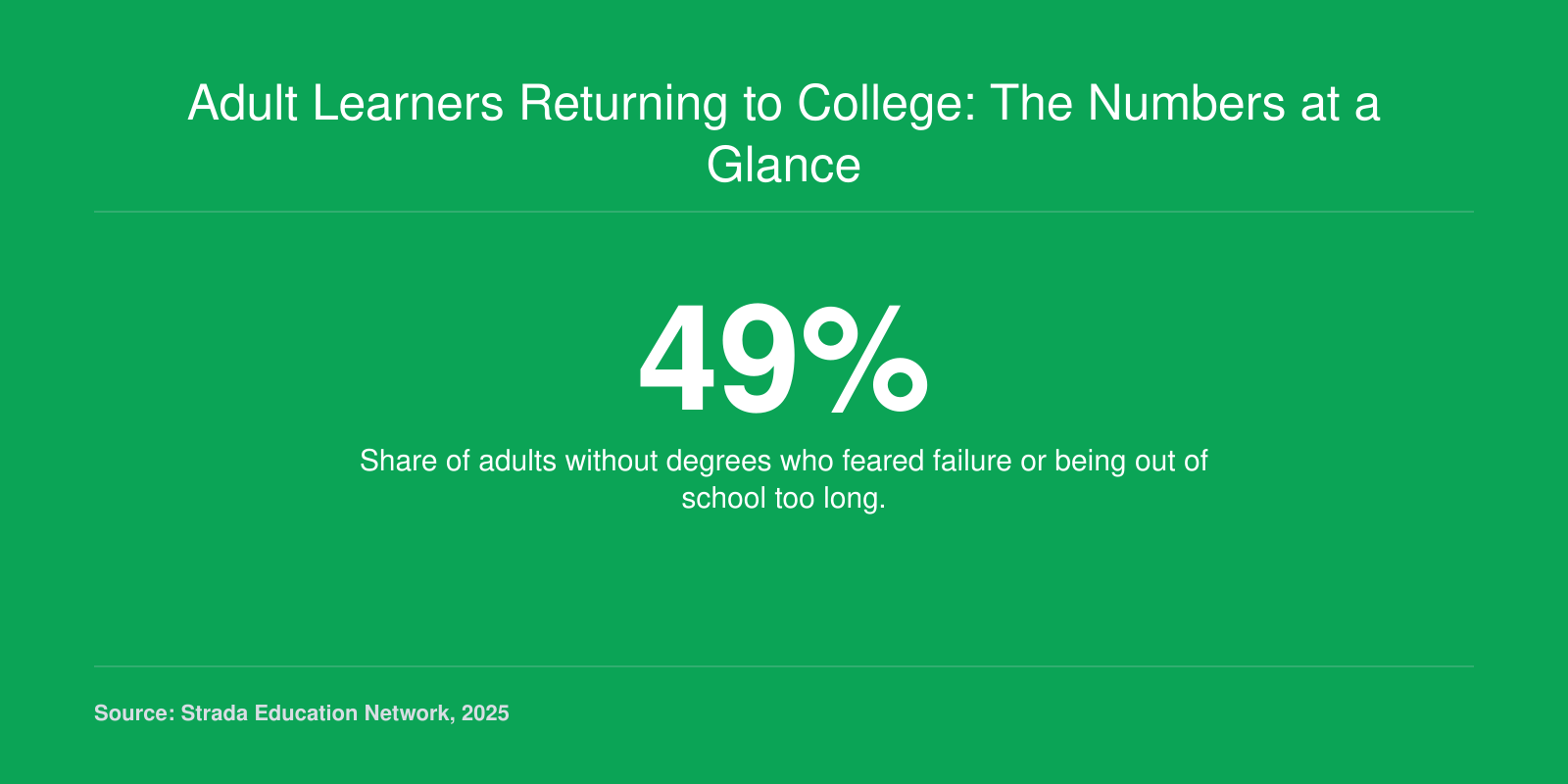
Adult Learners Returning to College: The Numbers at a Glance
Cost is the most widespread barrier, cited by 81% of adult learners in CAEL research reported in 2026, but it is far from the only one. In a Strada Education Network survey published in 2025, 55% of adults without degrees named work, family, schedule, or transportation conflicts as major concerns, and 48% called cost extremely or very challenging. Those non-money worries matter because you can test and plan for them before you spend anything on tuition.
- Adults Want to Go Back to School, We Should Make It EasierLumina Foundation
- Some College, No Credential: A 2025 SnapshotStrada Education Network
- Who's Ready to UpskillStrada Education Network
- Enrolling in Education: Motivations, Barriers and ExpectationsStrada Education Network
- State of Higher Education StudyGallup
Which Motivations Predict Finishing a Degree
The reasons most likely to carry you across the finish line are specific and tied to a concrete outcome, not vague aspirations. Research on adults returning to college suggests that seeing how coursework connects to your actual goals, carrying a clear sense of purpose, and feeling you belong on campus are all associated with staying enrolled. But the honest picture is more cautious than confident.
What the Evidence Supports and What It Doesn't
Studies from groups like Ithaka S+R, Lumina, and the National Student Clearinghouse Research Center consistently connect internal factors such as motivation, perceived relevance, and goal clarity to re-enrollment and persistence among adults with some college and no credential. Lumina's 2026 report, 65 Million Reasons Why Intent Matters Most, found learning and self-improvement to be the most common primary motivation for this group, with job skills close behind.
What the research does not do is prove that motivation alone causes completion. The strongest effects show up when motivation pairs with structural support. In Ithaka S+R's study of New Jersey students with some credit and no degree, persistence rose from 67 percent to 83 percent after students received reacclimation help plus financial aid. Nationally, a survey found 60 percent of stopped-out students said they would return with a clearer path.1 Motivation matters, but it works alongside money and support, not instead of them.
Why a Near-Term Goal Gives Re-Enrollees an Advantage
The some college, no credential population is large, and within it, students who return with a specific, reachable target tend to fare better. National data shows that those with substantial prior enrollment are more likely to re-enroll and earn a first-year credential, though the first-year credential rate for re-enrollees overall sits around 4.7 percent.2 A defined, near-term goal shortens the distance between enrolling and a visible win.
Your One-Sentence Why
Translate all of this into a single sentence you can read on a bad week. Make it concrete and tied to an outcome you can name. "I'm finishing my associate degree in applied science so I can apply for the supervisor opening at work" beats "I want to better myself." The first sentence tells you what you're working toward, roughly when, and why it's worth a hard Tuesday night. The second evaporates the moment the semester gets heavy.
- Improving the Share of Adult Learners at Four-Year InstitutionsIthaka S+R
- Some College, No CredentialNational Student Clearinghouse Research Center
How Motivations Differ by Age, Parenting Status, and Career Stage
Five national sources carry most of the useful research on adult learners: BLS, NCES, Strada, Gallup/Lumina, and CAEL. Motivations shift with age, parenting status, and career stage, and published surveys like the Going Back to School as an Adult survey slice those groups differently. The fastest way to get numbers that match your situation is to pull the latest editions yourself rather than rely on a single headline figure.
National Sources Worth Checking
- BLS.gov: Best for enrollment and labor trends by age, plus how education levels line up with employment. Search "BLS school enrollment by age" and "BLS employment projections education."
- NCES (nces.ed.gov): Best for adult learner demographics, including how many students are 25 and older, who attends part-time, and who works while enrolled. Search "NCES Condition of Education undergraduate enrollment" and "NCES student age distribution."
- Strada Education Foundation and Gallup/Lumina: Best for survey data on why adults return to school and what they expect from it. Search "Strada, Gallup Back to School report" and "Gallup Lumina State of Higher Education."
- CAEL: Best for adult learner and workforce research, including interview-based work on how economic and personal motives overlap. Search "CAEL adult learner research" and "CAEL Intent Matters."1
When you open a report, look for the breakdown tables. Check whether it splits results by age band, by parent status, and by employment, and note the age range it actually surveyed. A report covering ages 25 to 64 may not describe someone at 52 or 27 very well.
Ask People Who Know the Program
National data describes adults in general. Your target school can describe the adults in the program you're considering. Contact the admissions or adult-learner office, then talk to a program advisor. If you work in a regulated or credentialed field, a professional association can also tell you what employers in that field expect. Useful questions:
- What is the average age and work status of students in this program?
- How many students in this cohort are parents?
- What share of students finish while working full-time?
- Which courses do working parents or career changers usually take first?
- Are evening, online, or weekend sections offered every term?
Next Steps for Benchmarking Yourself
- Compare against national data: Find the age band and employment group closest to yours in a Strada or CAEL report, then note which reasons for returning match yours and which don't.
- Talk to an advisor: Bring your age, family situation, and work schedule, and ask for a cohort profile and two or three recent graduates you can contact.
- Check employer tuition benefits: Ask HR for the written policy, including annual caps, approved programs, and any repayment terms if you leave. Benefits often shape which motivation, advancement or career change, the program can realistically serve.
- Intent Matters: Adult Learner Intent to Enroll (CAEL–CollegeAPP)Lumina Foundation
How to Test Your Readiness Before Paying Tuition
Most adults do not fail because they lack ability; they fail because they enroll before they have tested the non-tuition parts of readiness. Before you pay a deposit, run a self-assessment that costs little more than a few hours of your week.
The Five Parts of a Tuition-Free Readiness Test
- Academic confidence: This week, take one free sample math or writing module from a college prep site or an open course. Do not time yourself until you feel steady, then complete one timed exercise. If you need a placement review, most community colleges offer free or low-cost refresher links before the exam.
- Weekly time: This week, track a normal week in 30-minute blocks for three days. Look for eight to ten hours you could protect without cutting sleep, parenting, or paid work. If the only available hours are after 10 p.m., treat that as a yellow flag.
- Tech and workspace: This week, use the exact laptop, tablet, or shared computer you would rely on. Complete one short online module in your usual study spot and note any connection drops, noise, or login problems.
- Support people: This week, write down two people you could call for childcare, transportation, or encouragement. Then ask one of them, "If I enrolled, would you be able to help on a specific night?" A real yes matters more than a supportive maybe.
- Credit-transfer status: This week, request an unofficial transcript from every prior institution. Send it to the school or compare it against the transfer guide. Even a preliminary review can reveal that you are closer to a degree than you think, or further away.
A Green, Yellow, Red Check
Score each area as green (ready enough), yellow (workable with a change), or red (would undermine the term). This is a planning heuristic, not a validated instrument. It works best when you are honest about sleep, family, and the emotional weight of a bad week.
You are ready enough to start when no area is red and you have at least one green in academic confidence, time, and support. If you have two yellows, adjust before enrolling: take a single course, reduce work hours temporarily, or pick an asynchronous option. If you have any red, do not pay tuition yet. Spend the next month fixing that area and retest.
Ask Yourself Before You Apply
Which reason for returning will still matter in week eight, and have I written it down?
A tuition refund deadline passes quickly, but motivation is what keeps you logging in after a hard workday. Put the reason somewhere you will see it before add/drop ends.
Could I name the person I will text when an assignment goes sideways?
Adult learners with one reliable contact are less likely to disappear after a bad grade. Choose a classmate, mentor, or partner who will answer without making you feel judged.
Do I know how many of my old credits will actually count toward this specific degree?
Transfer-policy surprises surface after enrollment and can add terms and cost. Ask for a credit evaluation before you pay and confirm which requirements each course satisfies.
How to Talk to Family and Your Employer About Returning
Federal tax rules currently let employers provide up to $5,250 a year in tax-free educational assistance, yet many working adults never ask whether their company offers it. Two conversations, one at home and one at work, can decide whether your return is supported or quietly undermined.
The Family Conversation
Keep it short and concrete. A simple four-part frame works well:
- What changes: Name the specifics, such as evenings spent studying, weekends with fewer free hours, or a different dinner routine.
- What you need: Ask for exact help, like protected study blocks, shared school pickups, or a quiet room two nights a week.
- What's temporary: Say how long the heaviest stretch lasts, ideally by term, so people can see an end point.
- What the payoff is: Tie the degree to something your household cares about, whether that is a promotion, more stability, or finishing what you started.
A sample opener: "I'm going back to finish my degree. For the next two terms, I'll need Tuesday and Thursday evenings to study. After that, we'll reassess. Here's why it matters to me."
The Employer Conversation
Frame the request as business value, not a personal favor. Ask about tuition assistance, flexible scheduling for class or exam days, and whether the degree opens an internal path, such as a supervisory role. Explain how the coursework applies to your current work.
Do your homework first:
- Read the HR tuition policy in full, including eligible programs and grade requirements.
- Ask about repayment clauses if you leave the company within a set period after reimbursement.
- Get any agreement in writing, including approved schedule changes.
If Support Is Lukewarm
Tepid reactions are common and do not mean you should stop. Look for an alternative ally: an academic advisor at your target school, a peer group of other adult students, or an alumni mentor who finished while working. Someone who has done it can answer questions your family or manager cannot, and can remind you why you began on a hard week.
Setting a Realistic First-Term Course Load
Start With One or Two Courses
If you are wondering how many classes to take your first semester back, the honest answer for most working adults is one or two. The reason is practical. CAEL reports that more than half of adult learners stop out after their first year, often when work, caregiving, and coursework collide before new routines are in place. The familiar advice to take 15 credits a term for momentum carries an exception: the Postsecondary Completion Playbook from StriveTogether finds that students working more than 30 hours a week do not appear to benefit from the heavier load.
Budget Roughly 3 Hours per Credit
A common planning norm, described in University of Florida's Considering Student Workload guidance, is about 3 hours per week for each credit. That covers one hour of instruction plus at least two hours of reading, assignments, and study. Actual time varies by course, format, and your background, and online or shortened terms do not lower the expectation. The math looks like this:
- One 3-credit course: about 9 hours a week
- Two courses (6 credits): about 18 hours a week
- Four courses (12 credits): about 36 hours a week
For someone working 40 hours plus a commute, 18 extra hours means two to three hours on most weeknights and a longer block on the weekend. Thirty-six hours on top of a full-time job leaves almost nothing for sleep, family, or a sick kid. Map your current week hour by hour before registering and see where 9 or 18 hours would actually fit.
Plan for Early Wins
If you take two courses, pair one that feels familiar (a subject tied to your job, or a general education course you already know well) with one that moves your degree forward. Avoid stacking the two hardest requirements, such as a gateway math course and a lab science, in the same term. A strong first grade rebuilds academic confidence faster than any pep talk.
Know the Trade-Off
A lighter load protects your first term, but it lengthens time to degree, and part-time students nationally complete credentials at roughly half the rate of full-time students, according to Part-Time, Full Potential. Enrollment status can also affect aid: some programs, including federal student loans, require at least half-time enrollment, and each school sets its own thresholds. Ask the financial aid office how your planned credits will be classified before you finalize your schedule, then revisit your load after each term as you learn what is sustainable.
Your first term is a test of fit, not a race to the finish. Start with a course load you can carry on your hardest week, then add more once the routine holds.
degreecompletion.com
When Money Really Is the Blocker: Aid, Scholarships, and Low-Cost Paths
Federal tuition-aid rules have been shifting for 2026-27, so check current figures before you build a budget. For adults asking how to go back to school with no money, a short, ordered path works better than a long list of options.
Start With FAFSA, Pell, and State Aid
File the FAFSA first. Age alone does not disqualify you, and the form also feeds most state and school aid. For July 1, 2026 through June 30, 2027, the maximum Pell Grant is $7,395, according to Federal Student Aid. Pell generally goes to undergraduates with exceptional financial need who do not yet hold a bachelor's degree, and your actual award depends on your Student Aid Index and enrollment. Lifetime use is capped at 12 full-time terms, roughly six years, so earlier attempts may count against you.1 Then check your state's grant agency, since deadlines and adult eligibility rules vary.
Ask Your Employer What It Will Pay
Under IRS rules detailed in the IRS FAQ on Educational Assistance Programs, an employer can provide up to $5,250 per calendar year in educational assistance without it counting as taxable wages. That covers tuition, fees, books, supplies, and equipment, and graduate courses qualify. Employer payments toward qualified education loans count toward the same limit.2 Anything above $5,250 is generally taxable unless another exclusion applies, as detailed in the IRS Publication 15-B. The exclusion has been made permanent for payments after 2025, with cost-of-living adjustments for taxable years after 2026. Ask HR for the written policy, since many employers require pre-approval, a minimum grade, or a stay-on commitment.
Look for Adult-Focused Scholarships
Some scholarships target returning students, parents, or people in specific fields. Names, amounts, and deadlines change often, so confirm current terms with your school's financial aid office and your state agency rather than relying on an old list. Local foundations and professional associations are worth a look, because they tend to draw smaller applicant pools.
Cut the Bill With Prior Learning Credit
Many colleges award credit for prior learning, which may include exams, a portfolio, military training, or workplace training. Each credit you earn this way is one you do not pay tuition for, and it shortens your timeline. Policies differ widely by school, so ask which methods the college accepts, what it charges for assessment, and whether the credits apply to your major or only to electives.
Use Community College as a Low-Cost Entry
Starting at a community college is often the cheapest way back in, especially for general education courses. The risk is credits that do not transfer. Before you register for anything, get the transfer agreement in writing, confirm it covers your intended degree, and ask the four-year school for a credit evaluation.
- Federal Pell GrantsFederal Student Aid
- Publication 5993: Educational Assistance ProgramsIRS
Your Pre-Enrollment Decision Checklist
Use this list to pair your personal reasons for returning with the practical realities of enrolling. Each item includes what "done" looks like, so you can tell when you are actually ready.
- Write down your 'why'Done when you have a few sentences, in your own words, explaining what finishing will mean to you, and you would still believe them during a hard week.
- Review your transcripts and transfer creditDone when you have requested official transcripts and received a written credit evaluation showing what counts toward your degree.
- Check cost and aidDone when you have submitted the FAVSA, compared net cost after aid, and listed any employer or scholarship funding you qualify for.
- Build a weekly time budgetDone when you have blocked specific hours for class, study, and travel around work and family, with a backup plan.
- Name your support peopleDone when the people you will lean on know what you are asking of them.
- Talk to your employerDone when you know where your manager stands on schedule flexibility and any tuition benefits.
- Choose your first-term loadDone when you have picked a course count your time budget can absorb, not the most you could squeeze in.
- Your next stepPick the one item on this list you can finish this week, and do it.