Why Adult Learners Stay in Online Classes That Feel Navigable
Five course-design moves that help working adults persist, recover, and finish

Key Points
- Timothy Montalvo's framework names five design moves for adult online courses.
- About 43.1 million adults had some college but no credential in 2023-24.
- Built-in recoverability after missed weeks supports persistence without lowering academic rigor.
Why Adult Learners Stall in Online Classes (and What Course Design Can Do About It)
Most conversations about adult stop-out still start with the student: motivation, time management, grit. Timothy Montalvo's article in Adult Learning, first published online October 7, 2026 (DOI: 10.1177/10451595261495511), starts somewhere else. It treats persistence as a course-design problem for adults who are balancing jobs, caregiving, and money while carrying past experiences of academic discouragement.
That shift matters for completion. When a working adult disappears from an online class in week four, the first thing to examine is whether the course made the next step visible and the missed week recoverable.
The source's five design moves, along with retention benchmarks, early warning signs, and questions worth asking before enrolling, all follow from that premise. Ambiguity costs adults the most, and it can be designed out without lowering rigor.
What Belonging-Centered Course Design Means for Adult Undergraduates
Belonging-centered course design treats persistence as something a course helps produce, not something an adult learner is expected to supply through willpower alone. In plain terms, it means building a class so that adults can tell what is expected, how to take part, and how to recover when a week goes sideways.
A Design Problem, Not a Deficit
Timothy Montalvo's "Making College Feel Navigable," published in the journal Adult Learning (first online October 7, 2026, DOI 10.1177/10451595261495511), frames the issue this way for adult undergraduates in online and hybrid courses.1 The implication for degree-completion students is practical. When an adult stalls, the first question becomes what the course made hard to see or hard to do, not what the student lacked.
The article grounds its approach in familiar adult learning principles: relevance, self-direction, respect for prior experience, and usable feedback. Those principles are less about making courses easier and more about making them legible. A student who can see why an assignment matters, decide how to organize their own time, and get comments they can act on is better positioned to keep going.
Who the Learners Are
The abstract describes adult learners as people balancing coursework with employment, caregiving, and financial responsibilities, some of whom carry earlier experiences of academic uncertainty or discouragement. It also says they bring lived experience, professional knowledge, persistence, and a clear sense of purpose.1 Both halves matter. A design that only addresses hardship treats adults as fragile, while one that only celebrates their strengths ignores real obstacles.
How to Read the Evidence
Montalvo's piece is an innovations-in-practice article describing a framework. Treat it as a useful design lens, not as proof that any single tactic raises completion rates. Practices instructors commonly use, such as structured assignments, detailed guidance, rubrics, low-stakes practice, and supportive feedback, fit the same logic highlighted in building confidence in struggling adult learners through structured supports. They are helpful context here, not findings attributed to the article.
- PubMed Record LookupPubMed (NLM)
Why Belonging Correlates With Persistence for Returning Adults
You can read the research two ways: belonging as a nice-to-have that follows academic success, or belonging as something that quietly feeds the decision to keep going. The 2026 evidence leans toward the second reading, though with real caveats.
What the Strongest Findings Show
A 2026 meta-analysis pooling 83 correlational studies found belonging tied to several outcomes that matter for finishing a degree:
- Intention to keep going: belonging correlated with persistence intention at about 0.29, and negatively with dropout intention at roughly -0.24.
- Engagement and motivation: belonging tracked with academic engagement (about 0.27) and academic motivation (about 0.30), the day-to-day behaviors that make interrupted enrollment recoverable.
- Retention and performance: the associations with actual retention (about 0.18) and grades (about 0.15) were present but smaller.
A separate 2026 meta-analytic model of 20 studies estimated a direct path from belonging to persistence of roughly 0.14, with the learning environment itself shifting the strength of that link. Notably, academic self-efficacy correlated with persistence more strongly (around 0.31), which suggests belonging works partly by feeding confidence rather than acting alone.
Correlation Is Not Causation
Almost all of this is cross-sectional, so the arrow could run either way: students who persist may feel more belonging precisely because they stayed, and motivation or self-efficacy may be doing some of the heavy lifting underneath both.
Where the Evidence Thins Out
Be honest about the gaps. The samples skew young and undergraduate; one 2026 review found 86.5% of included studies used undergraduate-only populations, with little that isolates adult, returning, or online learners specifically. Some studies are small: a 2026 first-generation study tracked just 101 students and documented belonging sliding about five points over the first year, but reported no persistence effect size. A larger study of 3,370 undergraduates showed peer inclusion strongly predicting belonging (about 0.57) yet drew an 11% response rate. And belonging is almost always self-reported. No 2026 source pins down a clean odds ratio for belonging predicting completion among adult online students.
What It Supports in Practice
Taken together, the findings point to a modest but consistent payoff, and they point it at design. Belonging that correlates with staying enrolled is not produced by optional mixers or a welcome email. It shows up through the structure of the course: how participation is framed, how feedback lands, and how easily a returning adult can re-enter after an interruption.
The Constraints Course Design Has to Work Around
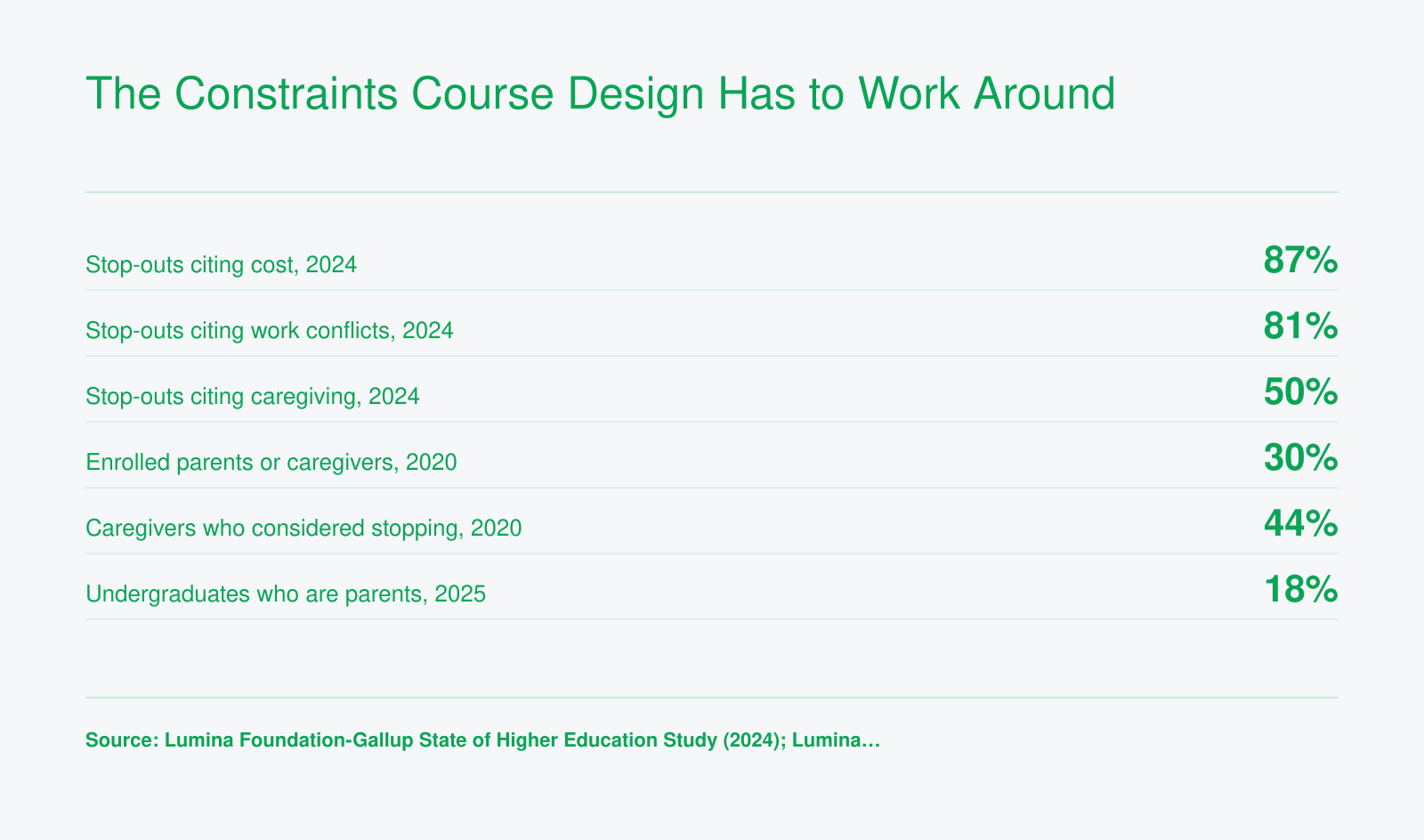
These are the demands a navigable course has to fit around. In a 2024 Lumina Foundation-Gallup study, most students who stopped out before earning a credential rated cost and work conflicts as very or moderately important reasons, and half pointed to childcare or adult care. The caregiving figures come from a 2020 Lumina Foundation-Gallup study and from IWPR in 2025. Because the surveys cover different groups, the figures are not directly comparable.
- Institutional Supports for Students with Stranded CreditsIthaka S+R
- Supporting Student Parents: IWPR Federal Policy Agenda 2025Institute for Women's Policy Research (IWPR)
- Students Continue to Weigh College Costs and Career GoalsGallup
- Lumina Foundation-Gallup State of Higher Education StudyGallup
- College Student Caregivers Likely to Stop ClassesGallup
- Why Students Stop Out and What Brings Them BackInside Higher Ed
Practical Elements: Cohorts, Discussion Design, and Instructor Presence
A belonging-centered course turns the five design moves into three things a student can see on the screen: who they are learning alongside, what they are asked to talk about, and how often the instructor shows up. None of these requires a live meeting, which matters for adults working around shifts and caregiving.
Cohorts: Light-Touch Grouping
A light-touch cohort means shared start dates, small pods of four to six students, and one named peer contact per learner. It asks for no scheduled video calls. This supports the move of teaching the hidden rules of academic participation, because a classmate is the easiest person to ask what a term means or where a file lives.
- Before: Students enroll on rolling dates and see a class roster of strangers.
- After: Students start together, receive a pod list in week one, and a welcome note that says, "Your contact is Dana. Message her first with logistics questions."
Discussion Design: Prompts Tied to Real Work
Generic "post and reply" prompts reward filler. Prompts that draw on a learner's job or life experience respect prior knowledge, and a rubric plus clear reply expectations makes participation predictable. This ties to feedback that identifies a next move.
- Before: "Discuss this week's reading on organizational communication. Post once and reply to two classmates."
- After: "Describe a communication breakdown you have seen at work or in a community role and apply one concept from the reading. Reply to two pod members with a question or a contrasting example, 75 words or more each. The rubric scores application, evidence, and reply quality."
Instructor Presence: Predictable and Personal
Three habits do most of the work: a weekly preview and recap message, a stated response-time window, and short audio or video feedback. Together they support making the learning arc visible and communicating with warmth, clarity, and academic seriousness.
- Before: The instructor posts grades with a one-line comment and replies "when possible."
- After: Monday's preview lists three tasks and the week's purpose. Friday's recap names one strong pattern and one common error. The syllabus promises replies within 24 hours on weekdays, and each major assignment returns with a two-minute audio note that ends with a concrete next step.
Where to Start
A designer with limited time can adopt the pod structure and the weekly messages first, since both are low-cost and change what students see in the first two weeks. Revised discussion prompts and audio feedback can follow as the course is updated. None of these changes lowers the academic bar. They remove guesswork about what the course expects.
How to Build Peer Connection in Asynchronous Programs (and Whether Synchronous Is Better)
Live classes promise connection, while asynchronous classes promise flexibility. For working adults, the evidence does not crown either one.
What the Evidence Says About Format
A 2022 review of 124 adult online learning studies found that both synchronous and asynchronous formats can raise final scores.1 Synchronous courses tended to emphasize interaction, while asynchronous ones supported deeper cognitive engagement. One 2023 comparison from a systematic review of synchronous, asynchronous, and blended higher education models found higher cognitive presence in asynchronous courses (mean 4.47 versus 4.26, p = 0.041), yet another study found higher social and cognitive presence in synchronous ones. A 2026 review found no significant knowledge-acquisition difference between the two.2
Blended and HyFlex options look promising, but the evidence is thinner than it sounds. A 2026 HyFlex review found well-implemented models can match face-to-face engagement.2 The blended-learning gains in a 50-study review were not specific to working adults. No controlled comparison shows which format retains employed adults best. Design quality seems to matter more than mode.
Five Asynchronous Tactics That Work
Asynchronous peer interaction works best when it is instructor-guided, purpose-driven, and time-bounded.1
- Pods with rotating roles: Small groups assign a facilitator, summarizer, and questioner each week, so no one drifts into lurking.
- Peer feedback with a short protocol: Two or three prompts, such as one strength and one next step, keep responses useful rather than superficial. Peer review can help especially when writing ability is low.1
- Voice or video introductions: A 60-second clip carries tone and personality that a text post cannot.
- Optional live office hours, recorded: Learners who cannot attend still get the answers and can see classmates' questions.
- Shared project check-ins: Brief written updates on a set schedule create accountability without requiring anyone to be online at the same moment.
Posting and response deadlines matter too. Without them, discussion activities in asynchronous online learning for adults tend to thin out.3
The Working-Adult Constraint
A live session scheduled against a shift or a childcare window can shut out the very learners it was meant to include. Required attendance turns a connection tool into a barrier, and a missed session can leave a student feeling behind before the week has begun.
A Rule of Thumb
Keep core learning asynchronous, offer synchronous sessions as optional with recordings, and make connection structured rather than left to chance. Instead of hoping students befriend each other, look for courses that assign roles, set response windows, and give people a reason to reply.
- Systematic Review of Adult Online Learning (124 Studies)PubMed Central (NIH)
- Synchronous vs Asynchronous LearningRuzuku
- Blended Online Course ModelsOhio State University (ASCODE)
Early Warning Signs and Recoverability for Stop-Out Risk
What are the first signs that an online student is about to drop out? Research on learning-management-system data points to a handful of early signals, and no single one is reliable alone.
The Early Signals
Studies of online undergraduate courses keep returning to the same patterns:
- A late or missed first assignment: Non-submission of an early, low-stakes task has flagged disengaged students before withdrawal deadlines in Australian work.1
- A drop in LMS logins: Declining logins, long stretches of inactivity, and fewer resource views are treated as warning signs, though no universal threshold exists.
- No first-week participation: Less interaction at the start of a course is linked to higher dropout risk.2
- Activity inside early withdrawal windows: Students who go quiet before a census or withdrawal date are often deciding whether to stay.1
The evidence is mostly observational. A large analysis of the Open University Learning Analytics Dataset found that online behavior dominated prediction, and a review of LMS behavioral features for early dropout detection recommends combining signals rather than trusting one.
Why the First Four Weeks Matter
One 2026 deployment study used only the first four weeks of activity to predict outcomes. Early patterns are also the cheapest to act on, before a missed week becomes a missed month.
Low-effort outreach can be simple: a short, warm, specific message that names what was missed and offers one next step. In an Australian effort, staff contacted disengaged students, and some re-engaged while others withdrew on time rather than take a failing grade.1 A 2025 pilot that contacted students flagged by early thresholds saw a modest decline in dropout, but it was not randomized, so outreach is not proven to cause the improvement.
What Recoverable Design Looks Like
Outreach only helps if the course offers a way back. Recoverable design usually includes:
- A late-work policy with clear, stated conditions
- A re-entry plan after a missed week, so students know what to do first
- Modular catch-up points where the course lets students rejoin the sequence
None of this lowers standards. The outcomes, assessments, and grading criteria stay the same. Only the path back differs.
Returning Students
This matters most for adults who have stopped out before. A course that is easy to re-enter is how many of them return, and how they finish.
- Outreach and Early Assessment Non-Submission Study (Australia)APUB Open Publishing
- Early-Warning Systems and Preventive Interventions in Distance EducationCharles Sturt University Research Output
What Retention Benchmarks Do and Don't Tell You
A retention benchmark is a published percentage showing how many students stay enrolled or finish something, and it only means something once you know what "something" is. Three different measures get blurred together in marketing copy, and they are not interchangeable.
Three Measures That Are Not the Same Thing
- Course completion: whether a student finishes a single class, usually reported by a college or a course platform.
- Term-to-term retention: whether a student comes back the next term or year. The National Student Clearinghouse separates persistence (enrolled anywhere) from retention (enrolled at the starting institution).
- Program graduation: whether a student finishes the degree, often measured over several years.
A program can post a strong course completion rate and still lose many students between terms.
What the National Numbers Show
The National Student Clearinghouse's Persistence and Retention 2025 Method Notes follow first-time students who started in fall 2023. Nationally, 86.4% were enrolled somewhere by the first spring, and 83.7% were still at their starting institution. By the second fall, persistence was 77.6% and retention was 69.5%. An Edu Ledger report on college freshmen returning for their second semester cites a different second-fall retention figure of 78.1%, and the reports do not make clear whether the gap comes from the cohort, the measure, or the student group counted. Check the definition before quoting any number.
The gap by enrollment intensity matters more for adults. Part-time first-time students had a first-spring persistence of 67.4%, against 92.1% for full-time students. By the second fall it was 53.2% against 84.4%. Clearinghouse commentary also notes that older first-time students are less likely to continue. Headline averages are pulled up by younger full-time students.
Where Reliable Benchmarks Run Out
This series covers early enrollment outcomes for first-time students. It does not report separate figures for online-only, hybrid, or distance-education students, and it does not measure completion of individual courses. We did not find a current federal table giving online completion or retention rates with clear definitions, and no widely cited Online Learning Consortium figure supports a general online course completion rate. One secondary report describes an intervention that improved completion in two courses by 15% and 32%1, but those are changes, not starting rates, and the students are not described. Published online course numbers also tend to count only those who stayed long enough to be measured, which can flatter the result.
So there is no dependable benchmark specific to adult learners in online courses. Treat any program that offers one with caution.
How to Use a Benchmark
Use these figures as a rough yardstick for asking questions, not as a forecast of your own outcome. Ask a program how it defines completion, which students are in the count, whether part-time and returning adults are reported separately, and what share come back the following term. A program that can answer plainly is telling you something useful, whatever the number turns out to be.
- Student Clearinghouse Research Reports ListingsNational Student Clearinghouse
Clarity is not the same as lowering the bar: a course can be demanding and still tell you exactly what to do next.
Belonging-centered course design framework
Questions to Ask About Course Design Before You Enroll
Before you commit to an online program, ask an advisor or instructor how the courses are actually built. Their answers will tell you more about your odds of finishing than any brochure. Use these questions, and listen for specific, concrete responses.
- Is there a week-by-week map of the course?A good answer: yes, you'll see the full learning arc, including major assignments, due dates, and how each week builds toward the final project, before the term starts.
- What does participation actually look like?Listen for clear expectations, such as how many discussion posts are required, what a strong post includes, and whether there are examples. That shows the unwritten rules are being taught, not assumed.
- How fast is feedback returned, and what does it include?Strong programs name a turnaround window and describe feedback that tells you what to do next, not just a grade.
- What is the late-work policy?Look for defined grace periods, extension requests, or resubmission options. That kind of recoverability matters when work or caregiving runs over.
- What happens if I have to pause mid-term?A good answer covers incomplete grades, withdrawal timing, and how you would re-enter without starting over or losing credit you've earned.
- How are returning students supported?Ask whether there is an advisor, orientation, or re-entry check-in for students coming back after a break.
- How do students connect with each other?Listen for structured options such as cohorts, small discussion groups, or peer review, rather than a single open forum.
- What is the mix of live and self-paced work?You should get exact numbers, such as required live sessions per week and their time zone, so you can plan around your job.
- Red flag: vague or hands-off answersIf you hear "it depends on the instructor" or "it's self-paced, you're on your own," treat it as a warning. Flexibility without structure often leads to stalled progress.