What Stopping Short Costs You, and What Finishing Pays Back
Real earnings, benefits and mobility gaps, plus how to judge your own payoff

Key Points
- Bachelor's degree holders earn 86% more than high school graduates (APLU).
- Lightcast: degree finishers are 22% more likely to move upward.
- Transfer students lost an average of 43% of credits (GAO, 2017).
Introduction: The Real Price of Stopping Short of the Finish Line
Millions of American adults hold college credits and no credential, and the calculation they face isn't whether degrees are valuable in the abstract. It's whether finishing changes anything measurable for them specifically.
The figures that matter are narrower than the usual pitch. The Association of Public and Land-grant Universities puts the bachelor's earnings advantage over a high school diploma at 86%, with poverty 3.5 times less common among degree holders. Lightcast found employees who finish are 22% more likely to move up at work.
The harder questions come after that: whether old credits still count, what the remaining tuition really is, and when a certificate does the same job faster.
What 'Some College, No Degree' Means and How Big This Group Is
What does some college, no degree actually include, and how many adults are in this group?
The category covers anyone who enrolled in college and earned credits but left without completing an associate or bachelor's degree. It spans a student who stopped after one semester and a near-finisher who completed every requirement except one final course. Some left within the last year; others left decades ago. Because the label groups those histories together, national figures are broad.
The National Count
The 2025 National Student Clearinghouse Research Center report puts the total at nearly 43.1 million Americans.1 Of those, 37.6 million are working-age adults under 65, which translates to nearly one in five working-age adults under 65.1 That working-age population grew 2.2 percent from the start of the prior academic year.1
Who Returns and What Happens
In 2023-24, more than 1 million people in this group re-enrolled, but that was less than 3 percent of the tens of millions of working-age adults with some college but no credential.2 Among the 2023-24 re-enrollees, 4.7 percent earned a credential within the first year2, while 14.1 percent of the 2022-23 cohort did so within two years2. The odds look better for people the Clearinghouse calls potential completers, those with at least two years of full-time equivalent enrollment before stopping out. That group is small, about 2.7 million people, or 7.2 percent of the some college, no credential population.3 Their two-year completion rate was 22 percent2, compared with 12.2 percent for re-enrollees with less prior coursework2. These are correlations from re-enrollee data, not a promise for every adult.
One State Shows the Scale
New Jersey official higher education sources count more than 840,000 adults with some college credit and no credential. The American Institutes for Research has cautioned that this label hides big differences among people because it includes students who took only a few classes and those who nearly finished. A coordinated New Jersey effort helped more than 13,500 residents re-enroll.
- Some College, No Credential Student Outcomes Report 2025National Student Clearinghouse Research Center
- Re-Enrollment Trends of Some College, No Credential Adults in AmericaTexas A&M University
- The Nuanced Nature of Some College, No Credential Adults in AmericaTexas A&M University
Earnings and Unemployment by Education Level: Where Some College Falls
The U.S. Bureau of Labor Statistics tracks earnings and unemployment for workers 25 and older by highest education level. The usual weekly earnings by educational attainment below are from the second quarter of 2026, and the unemployment rates for people 25 years and older by educational attainment are for September 2026. The annualized column is simply the weekly figure multiplied by 52.
Education level
Median weekly earnings
Annualized
Unemployment rate
Less than high school diploma
$803
$41,756
4.3%
High school diploma, no college
$994
$51,688
4.4%
Some college or associate degree
$1,125
$58,500
3.6%
Bachelor's degree and higher
$1,768
$91,936
2.5%
Reading the Gaps
The published figures group "some college, no degree" together with associate degree holders in a single row, so the two cannot be separated here. That matters, because associate degree holders are included in the $58,500 figure. The pure no-degree group likely sits somewhat lower, which means the real cost of stopping short may be larger than the table suggests.
The gap that can be measured is clear enough. Workers in the combined some-college row earn about $6,800 more per year than high school graduates. Workers with a bachelor's degree or higher earn roughly $33,400 more per year than that combined group ($91,936 versus $58,500). Unemployment follows the same ladder, falling from 3.6% to 2.5% between the two groups.
What These Numbers Do and Don't Say
Medians describe groups, not any single person's outcome. Half of the workers in each category earn more than the figure shown and half earn less. Your own result will depend on your field, your region, your years of experience, and the role you move into after finishing. The bachelor's row also includes people with graduate degrees, which pulls the figure up. Treat the table as a map of the typical pattern, then use the later sections on ROI and credit transfer to work out what finishing would mean for you.
Beyond the Paycheck: Poverty, Health Insurance, Hiring Filters and Promotions
The case for finishing a degree now rests on more than salary, and the evidence reaches into job security, benefits and who gets considered for the next role.
Poverty and Health Coverage
The Association of Public and Land-grant Universities (APLU) reports that poverty incidence among bachelor's degree holders is 3.5 times lower than among high school graduates.1 It also finds that bachelor's holders are 47% more likely to have health insurance through their job, and that employers contribute 74% more toward their coverage.1 The comparison group in all three figures is high school graduates, not people with some college, so the gap for someone who already has credits may be narrower.
The Hiring Filter
Many job postings and internal promotion tracks list a bachelor's degree as a requirement. Screening often turns on whether the credential appears on a résumé, not on how many credits sit behind it. That is why years of coursework can leave you stuck at the same level while a colleague with the diploma gets the interview.
Upward Mobility and Motivation
Lightcast's 2022 report, Moving Up and Moving Forward, analyzed more than 125 million social-profile records, including about 270,000 adult learners without a prior bachelor's degree. Of those who returned to education, 56% achieved upward mobility, compared with 46% of comparable working adults who did not. That is the 22% difference: a higher likelihood of reaching the outcome. Lightcast defined mobility as a post-education salary above the person's baseline and above $35,000 a year.1 It is not a 22% raise for every graduate. Returners also saw average annual salary increases above $15,000.
Note that the study follows adults who went back to school, which is a slightly broader group than strict degree completers.
Motivation matches the data. EAB's 2026 study, Adult Learners: Who They Are and What They Want from College, found that 39% of those surveyed sought further education for career advancement. Earlier write-ups cite a figure of 38%, so treat it as roughly four in ten.
Takeaways
- Lower poverty risk: Bachelor's holders face poverty at a fraction of the rate of high school graduates, according to APLU.
- Better coverage: They are more likely to have employer-provided health insurance, and employers contribute more toward it.
- Credential screening: A posting that requires a bachelor's will often pass over a résumé that shows only credits.
- Mobility odds: Returning adults in the Lightcast data were more likely to move up, by the study's salary-based definition.
These are associations, not guarantees. People who finish degrees differ from those who don't in ways no dataset fully captures, and results vary by field, employer and region.
- Four Career Benefits to Completing Your DegreeElmhurst University
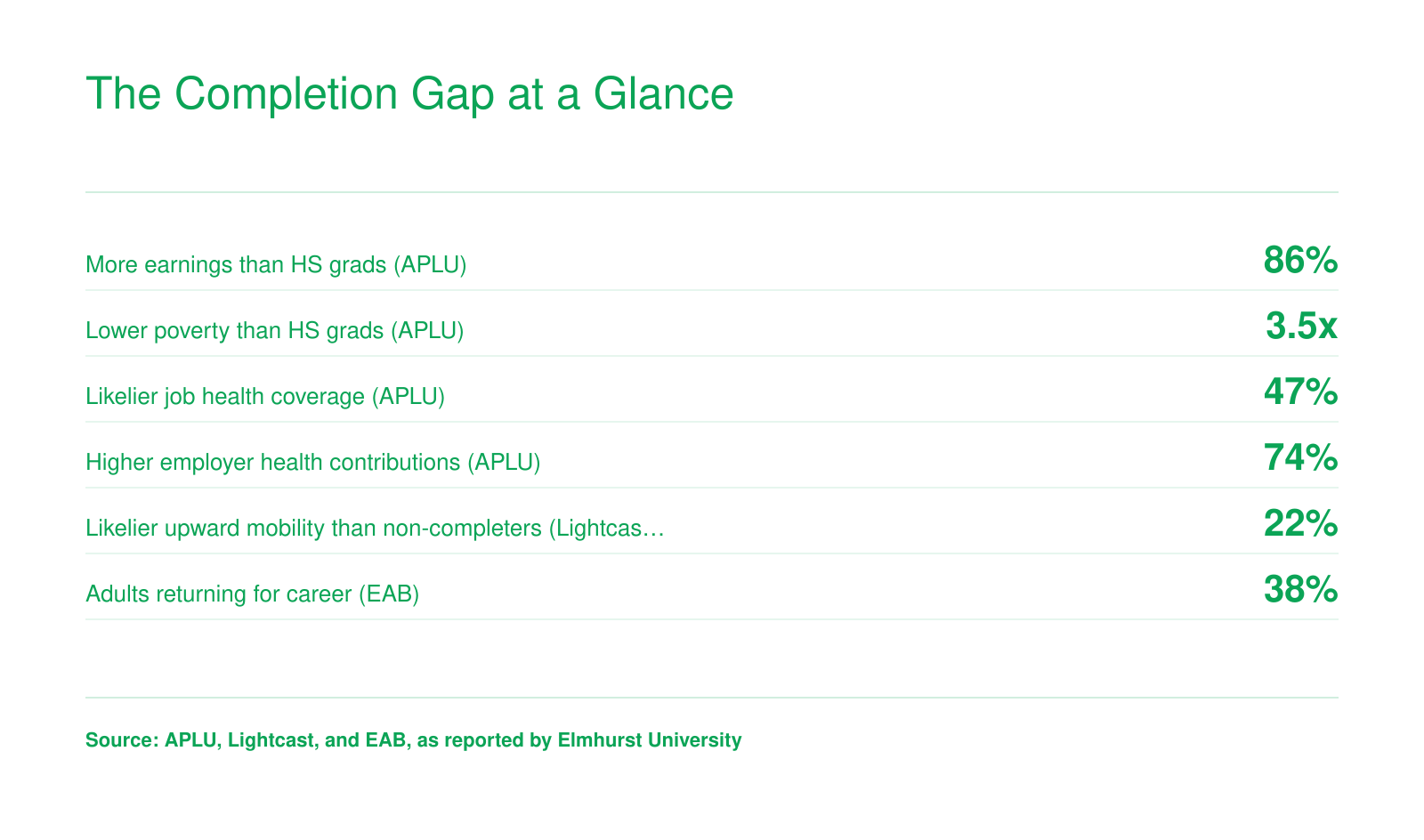
The Completion Gap at a Glance
These six figures show what finishing a bachelor's degree is associated with, but they use different comparison groups. The APLU figures compare bachelor's degree holders with people whose highest credential is a high school diploma. The Lightcast figure compares employees who finished their degree with those who did not, and the EAB figure describes why adult students return to college.
Is Finishing Worth It? A Simple ROI and Payback Framework
Published online completion pricing runs roughly $150 to $350 per credit at public in-state schools and $300 to $500 at private nonprofits, and a full bachelor's degree is 120 credits. That puts a from-scratch degree at about $18,000 to $42,000 public and $36,000 to $66,000 private, before other costs. Most returners won't pay for all 120, which is why the math should start with your own transcript.
The Basic Formula
Add three costs: remaining tuition and fees, income you lose if you cut hours, and any new debt you take on (interest included). Divide that total by the annual wage gain you expect from finishing. The result is your payback period in years after graduation.
Tuition is only part of the bill. Books, technology fees, transfer evaluation and prior-learning assessment all add up. No national figure captures the all-in total, so build your own.
A Worked Example
The numbers below are illustrative assumptions, not averages. Nobody has established a typical number of credits remaining for adults, so use your own.
- Credits left: 60, with the other 60 already transferred.
- Tuition: 60 credits at $250 (mid-range public) is $15,000.
- Extras: about $1,500 in fees and books.
- Lost income: $0, since you keep working and study part-time.
- Annual gain: $10,000. Replace this with the earnings gap from the table above for your own education level.
Total cost is $16,500, so payback is about 1.65 years after you finish. At 12 credits per term and two terms a year, completion takes about 2.5 years. Break-even lands roughly four years after you re-enroll, sooner if a raise or promotion arrives before graduation.
What Moves the Answer
- Employer tuition assistance: Even a partial benefit can cut payback by months.
- Transfer and prior-learning credit: Every 3-credit course you don't repeat saves roughly $750 to $1,000 at mid-range rates.
- Pace: Part-time study keeps your paycheck whole but pushes the wage gain later.
- Promotion rules: If your employer requires a degree for the next level, the gain may arrive right after graduation.
- Sector: Private nonprofit pricing is higher, though Georgetown research found private graduates earn about $8,000 more per year at ten years. Their loans also run more than twice as large, so the extra earnings don't always cover the extra cost.
When the Math Doesn't Work
Borrowing deserves a hard look. Lumina found that 71% of adults with student loans delayed a major life event because of that debt. The numbers also tilt against you if your credits mostly won't transfer, your field pays little extra for a degree, or you'd borrow heavily at private rates for a modest raise. Georgetown's ROI figures, such as a $174,000 ten-year median for public bachelor's colleges, describe institutions and include students who never finish. They don't promise your payback. Run the formula with conservative numbers, and proceed only if it still holds.
Will Your Credits Count? Transfer, Expiration and Prior Learning
Transfer Credits: The Receiving School Decides
When you return to college, no universal rule says your old credits will follow you. The school you attend decides whether each course transfers, whether it counts toward your major or only as an elective, or whether it does not count at all. A GAO report on transferring college credits of students who transferred between 2004 and 2009 found that 43% of credits, on average, did not transfer or did not count toward the receiving program. Among students moving between public institutions, that figure was 37%. This does not mean the credits disappear from your transcript, but it can mean repeating courses and adding time or cost.
Expiration Rules and Prior Learning
Credit age matters in some fields. Technology and health-related programs often set a five to ten year limit on transfer credit because the content changes quickly. General education credits, such as composition or math, usually stay usable longer, but there is no single national standard. Ask whether your specific courses carry an age cap.
Prior learning assessment, or PLA, can turn work experience, exams, military training, or professional credentials into college credit. In one large CAEL-WICHE PLA Boost study of adult students, only 11% earned PLA credit, yet earning PLA credit was associated with a 17% higher likelihood of completion. Adults who earned 12 or more PLA credits saved an average of 9 to 14 months toward a degree.1 Caps vary widely: a school may limit PLA to a specific number or percentage of the degree and may restrict it to electives.
Time to Completion and the Credit Audit
Use your credit count to set expectations. A student with about 30 credits left may finish in about a year of steady part-time study. Around 60 credits left often maps to two to three years while working, and 90 or more can take three to five years, depending on course load and session length. These are planning ranges, not guarantees.
An official credit audit should show, in writing, how each prior course will count, which courses expire, and how many PLA credits the school will accept before enrollment. Policies differ by institution, so compare written evaluations rather than relying on a verbal estimate.
Certificate vs. Bachelor's: When a Credential Is Enough
About 37% of U.S. adults with at least a high school diploma hold a nondegree credential like a professional certification, license, or certificate, according to the Census Bureau. For many working adults, the practical question isn't "degree or nothing" but which credential actually moves the needle in their field.
How the Three Options Compare
- Certificate or certification: Fastest to finish, often months to a year, and the payoff swings hard by field. Georgetown's certificate and associate's degree analysis found engineering technologies certificates landing in the $75,000-$150,000 range in one analysis, while cosmetology and education certificates sat near $10,000-$20,000. Certificates fit well when you need a specific, licensable skill fast.
- Associate degree: Typically two years. Roughly 43% of associate degrees held by adults are occupational, often in healthcare and technical fields, and these can pay strongly. Georgetown's overlooked value of certificates and associate's degrees report shows chemical technology associate holders in Texas posted a median around $75,500, above the state's overall bachelor's median near $50,600.
- Bachelor's degree: The longest path, but the one most often required for management roles and graduate school, and the broadest in where it can take you.
The Honest Trade-Off
Field matters more than level in some cases. Georgetown found the median male certificate holder out-earns 40% of men with associate degrees and 24% of men with bachelor's degrees; for women the figures were 34% and 24%.1 A licensed trade or technical certificate can out-earn a general-interest bachelor's. But those are exceptions, not the rule: on average, degree holders still earn more, and certificates pay off most when you work in the field you trained for, where holders earn about 37% more than those working outside it.1
Why Finishing Still Helps
Credentials stack, but they don't substitute for a degree everywhere. Census data shows adding a certification or license to some college or an associate degree is linked to 10.9% to 16.2% higher earnings. Yet many licensure boards, management tracks, and graduate programs require a completed bachelor's as the entry ticket. Loose credits alone don't clear those pathways; a finished degree does.
- Certificates: Gateway to Gainful Employment and College Degrees (Executive Summary)Georgetown University Center on Education and the Workforce
Where Adult Learners Go: From Sales and Healthcare to Management, IT, Finance and Operations
For many adults, finishing a degree is not a detour away from work; it is a bridge from one part of the labor market to another. Lightcast, a labor market analytics firm, has found that adult learners most often enter degree programs from sales and healthcare roles and, after completing, commonly move into business management, IT, finance and operations. That pattern matters because it shows the credential is not just a resume line but a repositioning tool.
The Industry Switch Behind the Diploma
Lightcast's analysis of adults who finish their degrees points to a consistent flow. Sales and healthcare jobs tend to have strong practical skills but often stop at a ceiling without a bachelor's. Completing a degree, especially one with management and analytical coursework, can shift a worker toward roles where those same people skills meet higher-level decision making, budgeting and process oversight. Employees who finish are also 22% more likely to achieve upward mobility than those who stop short, according to Lightcast.
How a Management Completion Track Fits
A business administration completion track, such as Elmhurst University's Management Program within its Degree Completion Programs, lines up with those destination roles. The curriculum typically covers management principles, finance basics, operations and analytics. Those are the foundational skills that show up in business management, IT coordination, finance support and operations roles. The program itself does not promise a specific job, but it gives working adults a structured way to build the vocabulary and tools those roles expect. Elmhurst University's degree completion blog details how the degree can connect to career advancement.
The Cohort Effect Beyond the Syllabus
For adult students, classmates can be as valuable as coursework. Many peers are in similar jobs, often coming from sales or healthcare, and they share schedules built around full-time work. That means group projects and discussions pull from real-world experience, and contacts often span different industries. A student in medical sales, for example, may learn directly from a classmate in hospital operations or a peer moving into IT management. Those connections can become referrals, mentors and hiring leads long after the final course.
Finishing is mostly about the credits you already earned, not starting over. Existing credits shorten the path, reduce the tuition still ahead of you, and pull the payback period closer.
degreecompletion.com
How to Decide: A Checklist for Working Adults Considering a Return
Some adults jump straight to applying and sort out the details later. A better route is to gather facts first, then commit. Four steps do most of the work.
The Pre-Enrollment Checklist
- Transcripts and credit audit: Request transcripts from every school you attended, then ask each target program for an unofficial audit of what transfers.
- Compare two or three programs: Line them up on transfer policy, total cost, and how many credits you would still need.
- Employer tuition help: Ask HR whether a tuition assistance program exists. Under IRS Section 127, employers can provide up to $5,250 a year tax-free for 2025 and 2026, per the IRS educational assistance program FAQs. That is not a lifetime cap and does not use up Pell eligibility.
- Format: Choose online, hybrid, or evening classes based on your shift pattern and commute, not on what sounds most convenient in theory.
Financial Aid for Returners
File the FAFSA every year, since prior filings do not carry forward.1 Having attended before does not disqualify you,2 but your school will review your record under its own satisfactory academic progress policy,1 which covers grades and completion pace. If you struggled earlier, ask about the appeal or probation process before you enroll, because rules differ by institution.
Pell Grants are limited to 12 full-time terms (600% of lifetime eligibility, roughly six years), counting every school you ever received Pell at.1 Part-time enrollment uses a proportionate share. Pell also ends once you earn a bachelor's degree, per the Federal Pell Grants page. Beginning Fall 2026, some schools, including the University of South Florida, treat students as ineligible if nonfederal grants or scholarships already cover the full cost of attendance.3
A Realistic Look at Time and Energy
Plan on a part-time pace, typically one or two courses per term. A common rule of thumb is two to three hours of work outside class for each credit hour, so a six-credit load can mean roughly 15 to 20 hours a week of class and study on top of your job. Expect some terms to run heavier than others, and build in a lighter term if work or family spikes.
The Personal Side
Many adult completers report more confidence at work and real pride in finishing something they started. Those effects matter, and they often show up in how people speak in meetings or apply for roles. Still, treat them as a bonus. The financial case, built from your own credit audit, aid, and employer support, should carry the decision.
- Staying Eligible for Federal Student AidFederal Student Aid (U.S. Department of Education)
- Federal Grants - Financial AidYork College, CUNY
- Federal Pell Grant GuidanceUniversity of South Florida