How to Vet a College Info Session Before You Return to School
A checklist for adult learners to separate real support from sales pitches

Key Points
- A GAO study found transfer students lost 43% of earned credits.
- Per CAEL, adults earning PLA credit finished at rates 22 points higher.
- Get credit evaluations and timelines in a written degree plan before depositing.
Before You Decide: A 6-Minute Vetting Plan for Adult Learner Information Sessions
Is a weeknight information session actually worth three hours away from your family and a deposit pitch at the end? For an adult juggling a shift schedule, childcare, and prior college credits that may or may not count, that is the real question.
Here is the honest answer: these events are useful only if you work them. Come with transcripts, employer training records, and certifications in hand, and ask pointed questions about accreditation, transfer policy, and credit for prior learning. The goal is to leave with a written degree plan carrying real numbers, not a brochure.
Treat the session like a vendor meeting. You are evaluating whether this campus can get you to graduation, and the staff are selling you a product.
Is a College Information Session Worth Attending as an Adult Learner?
A free evening session costs you time, and time is the scarcest thing an adult student has. Still, the answer is usually yes, provided you treat the event as a way to reach transfer, prior-learning, and advising staff rather than as a presentation to sit through.
General Sessions vs. Adult-Specific Sessions
A general admissions session is built mostly for traditional-age applicants. Expect campus life, residence halls, and first-year programs. Transfer credit and work-based learning may get a single slide, if they come up at all.
A session aimed at adults, such as one for students 25 and older, is more likely to address how prior coursework is evaluated, whether credit for prior learning exists, and how evening or online scheduling works. Check the event description before you register. If it doesn't mention transfer students or adult learners, ask the admissions office whether a separate session or a one-on-one appointment is available.
When a Session Is Useful and When It's Just Promotion
A session earns your time when it gives you direct access to people who can answer questions about your situation. Look for these:
- Transcript review: Staff who will look at your prior transcripts, even informally, and say how they might transfer.
- Degree planners: Sample degree maps or a planner who can sketch a path using your credits.
- Financial aid staff: Someone present who can discuss aid for part-time and returning students.
- Current adult students: Real students or recent graduates who will describe juggling work, family, and classes.
A session is mostly promotional when it consists of a slide deck, a general overview of programs, and a request to fill out an interest form. If nobody there can discuss your credits or your timeline, you have learned something about how the college treats adult students. You could also have gotten that same information from the website.
Before You Go: Verify Accreditation and Pull the Outcome Data
The Council for Higher Education Accreditation's CHEA database covers more than 8,200 institutions and more than 44,000 programs, so a few minutes of searching before the session will almost always turn up the school you are considering. Do it the night before, and write down what you find.
Check Institutional Accreditation
Start with the U.S. Department of Education's Database of Postsecondary Institutions and Programs (DAPIP). Search by legal name, city, or state, then note the accreditor's full name, the status (accredited, candidacy, probation, show-cause, or withdrawn), and the effective and review dates. Confirm that the campus, delivery format, and program you want are covered. One campus being listed does not prove every campus or online option is.
Next, cross-check CHEA's directory. CHEA says colleges are accredited by one of 19 recognized institutional accreditors.1 Recognition by CHEA and by the Department of Education are separate, and an accreditor may hold one or both. If the two databases disagree, record each status and date, then ask the accreditor directly. Also note the "as of" date on each record, since listings change.
Look for Programmatic Accreditation
Institutional accreditation covers the whole school. Programmatic accreditation applies to one profession or program, and CHEA lists about 63 programmatic accreditors.1 It matters most in fields tied to licensure or hiring, such as nursing, business, counseling, and information technology. A school can be accredited while a particular program is not, so search the program by name.
Pull the Outcome Data From College Scorecard
Open the College Scorecard and record these figures for the school:
- Graduation rate: The share of students who finish. Check whether it reflects students like you, since many rates track first-time, full-time students.
- Retention rate: How many students return after the first year.
- Median earnings: What former students earn after leaving, which varies by field.
- Median debt: Typical borrowing among students who took out loans.
- Net price: The average cost after grants and scholarships, which is more useful than sticker tuition.
When the Pitch Conflicts With the Record
If a presenter's claims about accreditation, completion, or earnings do not match these sources, the burden is on the school to explain where its numbers came from. Ask politely, ask for the source in writing, and treat a vague answer as information.
- CHEA Accreditation Resources for FacultyCouncil for Higher Education Accreditation (CHEA)
What to Bring: Transcripts, Training Records, and Certifications
Walking into an adult learner information session with the right paperwork turns a general sales pitch into a working advising appointment.
A Practical Document Checklist
- Unofficial transcripts: Bring copies from every regionally accredited college or university you previously attended, even if you believe the credits are too old or unrelated to your current goal.
- Employer training records: Include completion certificates, internal training transcripts, or documentation of union, corporate, or apprenticeship programs.
- Military Joint Services Transcript: If you served in the armed forces, this record can support credit for military experience and occupational specialties.
- Professional certifications and licenses: Bring current and expired credentials, along with any renewal, exam, or continuing education documentation.
Why Partial or Unofficial Records Still Help
You do not need perfectly ordered official transcripts to have a productive conversation. An unofficial transcript or even a partial record lets an advisor identify likely transfer credits and discuss credit for prior learning before you pay for official copies. If something looks transferable, the college can tell you exactly which official documents to request later.
How to Bring Them
If you do not already have these records, request unofficial copies from prior schools, employers, or credentialing bodies before the event. Bring both print copies and saved digital PDFs on your phone or laptop, since advising staff may prefer one format for on-the-spot review while keeping the other for your file.
Questions That Reveal the Real Transfer-Credit Policy
Transfer is now the main route back to college for adults, so the credit policy matters more than the campus tour. National Student Clearinghouse Research Center data show that 56% of students returning in fall 2024 reenrolled somewhere other than the school they left.1 No national cap on transferable credits exists, so every college writes its own rules.
The Core Question Script
Bring these questions on paper and write down the exact answers:
- Maximum credits: "What is the most transfer credit I can apply to a bachelor's here?" A common ceiling is 90 semester credits toward a 120-credit degree, but some schools cap at 60 to 75, especially for two-year college credits. University of Maryland Global Campus, for example, accepts up to 90 from approved four-year sources and up to 70 from two-year colleges.
- Residency minimum: "How many credits must I complete through your institution, and do they have to be the final ones?" Many schools require about 30 credits, or roughly 25% to 30% of the degree. Wording like "final 30 here" or "at least 30 of the last 60" can reshape your schedule.
- Age of credit: "Do older courses face a time limit?" Some programs apply a five-year window to major courses2, while Colorado State University reviews coursework older than 10 years before deciding whether it counts toward the degree.
- Written policy: "Where is your transfer evaluation policy published, and does it separate credits that transfer from credits that apply to my degree?"
That last distinction is the trap. A course can be accepted as a general elective without satisfying a single major or general-education requirement. Phrases like "transferable but not degree-applicable" or "subject to approval by program chair" deserve a follow-up question every time.
Who Actually Reviews Your Transcript
Ask whether admissions or the academic department makes the final call. Admissions staff may offer a quick estimate, but department faculty often decide whether a course meets major requirements, especially in fields like nursing, IT, or engineering where course currency matters. An estimate from the wrong office can unravel later.
Ask About Real Outcomes and Appeals
Request specifics: "How many credits do adult transfer students in my intended major typically keep?" A representative who works with adults regularly should offer a range, not a shrug. Then ask what happens when a course is denied. Is there an appeal, who hears it, and can you submit a syllabus or catalog description to support your case?
Insist on a Transcript-Specific Evaluation
General policy answers are a starting point, not a commitment. Before you apply, pay a deposit, or sign anything, ask for a written evaluation of your actual transcripts showing which courses transfer and where each one lands in your degree plan. If the college won't provide one until after you enroll, treat that as a preview of how the rest of the process will go.
- Data Dive: Returning Learners Lead Transfer PopulationNational Student Clearinghouse
- Transfer College Credits TipsUniversity of the People
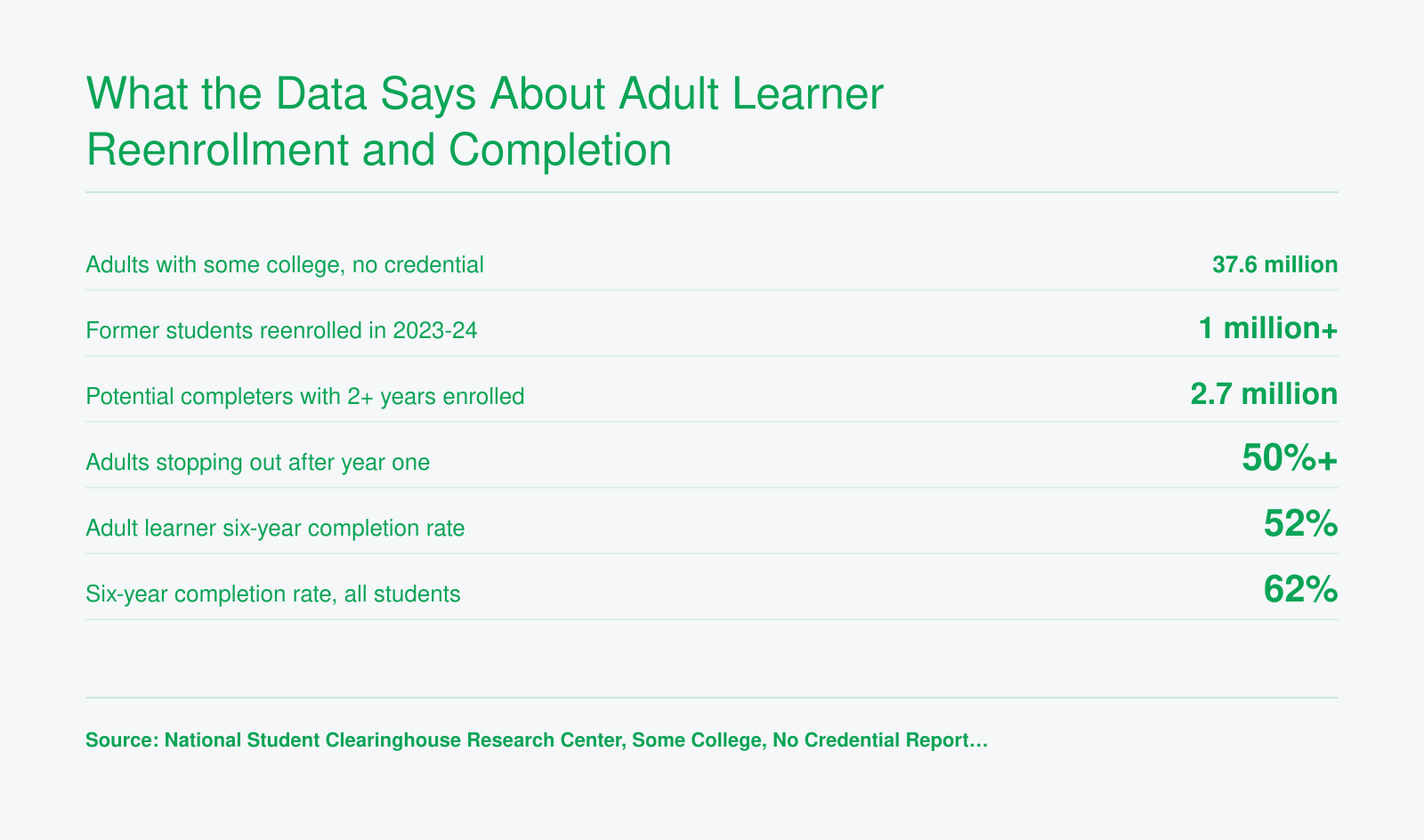
What the Data Says About Adult Learner Reenrollment and Completion
Returning adults do finish degrees, but the numbers argue for planning a multi-year path rather than expecting to graduate within a year or two. Reenrollment figures count anyone who enrolled at least once and do not show how many later completed. Completion is far more likely when transfer credits and prior learning are mapped out before the first class, which is exactly what an information session should help you confirm.
- Some College, No Credential Report 2025National Student Clearinghouse Research Center
- NSC Research Center Postsecondary ReportsNational Student Clearinghouse Research Center
- CAEL Stopping Out ReportCAEL
Asking About Credit for Prior Learning: PLA, Portfolios, CLEP, and Work Experience
A 2020 CAEL and WICHE study of more than 230,000 adult students at 72 institutions found that those with prior learning assessment (PLA) credit had completion rates 22 percentage points higher than comparable students without it.1 That makes PLA one of the most useful topics to raise at an information session.
The Main PLA Methods
Schools generally award credit for what you already know through a few routes:
- Exams: CLEP and DSST tests let you earn credit by scoring above a school-set threshold. For example, Sullivan University's prior learning assessment policy accepts CLEP scores of 50 or higher.
- ACE recommendations: The American Council on Education evaluates military transcripts and some employer training. These are recommendations only. The receiving college decides what it accepts and where it applies.
- Portfolio assessment: You document college-level learning from work, military service, or training and a faculty reviewer compares it to course outcomes. Under that same policy, Sullivan records successful portfolio credit as pass/fail.
Questions to Ask
Availability, fees, and limits vary by school, program, and catalog year, so get specifics:
- Which PLA methods do you accept, and for which courses?
- What is the maximum PLA credit allowed toward my specific degree?
- Does PLA credit count toward the residency requirement, or does it only fill elective slots?
- What does each method cost, and is the fee charged per credit or per assessment?
- Is the credit recorded in a way that affects my GPA?
The residency question matters more than it looks. Many schools require a minimum number of credits earned in their own classrooms. If PLA credit does not count toward that minimum, it may not shorten your path as much as the brochure implies.
Why It Is Worth the Effort
CAEL's research links PLA to better outcomes. Adult students with PLA credit were about 17% more likely to complete after controls, with larger gains at community colleges (25%) and minority-serving institutions (33%).2 The CAEL/WICHE research also found adult completers with PLA saved roughly 9 to 14 months.1 Among students with 49 or more PLA credits in the earlier CAEL study, detailed in Fueling the Race to Postsecondary Success, the average savings reached 10.1 months.
These are group averages, not promises. Ask the advisor to run your own documents against the catalog and tell you, in writing, which credits would count.
You're interviewing the college as much as it's interviewing you, so walk in ready to ask whether this campus is actually built to get an adult learner to graduation.
degreecompletion.com
Session Quality Scorecard: Separating Marketing From Real Adult Support
Keep this scorecard open on your phone or printed in your folder, and mark each row as the presenters cover it. A real adult-support signal is specific: it names people, schedules, and policies. A marketing red flag is a broad promise with nothing behind it. If you tally two or more red flags by the end, the session was mostly promotional, and you should get answers in writing before going further.
| Support Area | Real Adult Support | Marketing Red Flag |
|---|---|---|
| Class formats | Staff name the specific evening, weekend, online, or hybrid sections offered for your program and can show a sample schedule for an upcoming term. | "Flexible scheduling" is promised, but no one can say which required courses actually run outside daytime hours. |
| Dedicated advising | A named advisor or office serves returning and adult students, with appointments available outside standard 9-to-5 hours. | You are routed to a general admissions recruiter whose involvement ends once you enroll. |
| Financial aid for part-time students | Staff explain how aid changes at part-time enrollment, how employer tuition assistance is coordinated, and which scholarships are open to part-time or adult students. | Aid discussion centers on full-time packages, and part-time questions get a vague "just file the FAFSA and see" response. |
| Career services | Support is built for working adults and career changers, including evening or virtual appointments and help translating prior work experience into your new field. | Career services are described only in terms of internships and on-campus recruiting aimed at traditional-age students. |
| Family support or childcare | Presenters give concrete details on campus childcare or referrals to local care, along with attendance and course policies that account for caregiving responsibilities. | The session shows photos of a "supportive community" but offers no specifics on childcare availability, hours, cost, or family-related policies. |
Red Flags: When a Session Signals the Campus Isn't Built for Adults
In one FTC enforcement action, Sollers College advertised a 90 percent placement rate within months of graduation while some programs allegedly placed as few as 52 percent of graduates.1 That gap is a useful lens for an adult learner information session: a polished event can still be a recruiting floor, not a support system. The Federal Trade Commission and U.S. Department of Education point to several warning signs that map directly to the questions asked earlier.1
Red Flags Tied to the Checks You Already Ran
- High-pressure enrollment: Repeated calls, countdown deadlines, guaranteed admission, or pressure to enroll before you review curriculum, accreditation, cancellation terms, and financing are classic recruitment tactics, and they echo the online degree program red flags to check before enrolling. If the session pushes you past the accreditation and total-cost review described above, slow down.1
- Unverified job-placement and salary claims: Treat employer-partnership, placement-rate, and salary promises as unverified unless the school provides underlying data in writing.1 The FTC has alleged schools named AT&T, Yahoo!, Microsoft, Twitter, and American Red Cross as purported partners with no actual relationship.1 Cross-check any claim using the Choosing a College: FTC Consumer Guide and College Navigator and College Scorecard.
- Missing total cost disclosure: A recruiter who quotes only tuition while omitting books, equipment, lab fees, graduation fees, and drop or add fees is not giving you the full cost.1 Ask whether tuition is charged per course, semester, or program, and get every required charge in writing before comparing options.1
- Private loan or income share agreement steering: A school that pushes private loans before explaining federal student aid, or promotes income share agreements without clear total repayment, term, and conditions, is prioritizing its own revenue.1 Federal aid should be the first financing conversation.1
- No access to current adult students or support staff: If the session cannot connect you with an adult learner advisor, a credit-for-prior-learning specialist, a veteran services contact, or a currently enrolled adult student, that is a structural gap, not a scheduling conflict.
- Unsourced outcome data: Vague statements about graduation rates, median earnings, or loan repayment should send you back to College Navigator and College Scorecard. If the school will not provide written data, treat the claims as marketing.1
A Practical Break Point
One or two red flags warrant caution and written follow-up. Three or more, especially if cost or outcome questions get vague answers, mean you are likely on a recruiting floor. Walk away and keep your transcripts, training records, and certifications for a session that can answer them with documents.
- Some Colleges Recruit, But Don't Tell the TruthFederal Trade Commission
After the Session: Request a Written Degree Plan and Follow Up
A polished presentation is not an offer. The thing that actually lets you compare schools is paperwork: a written degree plan with real numbers attached. Verbal reassurances ("most of your credits should transfer") mean nothing until someone commits them to writing with their name on it.
Send a Written Request Within 48 Hours
Email the advisor you spoke with while the conversation is fresh. Keep it specific:
"Thank you for meeting with me on [date]. To help me decide, could you please send: (1) a written degree plan listing the exact courses I still need; (2) a preliminary transfer evaluation based on the transcripts I provided; (3) a term-by-term schedule showing how long completion would take at my planned course load; and (4) a total cost estimate including tuition and fees. I'd also appreciate confirmation in writing of any credit decisions we discussed."
Ask that every credit decision be confirmed in writing, and record the advisor's full name and title. If a school later reverses a transfer decision, that email is your evidence.
Compare Offers Side by Side
Build a simple spreadsheet with one row per school and columns for credits accepted, credits still required, estimated months to finish, total cost, and the date each plan was issued. Seeing it laid out strips away the marketing and shows which program genuinely shortens your path and which one quietly resets you to year one.
Schedule a Follow-up and Set a Deadline
Book a second appointment to walk through the written plan and press on anything vague. Then set yourself a personal decision deadline, something concrete like "I choose by November 15." Open-ended comparison shopping stalls more adult reentries than any single admissions hurdle. A date forces you to weigh the real tradeoff in front of you: a faster, cheaper finish versus the program that fits your schedule and goals.