Halfway Through a Degree You've Outgrown? How to Decide Whether to Switch or Finish
Count the credits that survive, compare cost and timeline, and sequence your pivot

Key Points
- Federal aid caps out at 150% of program length, often 180 credits.
- Gen-ed credits usually survive a pivot; upper-level major courses often don't.
- Multiply remaining credits by cost per credit, then add forgone salary.
Halfway Through a Degree You've Outgrown: Switch, Finish, or Sequence Both?
Finishing a degree you've outgrown and starting over in a new major are two different bets, and the numbers behind them rarely favor an abrupt exit. A typical bachelor's runs 120 credits. By year three, most students hold 80 or more, with good grades and a field they no longer trust.
One third-year animation student on Reddit put the feeling plainly: graduating in 2028 with the same narrow options they had at application. The tension is real, but it is a sequencing problem. What gets finished, what gets pivoted into, and in what order determines the cost.
Federal aid limits and program-specific transfer rules mean a late switch can quietly erase credits and borrowing room.
Finish First or Switch Now: The Sequencing Question Behind Most Major Changes
The sequencing question is simply this: do you finish the degree you are already most of the way through, or stop now and start the one you would rather have? Framing it as sequencing rather than a straight either/or matters, because for most people the real choice is the order in which they do two things, not whether they abandon one forever.
One Illustrative Case
A recent thread on the r/BackToCollege community captures the tension well. A 20-year-old in the third year of a four-year 3D animation program, with good grades, doubts whether the program's generalist approach matches an industry they see as demanding specialized skills. They are weighing finishing versus a possible second degree later. It is one person's story, not universal evidence, but the shape of the problem is common.
Three Different Sequences
Commenters on that thread described paths that all worked out differently:
- One left for a community college trade program, worked in that trade, and finished a bachelor's alongside it.
- One moved from art to business and later pursued a doctorate.
- One earned a general associate degree and expects a later, uncertain finish.
Each is a different order of operations, not a single right answer.
Why Completion Often Launches the Pivot
Finishing frequently works as a launchpad. A completed degree keeps the credits and tuition you have already paid for, preserves options you cannot easily recover once you walk away, and still leaves room to pivot afterward through a second credential, a minor, or graduate study.
The adult-learner difference is that you weigh all of this against a job, a family, and a budget. A 20-year-old choosing between graduating at 22 and starting over to finish at 26 faces a lower-stakes version of the math than a 38-year-old does. The same framework applies, but the cost of an extra two years rises sharply when work and family are already in the picture.
How to Count the Credits That Actually Survive a Major Switch
Credit transfer policies have become narrower and more program-specific, which means a major switch can quietly reset which courses still count. Start with a written audit before you rely on a catalog summary.
Run a Four-Step Credit Audit
- Pull transcripts: Request unofficial transcripts from every institution you attended, including community college, dual enrollment, or military credit.
- Sort credits: Bucket each course as general education, major, or free elective.
- Map the target major: Compare each bucket against the new program's published requirements.
- Check the quiet rules: Look for age limits, minimum grades, and residency requirements that can void a course even if it looks like a match.
The Clock Usually Belongs to the School, Not the Switch
Transfer credits do not expire simply because you change majors. The age window is set by the institution and program. Major-specific, STEM, and nursing courses tend to carry tighter limits, while general-education credit often lasts longer. Chamberlain University, for example, requires pre-licensure nursing coursework completed within the past five years1 and sets a B-minus minimum for nursing transfer credit, but allows a C-minus for non-science general education courses.2 Wentworth Institute of Technology will not accept a course older than seven years.4 Robert Morris University counts undergraduate credit only if earned within 12 years of degree completion.3 By contrast, Liberty University accepts credit for a lifetime unless faculty determine the course content has changed significantly.5
Two Sneaky Rules: Residency and Minimum Grades
Even if a course is recent enough, two rules can quietly erase it. Residency requirements dictate how many credits must be earned at the degree-granting school. Liberty, for example, requires 25 percent of the major and 25 percent of the degree be completed there.5 Wentworth caps transfer credit at 50 percent of the major.4 Minimum-grade rules also vary: Excelsior University Transfer Credit Guidelines accept a C-minus for undergraduate transfer credit, while Post University Transfer of Credits requires a C or better for undergraduate nursing courses and a B or better for graduate nursing credit. Some programs narrow further: Luna Community College Nursing AAS Program's core nursing courses expire after two years, though its science-course expiration is waived.
Before you file a change, request a written degree audit or credit evaluation for the new major. That single document should show exactly which courses count, which age out, and what remains to finish. Get it in writing before the switch, not after.
- Chamberlain University Transfer StudentsChamberlain University
- Chamberlain University Transfer CreditChamberlain University
- Registrar PoliciesRobert Morris University
- Transfer CreditWentworth Institute of Technology
- Academic Information Policies - Resident ProgramLiberty University
Switching vs. Finishing: A Time and Cost Comparison You Can Run Yourself
Start with a simple arithmetic before you choose a major. Multiply remaining credits by cost per credit, then divide by credits per term to estimate calendar time. Add living expenses for any extra terms and one more line: the salary you expect in the first jobs after graduation. Every extra year in school is a year without that salary, or a year of reduced work hours. That opportunity cost is often the largest number in the comparison.
Why Time-to-Degree Estimates Matter
National Student Clearinghouse Research Center data from 2026 shows how much stopouts stretch elapsed time, as reported in NSCRC time-to-degree research. Among bachelor's earners, median elapsed time from first enrollment to degree was 3.7 years with no stopout, 5.1 years with one stopout, 7.3 years with two, 10 years with three, and 16.3 years with more than three. A stopout is any break longer than 123 days. For one and two stopouts, active enrollment time was 4.0 and 4.3 years, meaning the added years are mostly life gaps, not extra coursework. If you are already returning after time away, the calendar cost of switching may be larger than it looks.
An Illustrative Cost Run
For illustration only, assume 60 credits remain at $350 per credit, and you take six credits per term, a typical adult learner credit load, as documented in this adult learner credit load study. Tuition is $21,000, and ten regular semesters, about five academic years, cover the coursework. If a switch strands 15 of those credits, the remaining load rises to 75 credits, adding $5,250 in tuition, before any extra fees, living costs, or lost earnings from the added year. These figures are not predictions; they are placeholders you replace with your own transcript and tuition bill. EAB's analysis of major switches found students who changed majors through term five still finished in a median of eight terms, and displaced courses often became general electives unless elective requirements were already filled. For a completely different field after junior year, some estimates add one to two extra semesters, according to Is It Too Late to Change Major?; adjacent majors may add little or no time.
Finishing vs. Switching
Finishing an existing degree usually wins on pure dollars: you avoid retooling costs and preserve credits already paid for. Switching is the rational exception when the current degree has no pathway to the job you want, because staying could cost more in long-term earnings than the added tuition would. The comparison you can actually run is sequencing: finish first, then pivot through a minor, graduate certificate, or second degree in a tighter time span, rather than treating the switch as abandoning the first three years.
What a Major Change Does to Financial Aid and Loans
Federal rules in the Federal Student Aid Handbook, Volume 3 give undergraduates a maximum timeframe of 150% of their program's published length, and a late major change is one of the fastest ways to use it up. For a typical 120-credit bachelor's, that ceiling works out to 180 attempted credits. Before you file any paperwork, you need to understand the four places a switch can affect your money.
Courses Have to Count Toward Your Current Program
Federal aid is tied to the program you are enrolled in, not to every class you take. After you change majors, courses that don't apply toward the new degree's requirements generally can't be used to establish your enrollment status for aid. Suppose you need 12 aid-eligible credits to be full time and one of your four classes is a leftover from the old major. Your aid package may shrink. Build your first term after the switch around required courses.
Satisfactory Academic Progress and the 150% Limit
Every school measures satisfactory academic progress (SAP) using three things: grades, completion pace, and that maximum timeframe. You don't have to reach 150% to lose eligibility. It ends as soon as finishing within the limit becomes mathematically impossible. A junior-year switch that adds 30 or 40 credits to your remaining path can hit that point sooner than you expect.
How your old-major courses are counted depends on your school's written SAP policy.1 Some schools count every attempted credit, including transfer, withdrawn, and repeated courses. Others may exclude credits that don't apply to the new major, and some limit how many times you can switch. Courses that do apply to your new major generally count no matter when you took them. Read the policy instead of assuming you get a clean slate.
Pell and Loan Ceilings
- Pell Grant: Lifetime eligibility caps at 600%2, often described as six years (12 semesters) of full-time awards. Part-time terms use less, so the calendar can stretch, but every term draws down the balance. Pell generally isn't available once you've earned a bachelor's, so a second bachelor's typically means no Pell.
- Direct Loans: Under 2025-2026 annual and aggregate loan limits, dependent undergraduates can borrow up to $31,000 in total ($23,000 subsidized). Independent undergraduates can borrow up to $57,500 ($23,000 subsidized). Annual limits rise with grade level, topping out at $7,500 (dependent) or $12,500 (independent) from the third year on. A second bachelor's draws from the same aggregate cap, so any earlier borrowing reduces what's left.
Institutional Scholarships Have Their Own Rules
School and departmental awards often come with conditions, such as a specific major, a minimum number of credit hours per term, or a GPA floor. Leaving a major can end a major-specific scholarship partway through the year. Ask the financial aid office to confirm in writing how the change affects each award, your SAP standing, and your remaining Pell and loan eligibility. Get those answers by email, in writing, before you submit the change form.
- FSA Handbook 2025-2026, Vol. 3, Ch. 1: Academic Years, Academic Calendars, Payment Periods, and DisbursementsFederal Student Aid (U.S. Department of Education)
- FSA Handbook 2025-2026, Vol. 1, Ch. 1: School-Determined RequirementsFederal Student Aid (U.S. Department of Education)
Adjacent Majors That Absorb the Most Existing Credits (and How Prior Learning Credit Speeds the Rest)
The cheapest major switch is usually the one where your completed credits can follow you. For adult learners, the clearest pivots tend to be into majors with broad general education and flexible electives: general studies, interdisciplinary or liberal studies, business, communications, and psychology. The catch is that every credit decision depends on the school and the starting major, so treat these as likely candidates, not guarantees.
Which Credits Actually Follow You
A useful rule of thumb: the more of your coursework was general education or broad foundation work, the cheaper the pivot. Writing, math, social science, science, and humanities courses often satisfy requirements across many degrees. Highly specialized upper-level coursework rarely moves cleanly. A junior-level animation course may not help a business degree, while statistics, communications, or project management might.
Prior Learning Can Shorten the New Path
Credit for prior learning can compress a pivot. CLEP is accepted at 2,900 U.S. institutions, mostly for general education.1 Portfolio assessment commonly counts for up to 30 credits, and some adult-focused institutions allow 60 or more.2 CLEP and DSST exam credit often caps around 30, industry certifications typically earn 3 to 15 credits each, and ACE-evaluated employer or military training can add 30 or more in some cases.2 Combined transfer credit plus prior learning frequently falls between 75 and 90 credits toward a 120-credit bachelor's degree, and programs like UMass University Without Walls allow up to 105.2
Research from CAEL and WICHE involving more than 230,000 adult students across 72 institutions found that adults who earned credit for prior learning had a 17 percent higher likelihood of completing a credential, after controls.3 Among adult completers with prior learning credit, time-to-degree was about 9 to 14 months shorter on average, and the average award was 15 credits.3 One nuance: those students also took roughly 17.6 additional institutional credits, so prior learning is not always a one-for-one substitute; it can accelerate progress by filling gaps and building momentum.3
Get the Cap in Writing
Some schools limit prior learning credit by program or count it against residency requirements. Ask the registrar or transfer office for the maximum allowable credits and whether they apply to your intended major. Do not assume every prior learning method stacks, and do not commit to a switch until you see the number in writing.
- Literature Review: Credit for Prior Learning (2025-26)Napa Valley College
- Credit Limits for Prior Learning Assessment (ERIC)ERIC (U.S. Department of Education)
- New Research from CAEL and WICHE on Prior Learning Assessment and Adult Student OutcomesCAEL
Bridges That Let You Pivot Without Starting Over, and When Finishing Then Pivoting at Grad Level Wins
More adult learners now treat a nearly finished bachelor's as a platform for a later pivot rather than a point of no return. The question is usually not "finish or leave?" but "finish now, pivot how soon?"
Electives, Minors, and Stackable Credentials
If you still have open electives, aim them at the target field rather than picking easier or interesting-only courses. A minor in the new direction can signal seriousness while keeping the original major on your transcript. A stackable certificate from a community college or continuing education provider can add job-ready skill without requiring a second bachelor's. Credit for prior learning may shorten some certificate paths if the institution accepts portfolio or exam credit, but verify that before paying.
The Trade-or-Community-College Bridge
One commenter in the source discussion described reaching junior year, discovering the intended career path was closed, switching to a community college trade program, working in that trade while finishing a BA, and later teaching. That is one person's path, not a universal result, but it shows how a shorter technical credential can fund the completion of a first degree while building a fallback skill.
When Finishing Then Pivoting at Grad Level Wins
Finish the current degree and shift at the graduate level when the current major is a standard admission path into the target master's, or when the target field is licensed or credentialed at the graduate level. For licensed fields such as counseling, social work, or accounting, the master's may be the actual entry credential, so a broad bachelor's plus prerequisites can still work.
In the latest BLS unemployment rates and earnings by educational attainment data for 2025, median weekly earnings were $1,062 for some college with no degree, $1,135 for an associate degree, $1,578 for a bachelor's, and $1,876 for a master's; unemployment rates were 3.8%, 3.0%, 2.8%, and 2.6%, respectively. BLS does not publish a certificate-only row, so the some college figure is the closest comparison available and should not be read as a certificate wage. Professional and doctoral degree holders earned $2,294 and $2,307 a week, with unemployment of 1.9% and 1.8%. Georgetown's Center on Education and the Workforce's Major Payoff report shows median annual earnings of $81,000 for bachelor's holders and $103,000 for graduate degree holders, though the summary does not clarify whether graduate includes only graduate degrees. The same center reports a graduate degree premium of 29% over a bachelor's overall, but its ROI 2025 report notes only 10% in humanities and arts versus 54% in social sciences including law. Averages hide large differences by field.
If the Current Degree Has No Connection to the Target Field
When there is little overlap between the current major and the target field, compare the cost of adding a long bridge (several prerequisites plus a graduate program) against a straight switch that may take extra semesters but leave you with one coherent credential. If the graduate pivot requires more than a year of prerequisites or would force a second full bachelor's, the bridge may not beat switching.
Questions to Ask Yourself Before You File a Change
Do I dislike the subject, or just this program's approach?
A generalist curriculum can feel wrong even when the field is right, especially if the industry wants specialists. If the gap is in how the program teaches, a specialization or elective path may fix it without a new major.
How many of my credits move to the new major, and what would the extra semesters cost me?
Count the credits that actually apply, then price the added terms in tuition, lost pay, and aid. Federal aid has limits, so extra semesters can matter more than the sticker price suggests.
Could finishing now and specializing later give me the same job with less risk?
A completed bachelor's keeps options open and can feed a certificate, trade program, or graduate degree later. Compare that route against the switch before assuming a new major is the only way to pivot.
Am I stacking a second heavy workload on top of a job and family?
A new program with a similar course load can lead to burnout, which is the most common reason adult learners stall. Be honest about your weekly hours before adding more semesters.
How to Talk to an Advisor Without Committing to a Change
There are two ways to walk into an advising appointment: as someone announcing a decision, or as someone gathering data to make one. The second approach costs you nothing and keeps every door open. Exploring your options is almost always free. Filing a formal change of major is the step that triggers aid and scholarship reviews, so you want answers before you reach that point, not after.
Open With a Script That Protects Your Status
You do not have to commit to anything to get real analysis. Try something like: "I'm exploring options and am not changing my major yet. Can you run a what-if degree audit for these two majors?" That phrasing signals you want information, not paperwork. A good advisor will model the scenarios without touching your official record.
Bring the Documents That Make the Meeting Productive
An advisor can only work with what you give them. Walk in with:
- Unofficial transcripts from every school you have attended
- Your current degree audit for the major you are in now
- Your most recent financial aid award letter
- Notes on any prior learning, work-based, or military credit you expect to claim
With those in hand, the conversation moves from guesswork to specifics.
Name the Requests That Actually Change Your Math
Don't wait to be offered the useful tools. Ask directly for:
- A what-if audit showing how your existing credits land against each major you are weighing
- Course substitution or waiver options for specific major requirements
- Academic renewal or fresh-start policy details if old low grades are dragging your record
These three requests often reveal that a pivot is cheaper, or more expensive, than you assumed. Get every answer in writing when you can, then decide on your own timeline. The point is to leave knowing exactly what a change would cost before anything official is set in motion.
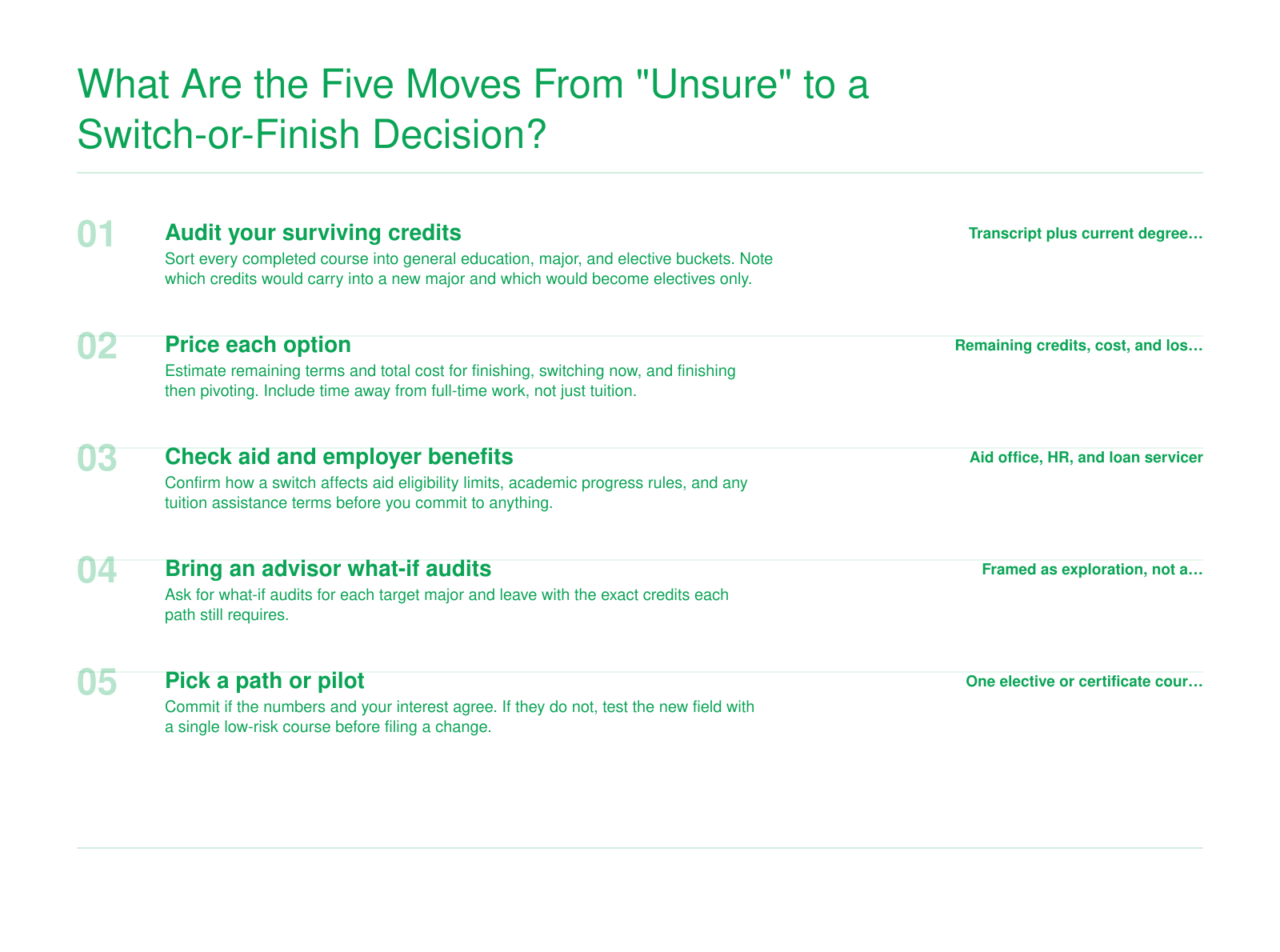
Your Switch-or-Finish Decision Path in Five Moves
The order matters here: each move gives you the information the next one depends on. Work through them in sequence before you file any paperwork, and you can stop at any point without losing ground.
Fitting the Decision Around Work, Family, and Burnout
The tension in this decision is rarely about interest alone; it is about whether a new path fits the life you already have. Work schedules, caregiving, and commute time often determine whether a major change is realistic before academic fit even matters.
Map the Logistics Before the Curriculum
Before you file a change, check whether the target program is available online, in the evenings, on weekends, or in accelerated terms. A major that is intellectually perfect but only offered Tuesday and Thursday at 9 a.m. may be impossible if you work those hours. Similarly, if you are caring for children or an older relative, asynchronous online courses or hybrid options can reduce childcare and travel pressure. Adult learners routinely rank schedule flexibility above academic reputation because a degree that cannot actually be attended has no completion value.
Treat Burnout as a Cost of the Switch
Stacking a heavy second program on a demanding current course load is a common failure point. If you are already near exhaustion, do not add a full-time pivot. Options include staggering the switch over two terms, finishing a lighter term first, or taking one or two required new courses while wrapping up current requirements. Part-time study or a term off is a legitimate planning choice, not a sign of failure.
A Screenshot-Ready Decision Checklist
Run these quick items before scheduling an advising appointment: - Credits that transfer: How many of your completed credits actually count toward the new major? - Total cost difference: Estimate tuition, fees, and delayed earnings for switch versus finish. - Aid impact: Will a major change affect eligibility, renewal, or loan timing? - Weekly hours available: What can you honestly protect for classes, study, and commuting? - Job outcome sought: Does the new major change the specific role you are targeting, or just the subject name?
Finish, Then Pivot Is Still a Pivot
For many adult learners, the right answer is to complete the current degree and then use a graduate certificate, master's program, or employer-funded training to change direction. That preserves the credential you have already paid for and gives you negotiating power while you retrain. Taking a term off or dropping to part-time to stabilize finances and caregiving is not quitting; it is sequencing.
Finishing the degree you've nearly paid for preserves the credential and the credits already earned, turning completion into the launchpad for a later pivot rather than a dead end.
degreecompletion.com