How to Tell if a College Reentry Program Is Truly Built for Adults
A decision guide for working adults weighing cost, credits, schedules and real support

Key Points
- Fayetteville State's NC Promise tuition is $500 per semester for in-state students.
- Real commitment means evening advising, human tutors and a named staff contact.
- Get a written credit evaluation and aid estimate before paying any deposit.
Going Back to College After 25: What Separates a Real Reentry Effort From a Brochure
At North Carolina's Fayetteville State University, a sponsored article reports in-state tuition under the NC Promise plan at $500 per semester and cites 15 degree completion programs offered fully online in fields like business administration, cybersecurity, nursing and interdisciplinary studies. That kind of specificity is rare. Most campuses now advertise that they welcome students over 25, but the welcome stops at the slogan.
If you have a job, a family and some college credit that stalled years ago, the question is not whether a school says it wants you. It is whether the costs, policies, advising hours and transfer rules actually bend around a working adult's week.
The examples here come from public universities and HBCUs, where adult-focused efforts are growing fastest and the details are easiest to check.
What Is a College Reentry Program (and What Isn't)?
A real college reentry program is not an "adult friendly" tag on a landing page. It is a structured path for students who started a degree, stopped out for a year or a decade, and now want to return and finish without starting over. That path typically includes a named office or advisor, a formal review of old credits, and scheduling built around jobs, caregiving, and commutes.
What It Is Not
A general adult admissions page is only an application route. It may welcome returning students, but it does not guarantee anyone will evaluate your transcript before you enroll or tell you which old credits still count.
A bridge or readiness program is different, too. Those are usually short, pre-enrollment sequences focused on math, writing, or study skills. Useful, but not the same as a degree completion pathway with credit review and advising.
A one-off online degree is not automatically a reentry program. Online delivery helps working adults, but without a dedicated adult learner office and prior-credit evaluation, the "program" may just be a standard major offered remotely.
Three Markers of a Real Program
- A named office or advisor: You should be able to identify the specific person or unit responsible for adult learners and transfers, not just a generic admissions contact.
- A written credit evaluation: The school reviews your transcripts and gives you a clear statement of what transfers and what remains, before you commit. If the answer is "we'll figure that out later," treat that as a warning.
- Policies for old grades and aid: Look for published policies on academic renewal, forgiveness of past GPA damage, or how returning students regain financial aid eligibility. A genuine program answers those questions up front.
The Quick Test
Ask one question: "Who will review my old credits, and what is the written policy for grades and aid if I return?" If the answer names a person or office and points to a policy, you are likely looking at a real reentry effort. If the answer is vague, you are looking at marketing.
Why Public Universities and HBCUs Are Building Adult Learner Efforts Now
Why are so many public universities and HBCUs suddenly recruiting students over 25? Three pressures are pushing campuses in the same direction, and understanding them helps you judge whether a school's interest in you is lasting or opportunistic.
The Forces Behind the Shift
- Enrollment pressure: Many campuses can no longer rely on recent high school graduates alone to fill seats. Adults who left with some credits and no degree are a natural group to bring back.
- Workforce demand: Regional employers need credentialed workers in fields like nursing, cybersecurity and business. Universities that help working adults finish strengthen their standing with local industry and state lawmakers.
- State tuition programs: Reduced-tuition initiatives make a return financially realistic for people paying a mortgage or raising kids.
One Example: Fayetteville State University
Fayetteville State University (FSU) in North Carolina is one campus leaning into this trend. A BizFayetteville article published Sep 22, 2026, and clearly labeled sponsored content, is written by Brittany Mundy, FSU's Executive Director for Adult Learners, Transfer, and Military Students. It reports a surge in adult learners, defined there as students over 25, and cites 15 online degree completion programs, including business administration, cybersecurity, interdisciplinary studies and nursing. It also describes adult learners as strengthening the workforce across Cumberland County and the broader Sandhills region.
Because the piece is promotional, we checked its claims against FSU's own pages.
What the Official Pages Confirm, and Where They Differ
- Program count: The FSU Academics page describes "several" online degree completion programs at the undergraduate and graduate levels but does not state a current total. The 2022-2023 undergraduate catalog lists only the RN to BSN. Ask admissions for the current list.
- Age definition: The Office for Adult Learners page says it serves students 24 and over1, while the 2022-2023 undergraduate catalog says at least 25. Either way, eligibility starts in your mid-20s.
- The office itself: Confirmed. It sits in the Broadwell College of Business and Economics, Suite 130, serves adult, transfer and military-affiliated students, and advises by email, phone, video and in person.1 The official pages we reviewed do not list specific hours.
- Tuition: The article cites NC Promise rates of $500 per semester in-state and $3,500 out-of-state. We could not confirm those 2026 figures on an official NC Promise page, so verify current rates with the university before budgeting.
The takeaway applies to any campus: treat sponsored coverage as a lead, then confirm the details directly with the school.
- Colleges, Schools and DepartmentsFayetteville State University
HBCU and Public University Adult Completion Options Compared
Every adult completion program asks you to trade something: a lower credit floor that lets you start sooner, an age or time-away requirement that recognizes your situation, or a delivery format that either fits your work week or fights it. The table samples named adult, reentry and evening programs at both HBCUs and public universities so you can see how differently the rules are written.
What the Options Look Like
- Fayetteville State University, Online Degree Completion: Fully online, built for students who have finished general education, with a 30-credit transfer minimum, a 2.0 GPA, and evening advising plus weekend calls.2
- University of Oklahoma, Adult Degree Completion: Online, requiring at least 60 credits, a 2.0 GPA, and that you be 25 or older (or five years past high school).
- Ramapo College of New Jersey, Degree Completion Program: Aimed at returning adults, with a 48-credit minimum (60 recommended), delivered as evening in-person courses or online.
- Temple University Harrisburg, Adult-Learner Pathways: Evening classes, some majors available fully at night, and encouragement to apply before you reach 30 credits.
- Belmont University, Adult Degree Program: A hybrid format across 18 majors, with most students needing 60 to 90 credits depending on prior coursework.1
Why the Rules Vary so Widely
Notice how little these programs agree on. Oklahoma builds an age threshold into admission; Fayetteville State and Belmont do not state one. Credit floors run from 30 to 60 before you can declare an upper-level major. Some delivery is entirely online, some is evening on campus, some is hybrid. None of this is standardized across higher education, so a policy that fits your credits and schedule at one school may not exist at the next.
Program names, credit thresholds and formats also change from year to year, and search results do not always reflect the current catalog. Before you count on any figure here, confirm it directly with the adult learner or admissions office at the specific school. Ask them to point you to the official page, and verify how your own transcript maps onto their minimums.
- Belmont University, Adult Degree ProgramBelmont University
- Why Adult Learners Are Choosing Fayetteville State UniversityBizFayetteville
The Practical Math: Cost, Credits and Time to Finish
A reentry program's real price is not the tuition line alone. It is the combination of what you still owe in credits, how fast you can take them around a job, and what each term costs once fees and books are added. Run that math before you commit, not after.
A Sample Scenario
Say you earned an associate degree or roughly 60 credits years ago, you work full time, and you have about 60 credits left to finish a bachelor's. Your first job is to find out how many of those old credits actually transfer. The second is to figure out how many terms you can realistically carry while employed. Most working adults take two courses a term, which stretches 60 credits across roughly four to five years part time. Figures vary widely by program and by how many credits you can shed through transfer and prior learning, so ask each school for its own numbers rather than trusting a general estimate.
The Credit Levers
Three things move your finish line:
- Transfer maximums: Policies differ. The UNC System Transfer Admission Regulation exempts applicants with 24 or more transferable credits from some admission requirements, and the UNC-Chapel Hill Credit Evaluation Policies list up to 75 transfer hours. Other systems set their own caps.
- Prior learning assessment: Portfolios, exams, and military or workplace credit can erase whole courses. The Minnesota State University, Mankato Credit for Prior Learning Policy allows up to 60 prior-learning credits (no more than 32 by exam); the Tennessee Recommendations for Standards in Prior Learning Assessment call for a combined maximum of at least 60 for a bachelor's. Prior-learning credit usually cannot count toward the minimum you must complete at the degree-granting school.
- Residency requirements: Every school reserves a block of credits you must earn there, which limits how much you can transfer in.
The Cost Comparison
North Carolina Promise tuition has been reported at $500 per semester in-state and $3,500 out-of-state, though those figures are unconfirmed. Compare that with typical in-state public tuition, which commonly runs several thousand dollars a term, and the gap over a degree is large. But sticker price is not the bill: add fees, books, and any employer tuition benefits you can tap.
A simple formula keeps you honest: remaining credits divided by credits per term, multiplied by cost per term. Plug in your transferred total and you will see both the time and the true number.
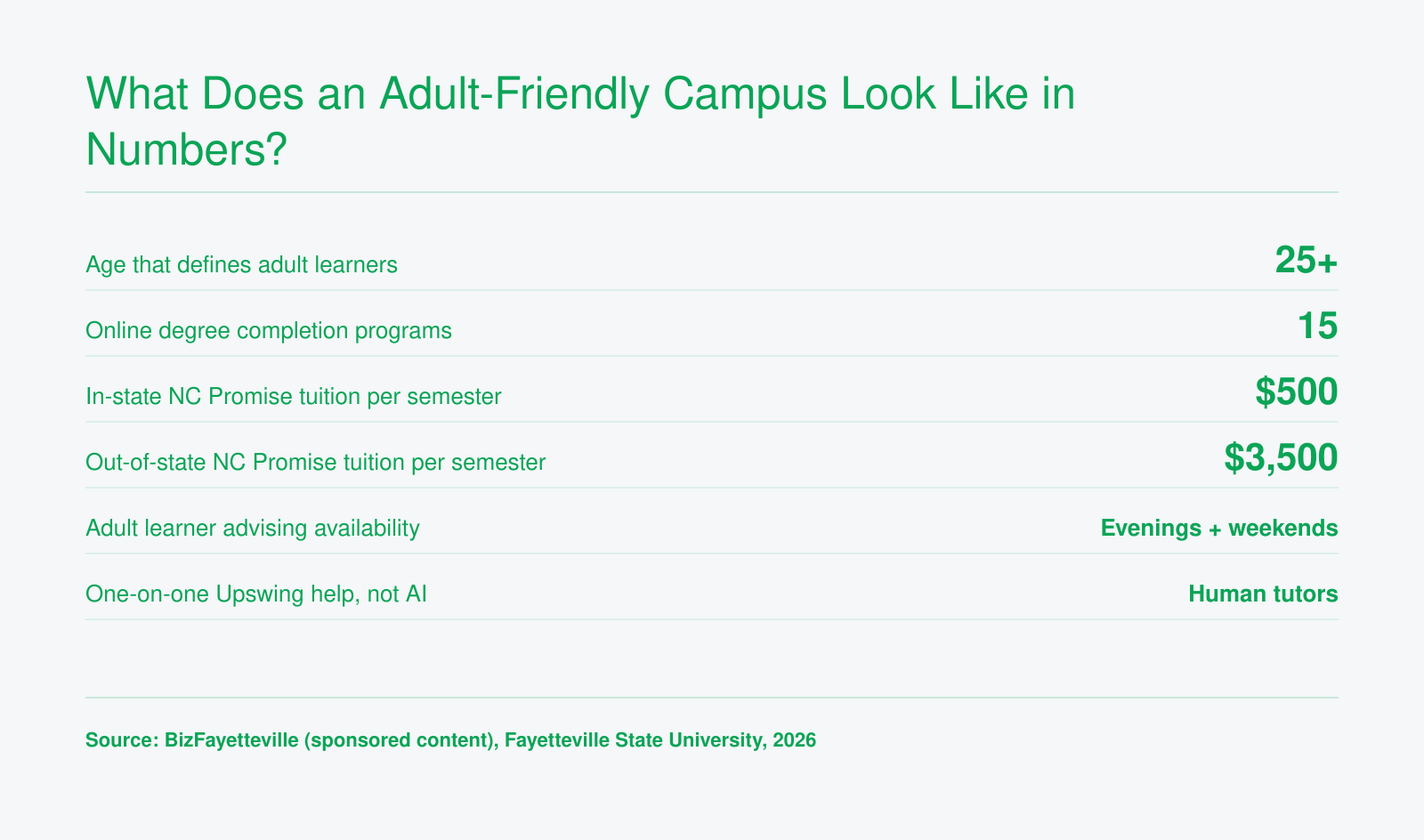
One Campus, in Numbers: What Adult-Friendly Looks Like at Fayetteville State
The figures below come from a single public HBCU, Fayetteville State University, and show the kind of concrete details worth looking for at any campus. Treat them as an illustration of what to ask about, not an endorsement. They come from sponsored content published on BizFayetteville in September 2026, so confirm current tuition, programs and support hours directly with the school.
Signals of Genuine Commitment vs. Marketing Language
Almost every campus says it welcomes adult learners, but real commitment shows up as named offices, posted hours and funded services you can confirm before you apply. Use the table below to sort marketing language from support that exists, then score the school: at least 4 of these 7 signals should be verifiable on the campus website without calling admissions.
| Signal | Marketing Version | Real-Support Version | Example or What to Check |
|---|---|---|---|
| Dedicated adult-learner advisors | "We welcome adult students of all backgrounds." | A named office for adult, transfer or returning students with a listed director and direct contact details | Fayetteville State runs an Office for Adult Learners, Transfer and Military Students led by an executive director, with a published phone number and email |
| Evening and weekend advising | "Our advisors are here for you." | Posted appointment times outside the 9-to-5 workday | Fayetteville State's adult learner office offers evening appointments and weekend calls for students with busy schedules |
| Reentry scholarships and funded aid | "Affordable options are available." | A named scholarship or tuition program with a stated amount, eligibility rules and deadline | Ask for aid specific to returning students in writing; in North Carolina, NC Promise sets in-state tuition at $500 per semester at participating schools such as Fayetteville State |
| Flexible formats | "Learn on your schedule." | A published list of fully online or evening completion programs, not just a few online electives | Fayetteville State lists 15 online degree completion programs, including business administration, cybersecurity, interdisciplinary studies and nursing |
| Human tutoring | "24/7 academic support." | Tutoring with real people, with a named platform or center and clear access steps | Fayetteville State's Student Success Learning Center uses Upswing to connect students with human tutors, not AI, for one-on-one help |
| Counseling | "We care about your well-being." | A counseling center with posted services, hours and a way to book | Fayetteville State offers counseling services to students; check whether hours fit a working schedule |
| Basic-needs support | "We support the whole student." | A food pantry or emergency resource with a location and eligibility details | Fayetteville State's Bronco Food Pantry is open to all students, staff and faculty |
- The Skills-First Movement: Redefining How Organizations Hire and GrowSociety for Human Resource Management
- Competence Over Credentials: The Rise of Skills-Based HiringBoston Consulting Group
- How Ohio Employers and Higher Education Professionals Perceive Micro-CredentialsUniversity of Cincinnati, Journal of Student-Centered Education
- Competency-based education: The employers' perspective of higher educationWiley Online Library
- Competency-based education: The employers' perspective of higher educationWiley Online Library
- Research Round-up: Perceptions of and Participation in Alternative CredentialsNational Career and Technical Education Foundation
- The Evolution of Hiring: What Managers Know About MicrocredentialsNortheastern University Center for the Future of Higher Education and Talent Strategy
Academic Renewal, Fresh Start Policies and Financial Aid After a Long Break
Can failing grades from years ago be dropped from your GPA when you go back to college? At many public universities, partly. Academic renewal (often called a fresh start) lets a returning student restart the grade point average after a required stretch away. It can help you clear probation or meet a program's GPA minimum, but it is rarely a clean slate.
What Renewal Does and Doesn't Erase
The old grades almost always stay on your transcript, so graduate schools and employers may still see them. Credit can be lost, too. Some policies list only courses passed with a C or better as carried forward, so ask whether a D you once counted toward your degree will need to be retaken. Conditions are common: a minimum GPA after returning, an application deadline, sometimes a one-time limit.
Three Public University Versions
- Eastern Illinois University Fresh Start: Fresh Start covers returning students with a cumulative GPA below 2.0 whose last EIU term was at least three full semesters (fall, spring and summer) earlier. You re-enter in fall or spring and must earn a 2.0 or better across your next 12 EIU credits before a separate Fresh Start GPA begins. The prior transcript remains, earned hours still count, and you need at least 30 more EIU credits to graduate.
- Indiana University Indianapolis Fresh Start: First-bachelor's students qualify after 36 consecutive months away from any IU campus, with at least 30 credits left to complete there. The GPA restarts at 0.00. C, P and S credits are kept but excluded from the new GPA, and you must apply by the last day of classes in your second semester back.
- University of West Georgia Academic Renewal: After a three-year break, a new renewal GPA starts with your first term back. The transcript is unchanged, and A, B, C and S credit is retained but left out of the new GPA.
Financial Aid Runs on Separate Rules
Renewal changes your campus GPA, not your federal aid record. Start with a FAFSA for the year you plan to enroll, since it determines Pell Grant eligibility.1 Federal Satisfactory Academic Progress is judged separately, and no federal guidance says a renewal policy automatically restores aid, so ask how your old record will be measured and whether you will need an appeal.
Past aid still counts. Pell is capped at the equivalent of six years (600 percent) over a lifetime, and renewal does not reset that clock.1 A defaulted federal loan blocks new aid until you get out of default.4 Rehabilitation takes nine voluntary, affordable monthly payments, each made within 20 days of its due date, and can remove the default from your credit history.2 A quicker route, six consecutive on-time payments, restores aid eligibility, but the loan stays in default unless you finish rehabilitation, consolidate or repay it, and a missed payment cuts off aid again.3 Starting July 1, 2027, a loan can be rehabilitated only twice.2
Before you enroll, request written aid-reactivation steps for your situation from the financial aid office.
- Federal Pell GrantsFederal Student Aid
- Loan RehabilitationFederal Student Aid
- What if I Defaulted on a Federal Student Loan but Want Federal Student Aid?Federal Student Aid
- Get Out of DefaultFederal Student Aid
State-Funded Reentry and Reconnect Programs for Adults
State aid for returning adults can cut your bill dramatically, but the rules behind it shift more often than the marketing pages do. Eligibility thresholds, covered expenses and award amounts are set by legislatures and agency rules that get revisited annually, so treat any figure you read (including in articles like this one) as a starting point to verify, not a promise.
What a State Reconnect Program Typically Requires
Tennessee Reconnect, as detailed in the Tennessee Reconnect Grant Evaluation, is a useful model. Under the Tennessee Reconnect Grant Rules, it serves adults who have not already earned an associate or bachelor's degree, who either qualify as independent students on the FAFSA or are at least 23, and who file a Reconnect application. Recipients participate in a success plan, hold at least a 2.0 cumulative GPA, and stay continuously enrolled part time (a minimum of six credit hours in fall and spring). The grant works as last-dollar aid for tuition and mandatory fees toward a certificate or associate degree at an eligible institution, with award levels set through state appropriations rather than a fixed published number.
Where to Check Before You Apply
Go to the agency that administers the money, not a third-party summary. For Tennessee, that is the Tennessee Higher Education Commission and its Student Assistance Corporation. For Minnesota Reconnect, check the Minnesota Office of Higher Education. For NC Promise tuition, use the official UNC System page. For career payoff, the Bureau of Labor Statistics occupational outlook pages are the neutral reference, and the relevant professional association will tell you whether a given degree actually satisfies licensure or credential requirements in your field.
The Questions to Get Answered
- Eligibility: Residency, age, and whether prior degrees or past enrollment disqualify you.
- Coverage: Tuition only, or fees, books and online course charges too.
- Timing: Application deadlines, enrollment minimums, and renewal conditions.
- Strings attached: Any service commitment or repayment trigger if you withdraw.
Then call the campus financial aid office and ask them to run your net cost after all aid. That number, not the sticker price or the headline grant, is what you are actually deciding on.
Judge a campus by the support you can verify, such as evening advising hours, human tutors and a named staff contact, not by the slogans on its adult learner page.
degreecompletion.com
How to Verify a Program's Claims Before You Commit
There are two ways to judge a college's adult learner claims: trust the website, or test the infrastructure behind it. Before you commit, do the second.
Start With the Adult Learner Office
Your first call should be to the office that specifically serves returning adults, not a general admissions line. Fayetteville State offers a working model: its Office for Adult Learners, Transfer and Military Students can be reached at 910-672-2700 or adultlearnerstransfermilitary@uncfsu.edu, and it advertises evening appointments and weekend calls for people with full-time jobs. At any other campus, find the equivalent adult learner, reentry, transfer, or military-connected office and ask the same questions. When you call, ask for the advisor's name, title, and direct line so you can follow up later.
Demand the Documents
Ask for four written items before you enroll: a credit evaluation that shows how your prior credits apply, a semester-by-semester degree completion plan, a net-price estimate after aid, and the full academic renewal or forgiveness policy text. The credit evaluation should list each transfer course and the requirement it satisfies. The completion plan should show the number of terms remaining. The net-price estimate should include tuition, fees, and estimated aid. Verbal assurances are not enough.
Check Outcomes and Accreditation
Request graduation and retention rates for adult or transfer students specifically, not overall first-time freshman numbers. If the office cannot share adult-specific outcomes, ask what data it can provide and who on campus tracks it. You can also verify institution-level data through College Navigator or IPEDS. Confirm regional accreditation, and for fields like nursing, check the programmatic accreditation status. Also confirm the online program is authorized in your state.
Test Responsiveness
Finally, book an evening or weekend appointment and note how quickly a real person responds. If you leave a voicemail on a weekend and nobody calls back for days, that tells you how the program handles working adults. A program built for adult learners should be able to match your schedule before you pay.
Questions to Ask Before You Enroll
Bring these questions to your first call with an admissions or adult learner office. Vague answers are a signal in themselves, so note who answered and what they said.
- Who counts as an adult or returning student here?Listen for: clear criteria on age, credits already earned and time away from school, not a general welcome message.
- How many transfer credits will you accept, and how many must I complete with you?Listen for: a specific transfer maximum, the on-campus residency requirement, and an unofficial credit evaluation before you pay a deposit.
- Can I earn credit for what I already know?Listen for: named prior-learning options such as exams, portfolio review, or evaluation of military and workplace training.
- Is my program fully online, hybrid or evening-based?Listen for: confirmation that every required course, including labs, clinicals or capstones, fits that format.
- How do I reactivate my financial aid after a long break?Listen for: concrete steps for refiling the FAFSA, appealing past academic progress problems and resolving any old balances.
- Can my old grades be renewed or set aside?Listen for: the policy's actual name, the required waiting period and exactly how it changes your GPA.
- How do adult students here actually do?Listen for: retention or graduation figures for students over 25 or transfer students, not campus-wide averages.
- Who will my advisor be, and when can I reach them?Listen for: a named person, direct contact information and evening or weekend availability.