Can Sophia and Other Alternative Credits Really Count Toward Your Degree?
Verify transfer rules, compare costs, and get acceptance in writing before you pay

Key Points
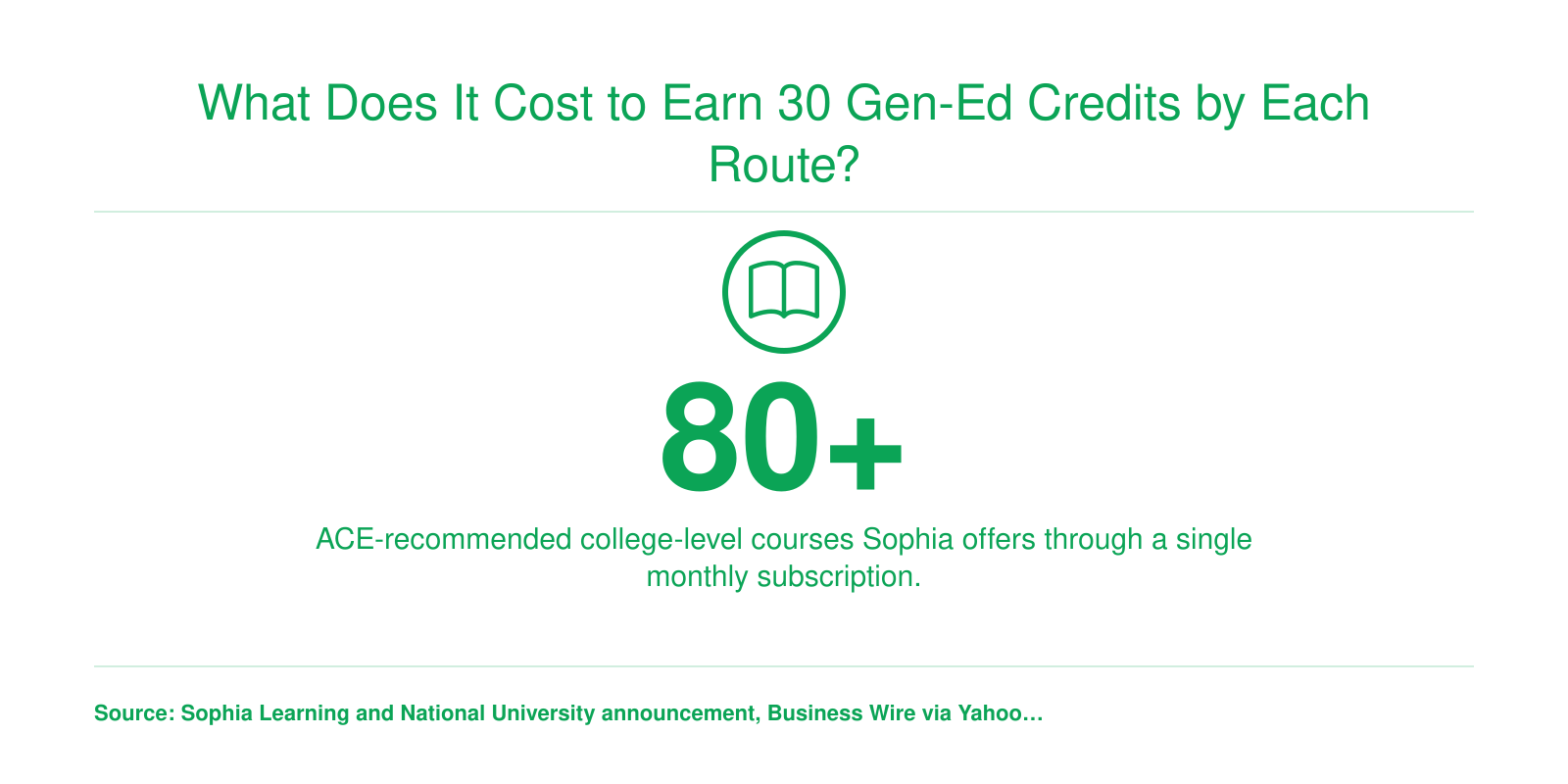
- Sophia offers more than 80 ACE-recommended courses on a monthly subscription.
- National University announced a Sophia transfer partnership on October 20, 2026.
- ACE recommendations aren't guarantees, so get written credit approval before paying.
Why Adults Are Finishing Degrees With Alternative Credit
What happens to the 15 or 30 credits an adult earned years ago, before life interrupted the degree? For the roughly 43 million U.S. adults with some college and no credential, those stranded credits sit alongside a hard arithmetic problem: limited hours after work, and per-credit tuition that climbs with every additional term.
Alternative credit promises a way through: self-paced, lower-cost ACE-recommended courses and exams that can stand in for general education requirements. The catch is that each receiving school decides on its own what it accepts and how much of it counts toward your major.
The October 2026 National University and Sophia Learning announcement is one timely example of that expanding access, but a partnership headline settles none of the transfer mechanics a learner actually has to verify first.
How Alternative Credit Fits Into a Degree-Completion Plan
The tension most adult learners feel is simple: finish faster and cheaper, or stay inside the traditional course structure the degree was built around. Alternative credit lives in the gap between those two, and used well, it can shave months and thousands of dollars off a completion plan.
What Counts as Alternative Credit
Alternative credit is college credit earned outside a standard semester-long course. The main routes are:
- Self-paced ACE courses: Platforms like Sophia Learning offer subscription-based, on-demand courses reviewed for college-level credit by the American Council on Education (ACE).
- Credit-by-exam: CLEP and DSST let you prove existing knowledge in a single sitting, no coursework required.
- Other course providers: Saylor Academy and StraighterLine offer low-cost or free courses many schools accept.
- Portfolio assessment: You document prior learning from work or life for faculty review.
- Military training credit: Service members can convert training documented on a Joint Services Transcript into credit.
Which Route Suits Which Learner
If you want college credit without classroom seat time, exams (CLEP, DSST) reward people who already know the material, while self-paced courses and portfolio assessment suit those building knowledge as they go. Military-trained learners should start with their transcript before paying for anything.
Where It Works and Where It Doesn't
Alternative credit is strongest for general education and lower-division electives. It is weakest for your major core and upper-division courses, which most schools reserve for their own faculty.
The rule of thumb: pull your degree audit first, see exactly which requirements remain, then match the cheapest route your school will actually accept to each one.
ACE-Recommended vs. Institution-Accepted: Why the Difference Matters
Sophia Learning lists more than 80 ACE-recommended courses, but that recommendation alone does not guarantee a receiving college will apply them to your degree.
The American Council on Education (ACE) evaluates courses and exams to recommend college-level credit. That recommendation signals academic rigor, but the authority to award credit rests entirely with the college or university you attend. Each school sets its own transfer policy, and policies vary even within a single institution: a course may count in one major but not another.
The Three Possible Outcomes
When you submit ACE-recommended credit, the receiving school typically does one of three things.
- General education: The course satisfies a required gen-ed slot such as math, humanities, or social science.
- Free elective only: The school accepts the credit but applies it only as an elective, not toward core requirements.
- Not accepted: The school declines to award credit or applies it to nothing relevant to your degree plan.
Are Sophia Learning Credits Accepted by All Colleges?
No. Acceptance varies by school, program, and sometimes by course. Even schools that accept ACE-recommended credit may limit how many credits transfer, restrict which Sophia courses count, or require a minimum grade. A partnership such as the National University-Sophia agreement announced in October 2026 does not automatically extend to other institutions or programs.
Practical Test: Look for the School's Policy
Before paying, ignore the provider's "ACE-recommended" label as the sole source of assurance. Find the receiving school's published transfer policy, a partner agreement, or a written pre-approval from an advisor. A partner list on Sophia's site shows interest, but the school's catalog or registrar is the authoritative source. Ask for course equivalency in writing, including how it maps to your specific degree plan.
What the National University–Sophia Partnership Shows About Transfer Mechanics
A partnership announcement is a starting point for verification, not proof that your credits will count. The October 20, 2026 news that National University will accept Sophia Learning coursework, reported in a Business Wire release, is a useful case study because of what it leaves open.
What the Announcement Leaves Unanswered
The release says eligible NU undergraduates can transfer Sophia courses toward "eligible NU programs" and that the 80-plus ACE-recommended courses are meant to help students complete general education requirements. It does not name the qualifying programs, publish a course-by-course equivalency chart, or say which Sophia course satisfies which NU requirement.
A Verification Checklist
Before subscribing, ask NU's advising or registrar staff to confirm each of these in writing:
- Program eligibility: Is your specific degree program on the eligible list, and are you an "eligible" undergraduate under NU's definition?
- Course mapping: Which Sophia courses fill which general education slots in your degree plan, and does any course land only as an elective?
- Payment: The subscription appears to be paid by the student, separate from tuition. Price, billing terms, and cancellation rules were not stated, so ask.
- Process: NU's earlier Transfer Credit Policy asks for an official Sophia transcript sent to the Office of the Registrar, and a Concurrent Enrollment e-Form four weeks before an outside course begins. Confirm those steps still apply.
Credit Limits and Residency
NU's published transfer credit policy caps transfer credit at 90 semester credit hours (135 quarter credits in the earlier version), unless programmatic accreditation requires otherwise, according to its Transfer Credit and Prior Learning Credit Policies. The excerpts reviewed show no separate cap for Sophia credit and no stated residency requirement, but that is not confirmation that none exists. Check the current policy and your program's rules directly.
What a Formal Partnership Adds
A formal agreement typically means pre-mapped course equivalencies, a defined submission process, and fewer surprises than a self-initiated transfer request, where a registrar reviews an unfamiliar course case by case. That reduces guesswork, which is where adult learners most often lose time and money.
The Evergreen Lesson
Partnerships reduce risk, but they do not eliminate it. Whether the school is NU or another, confirm your own program, your own degree plan, and your own course-to-requirement match before paying for anything.
How Many Sophia Credits Can Transfer? Caps at Aspen, AIC, Capella, Georgia Military College, and Phoenix
There is no single answer to how many Sophia credits can transfer to a university. Each school sets its own cap through its transfer policy and residency rule, and that cap usually covers all of your transfer credit combined, so Sophia courses compete for the same space as community college coursework, exam credit, or credit from a previous degree attempt. The published limits below range from program-specific general education blocks at Aspen to as many as 135 credits in select Capella bachelor's programs. We could not verify transfer caps, residency minimums, or Sophia-specific rules for Georgia Military College and University of Phoenix from the sources available, so they are left out of the table. Treat every figure as a starting point and confirm it on the school's current transfer-credit policy page or with an admissions advisor before you enroll.
| School | Maximum Transfer or Alternative Credit | Residency Requirement | Sophia-Specific Notes |
|---|---|---|---|
| Aspen University | Up to 90 total transfer credits toward a bachelor's degree program | The cited transfer-credit policy does not state a minimum number of credits that must be completed at Aspen | Up to 60 block general education and liberal arts credits may be awarded in the Bachelor of Science in Business Administration (Completion) and Bachelor of Science in Early Childhood Studies (Completion); up to 30 in the Bachelor of Science in Nursing (Completion Program) |
| American International College | Up to 90 term hours from other accredited institutions, subject to the residency rule | A minimum number of credit hours must be completed at AIC before graduation; the specific number was not available in the published regulations reviewed | Sophia credit is accepted toward eligible bachelor's degree programs, within the published limit of up to 90 transfer credits |
| Capella University | Up to 135 credits in select bachelor's degree programs | The cited source does not state a minimum number of credits that must be completed in residence at Capella | Sophia courses may fulfill eligible general education requirements; they must be equivalent to Capella courses or fulfill electives, cannot duplicate courses already taken or transferred, and cannot be applied once the transfer-credit limit has been reached |
- Transfer CreditsAspen University
- 2026–2027 Undergraduate Academic RegulationsAmerican International College
- American International College Expands Flexible Degree Pathways with Sophia LearningAmerican International College
- No-cost gen eds through Sophia LearningCapella University
Is Sophia the Same as CLEP? How Course Credit and Exam Credit Differ
No. Sophia Learning is a set of self-paced online courses on a monthly subscription, while CLEP and DSST are single-sitting exams you pay for per test. That structural difference changes the cost, the study experience, and the acceptance risk.
The Cost Math Works Differently
A CLEP exam runs $97 in 2026, paid to the College Board, according to the CLEP Information for Test Takers Bulletin, plus a separate administration fee set by each test center: $20 at Bellevue University1, $23.50 at the College of Lake County2, and $30 at the College of Southern Maryland3 in recent examples. DSST charges $100 per exam, according to the Eastern Florida State College CLEP/DSST Testing page, with its own local proctoring fees (for instance $20 at the College of Lake County2, $30 at the College of Southern Maryland3). Some centers waive fees for their own students, alumni, or active-duty military. With exams, you pay per subject regardless of how long you study. Sophia's flat monthly subscription instead rewards learners who can move quickly through several courses in one billing cycle.
How Exam Scores Translate to Credit
For CLEP, ACE recommends a scaled score of 50 (equivalent to a C) as the credit-granting threshold, according to the College Board's CLEP ACE Credit Recommendations, typically worth 3 to 6 semester hours depending on the exam, with awards ranging from 3 to 8 credits by subject and school4. DSST recommendations vary by exam: minimums fall roughly in the mid-to-high 40s, such as 45 for Introduction to Law Enforcement and 49 for Principles of Financial Accounting5. Crucially, schools set their own bar. Southern Utah University's 2026-2027 policy requires a 65 on CLEP Financial Accounting for 3 credits, well above the ACE floor of 506.
Who Each Route Fits
CLEP and DSST reward strong self-studiers who already know the material and want to test out fast. Sophia suits learners who prefer structured lessons and a steady pace rather than one high-stakes sitting.
Watch the acceptance limits with either path. Some schools cap exam credit separately from transfer course credit: the College of Lake County limits credit by exam to 30 semester hours2, and Southern Utah University caps combined exam credit at 30 hours6. At Bellevue University, CLEP and DSST credit is graded pass/fail and counts as lower-level1, so it may not satisfy upper-division or major requirements.
- Bellevue University CLEP/DSST TestingBellevue University
- College of Lake County National Exams Credit for Prior LearningCollege of Lake County
- College of Southern Maryland Credit by ExaminationCollege of Southern Maryland
- Temple College Credit by Exam GuideTemple College
- BRCC CLEP Prior Learning AssessmentBlue Ridge Community College
- Southern Utah University CLEP CreditSouthern Utah University
Sophia, CLEP, DSST, Saylor, StraighterLine and Study.com Compared
No single provider is best for everyone. The right choice depends on what your target school already accepts, how you learn, and how fast you can move. Prices below were current as of early October 2026 and can change. Before you pay, confirm any transcript or score-report fee, and make sure your credit will be sent directly to the college that will award it, not just to you.
| Provider | Pricing Model | Typical Cost | ACE Status | Pacing | Acceptance Risk / Best For |
|---|---|---|---|---|---|
| Sophia Learning | Membership of 1, 4, or 12 months that automatically renews for the same length you chose. Per Sophia's Account and Billing Tutorial, you can request a refund within 30 days of payment if you are dissatisfied and have not completed any courses, by contacting a Learning Coach. | $99 for 1 month, $299 for 4 months, $599 for 12 months | More than 80 ACE-recommended college-level courses | Self-paced. Cancel at least 5 days before your current term ends to avoid the next charge. | Acceptance is not universal. Best for: learners whose target college has confirmed it accepts the specific Sophia courses, such as students at partner schools. |
| CLEP | One fee per exam, plus a separate test-center or administration fee | $97 exam fee plus a $10 to $40 test-center fee | Exams evaluated by ACE | Study on your own, then schedule the exam when ready | Each college decides which exams it accepts and the minimum score. Best for: confident self-studiers who can pass one exam per subject and have checked their school's score rules. |
| DSST | One fee per exam, plus a separate administration fee | $100 exam fee plus a $25 to $50 administration fee | Exams evaluated by ACE | Study on your own, then schedule the exam when ready | Some schools accept both CLEP and DSST, some accept only one, and some accept neither. Best for: filling gaps in subjects CLEP does not cover at your school. |
| Saylor Academy | Free course access. You pay only when you formally claim credit through a proctored final exam. | Free courses, plus a $25 to $50 proctoring fee per credit-bearing exam | ACE- and NCCRS-recommended courses | Fully self-paced with no deadlines | Strong acceptance reported at WGU, UMGC, Thomas Edison, and Charter Oak, but acceptance varies widely at traditional schools. Best for: budget-first learners at credit-friendly schools who confirm course equivalencies. |
| StraighterLine | Membership plus per-course fees. Confirm current terms directly, since current pricing could not be verified for this guide. | N/A | ACE-recommended courses | Self-paced online courses | No provider-wide acceptance figure was available. Best for: learners whose college lists StraighterLine courses as approved equivalents, confirmed before enrollment. |
| Study.com | Monthly subscription for ACE-recommended courses | $95 per month | Subscription courses described as ACE-recommended | Self-paced subscription | Acceptance must be verified course by course. Best for: fast-moving learners who can finish several approved courses within a few billing cycles. |
- CLEP vs DSST: How to Choose the Right ExamPowerhouse Prep
- Best Accredited Online Courses for College Credit [2026]StraighterLine
What Alternative Credit Really Costs vs. Traditional Courses
Comparing per-credit prices alone hides the real cost of a degree-completion plan. A 30-credit block of general education coursework makes the tradeoff easier to see, but only if the credits actually count.
A 30-Credit Starting Point
Using College Board's 2025-26 published full-time tuition and fees from the Trends in College Pricing and Student Aid 2025 report, a public two-year in-district rate of $4,150 converts to about $138 per credit, so 30 credits cost roughly $4,150. At a public four-year in-state rate of $11,950, the same 30 credits are about $398 per credit, or roughly $11,950. Adult-focused private universities have no single national benchmark; check your school's published per-credit rate because prices vary widely and often run higher than public options. These are calculated equivalents from annual averages, not official per-credit prices, and your school's fees will differ. The Massachusetts FY2026 Community Colleges Resident Tuition Rates of $24 to $26 per credit show how much lower some state rates can be.
Add the Extras on the Alternative Route
Alternative credit is not just a subscription. Traditional courses often add books, technology fees, and campus fees beyond tuition, while alternative credit has its own ancillary costs: - Subscription months: The number of months you are actively enrolled and working through courses. - Exam and proctoring fees: Some providers charge per exam or per proctoring session. - Transcript fees: Sending completed credit to your university may cost extra.
The total depends heavily on pace: finishing 30 credits in two or three months costs far less than stretching a subscription over a year.
Where the Break-Even Point Sits
Alternative credit saves most when every credit transfers into a required course and you finish quickly. The edge shrinks when a subscription runs long or when transferred credits land as general electives that do not move your completion date. A credit that does not apply to your degree still costs money and saves nothing. Treat these numbers as starting estimates and plug in your own school's per-credit rate, mandatory fees, and approved course list before paying.
Estimated Cost of 30 Gen-Ed Credits by Route
Your cost for 30 general education credits depends on three quotes: the monthly subscription rate, the fee for each exam, and the per-credit tuition at your target school. On a subscription model, finishing more courses in each billing month spreads that month's fee across more credits, so a faster pace lowers your cost per credit. Get current pricing from each provider and your school, then multiply it by your own pace and credit count before you budget.
Red Flags: When Transfer Credits Won't Count Toward Your Major
Transfer-friendly policies keep expanding, but a credit that transfers in and a credit that moves you toward graduation are still two different outcomes. The gap usually surfaces in a degree audit, after the course is already finished and paid for.
Five Ways Credits Get Stranded
- Elective-only placement: The school accepts the credit but parks it in free electives. If your elective slots are already full, it adds nothing.
- Residency minimums: Many schools require a set portion of credits, often including upper-level major courses, to be earned at the institution itself. Alternative credit cannot fill that portion.
- Credit age limits: Some programs cap how old a course can be, especially in fast-changing fields like technology or the sciences.
- Accreditation mismatches: A school may readily accept credit from accredited colleges but evaluate ACE-recommended credit differently, or decline it entirely.
- Upper-division and major rules: Core major courses often must come from the department or follow a prerequisite sequence an outside course does not satisfy.
Can Alternative Credits Count Toward My Major?
Sometimes, but mostly at the edges. Self-paced ACE-recommended courses tend to land in general education and lower-division electives. Core and upper-division requirements are where acceptance drops sharply. Treat any major-course match as a bonus you verify, not an assumption.
The Financial Aid Angle
Federal aid follows program applicability. Under the 2026-2027 FSA Handbook, Volume 2, Chapter 2, only courses that count toward your degree or certificate can support aid eligibility, so credit that doesn't apply to your program generally won't help. Outside courses can count through a formal written consortium or contractual agreement, but your home school still administers your aid and must credit those courses on the same basis as its own.1 Federal guidance does not establish that a subscription to an unaffiliated provider qualifies, so plan to pay for platforms like Sophia out of pocket.
Two more checks matter. Enrollment status (half-time, full-time) follows your school's own rules, and federal guidance from Staying Eligible for Federal Student Aid does not say every transferred credit counts toward it. Satisfactory academic progress policies are also school-specific and must explain how transfer credits affect your pace, which can change how close you are to aid limits.2
Run This Scan Against Your Degree Audit
- Which exact requirement will this course fill?
- Is it general education, major, or elective credit?
- How many credits must I still earn in residence?
- Does my program set a credit age limit?
- How will transfer credit affect my enrollment status and academic progress pace?
- FSA Handbook, Vol. 2, Ch. 7: Agreements Between SchoolsFederal Student Aid (U.S. Department of Education)
- 2026-2027 Federal Student Aid Handbook, Volume 2Federal Student Aid (U.S. Department of Education)
How to Get Written Confirmation of Credit Acceptance Before You Pay
Written confirmation means having an admissions or academic advisor put the transfer decision in writing before you spend money on a course or exam. A phone call is useful for asking questions, but it does not protect you if the answer changes later.
Build the Request
Start by asking for an unofficial transcript evaluation or degree audit for your intended program. Then request a course-by-course equivalency list showing exactly which requirement each alternative course would satisfy. Attach a syllabus or ACE course description if you have one, so the advisor can evaluate content rather than title alone. Finally, confirm three rules in writing: any residency requirement for credits earned outside the institution, any time limit on older credits, and the minimum grade or score needed for the credit to count.
A Short Email You Can Send
Subject: Transfer credit pre-approval request: [Course or exam name]
Dear [Advisor name],
I am considering taking [exact course or exam] through [provider] and transferring it into the [program name] at [school]. Before I pay, can you confirm in writing whether this credit will apply to my degree plan, and which specific requirement it would meet? Please also note any residency, credit age, or minimum grade rules I should know.
Thank you, [Your name]
What Counts as Written Proof
A signed pre-approval letter or email from an advisor is the strongest option. A completed evaluation visible in your student portal can also work if it names the course and the degree requirement it satisfies. If the provider and university publish a partner agreement, keep a copy only if your specific program is listed. A general statement that "transfer credits are accepted" is not proof for your situation, and neither is a verbal assurance from a single phone call.
Save It and Recheck
Keep the confirmation with your admissions paperwork. If you change majors, switch catalogs, or pause enrollment, ask the advisor to re-confirm in writing. Degree plans and transfer rules can shift between catalog years, and an approval tied to an old plan may not carry over.