How Working Nurses Can Compare Online RN-to-BSN Programs
Check accreditation, clinicals, transfer credit and shift-friendly pacing first

Key Points
- CCNE and ACEN are both recognized; neither accreditor is "better."
- Per-credit tuition runs $311 (Fitchburg State) to $577 (Drexel) for 2026-2027.
- Employers can pay up to $5,250 of your tuition yearly, tax-free.
Introduction: Upgrading Your RN Credential Without Leaving the Bedside
The Bradford Era reported on October 22, 2026 that the University of Pittsburgh at Bradford now offers an online RN-BSN degree completion program, another signal that the bachelor's is becoming the default credential in hospital nursing.
That announcement is an example, not an answer. The harder work is comparison: accreditation, how many credits an ADN or diploma actually transfers, asynchronous versus cohort scheduling, practicum hours, total cost, and whether an employer pays.
Credit-award policy alone can separate two programs with identical sticker tuition by thousands of dollars.
What 'Degree Completion' Means for Working RNs, and What Pitt-Bradford's Online RN-BSN Shows
Online RN-BSN completion has become a routine path for nurses who started with an associate degree or diploma and want a bachelor's without leaving their work schedule. The University of Pittsburgh at Bradford, a campus of the University of Pittsburgh, joined that group with an online RN-BSN, as The Bradford Era reported on October 22, 2026.1
What Degree Completion Means
Degree completion means you do not start over. You already hold an RN license through an ADN or diploma, so the program adds the upper-division nursing coursework that turns that foundation into a BSN.
What Pitt-Bradford Shows
Per the program's overview and curriculum pages, the format is 100% online and asynchronous, with no set class times. The nursing curriculum is 26 upper-level credits, sitting inside the University of Pittsburgh's 120-credit bachelor's minimum. With prerequisites finished, full-time students can complete nursing coursework in as few as two 15-week semesters, and part-time enrollment is available.
A practicum is required. It takes place in community healthcare settings rather than on campus, runs through NUR 1403, Advanced Clinical Practicum (4 credits), and the school helps coordinate placements. Confirm the exact hour requirement with the school before you commit.
Who This Fits
These programs are built for licensed RNs. If you hold no RN license yet, you need a pre-licensure BSN instead, because a completion program assumes the clinical licensure is already in place.
Five Things to Check in Any Program
- Accreditation: Whether the nursing program holds CCNE or ACEN accreditation.
- Transfer credit: How much of your ADN or diploma coursework counts.
- Format: Asynchronous, hybrid, or cohort-paced, and how that fits your shifts.
- Practicum: Required hours, site rules, and whether your own employer can host.
- Cost and support: Per-credit pricing, fees, and employer tuition help.
- Pitt-Bradford Offers Online Nursing Degree Completion ProgramThe Bradford Era
Accreditation First: CCNE vs. ACEN and Why It Matters for Grad School and Employers
Nursing accreditation is a peer review confirming that a specific degree program meets professional standards. For an RN-to-BSN, the two names to look for are CCNE and ACEN. Neither is "better." Both are recognized accreditors, and what matters is that the BSN you choose holds one of them.
How the Two Accreditors Differ
The Commission on Collegiate Nursing Education (CCNE) focuses on baccalaureate and graduate programs: BSN, master's, DNP and post-graduate APRN certificates. It does not accredit practical, diploma or associate programs. Its reviews look at mission and governance, institutional resources, curriculum and teaching practices, and assessment and outcomes.
The Accreditation Commission for Education in Nursing (ACEN) is recognized by the U.S. Department of Education and CHEA, and it accredits across levels, from practical nursing through clinical doctorates. A school may therefore use different accreditors for different nursing programs: the ADN and the BSN at one college may not share one.
A Three-Step Verification Routine
- Check the directory: Search CCNE's Accredited Programs directory or ACEN's Accredited Program Search yourself. ACEN's listing also shows accreditation status and the next review date.
- Confirm the exact program: Look for the BSN at the right degree level, not just the school's name. A university's institutional accreditation does not guarantee every nursing program is CCNE-accredited.
- Confirm institutional accreditation: Verify the school itself holds regional institutional accreditation, which is separate from nursing accreditation.
Why It Matters Later
Most MSN and DNP programs accept a BSN from either accreditor, but some competitive university-based programs state a CCNE preference. Your target graduate program's admission requirements decide the answer, so read them before you enroll. Employers generally treat the two as equivalent, though policies vary by job and employer. Tuition reimbursement plans often require an accredited program, so check your HR policy too.
Don't Confuse It With State Approval
State board of nursing approval is a separate matter from national program accreditation. Boards maintain approved-program lists, and requirements vary by state. You already hold your RN license, but it is still worth checking the list for the state where you practice or plan to.
Transfer Credit for ADN and Diploma Nurses: How Many Credits You'll Actually Need
A course-by-course evaluation and a block-credit award can hand the same ADN nurse two very different totals. Which method your program uses matters more than any single number on its website.
Where Your ADN Credits Actually Land
A BSN usually sits near 120 credits, and your ADN nursing coursework, general-education courses and prerequisites are each treated differently. Massachusetts RN-to-BSN programs commonly require 128 total credits and cap transfer from state-approved ADN programs at 72, with a 34-credit general-education block available through MassTransfer. Nevada State awards 37 nursing block credits plus a 38-credit general-education block, counts that work as upper-division even though it was not taken there, and posts it after you finish the RN-to-BSN requirements. Other published policies award well over 100 lower-level credits to ADN holders. Some programs, Cincinnati among them, evaluate general education item by item and require anything missing from the ADN to be completed inside the BSN.
Caps, Blocks and Diploma Graduates
Nursing credit almost always depends on an active, unrestricted RN license and NCLEX-RN completion. Some programs also require the original program to hold ACEN or CCNE accreditation and set a minimum GPA (Carlow states 2.0, Cincinnati 2.5). Residency rules vary widely: Chamberlain's prior-learning award requires at least 30 additional credits earned there. Diploma graduates are often handled differently, because a hospital diploma transcript may not show regionally accredited course credit, so the award tends to rest on licensure credit rather than coursework. Ask how your credential type is specifically treated.
The Gaps Most ADN Nurses Have to Close
- Statistics: frequently required for the BSN and frequently absent from ADN curricula.
- Humanities and social sciences: a nursing block award may leave these uncovered.
- Sciences: anatomy, microbiology or chemistry can fall short on grade or recency.
Close gaps at a community college, through CLEP or DSST exams where the program accepts them, or at a competency-based provider. Confirm in writing that a specific course will transfer before you pay tuition for it. Cincinnati notes that its transfer credits do not expire.
Get the Number Before You Apply
Request an unofficial transcript evaluation before submitting an application. Send your ADN or diploma transcript, your license number and syllabi for any course you want reconsidered, then ask for the credit total in writing, along with the residency minimum and how remaining general-education gaps count toward the degree.
Asynchronous, Hybrid and Cohort Formats: Which Fits Shift Work
Online RN-to-BSN programs generally fall into three delivery styles, and the right one depends on how predictable your shifts are. The completion ranges below come from general online and workplace training sources, not nursing programs specifically, and they may reflect who chooses each format rather than the format itself. Treat them as a rough guide, and ask any school for its own RN-to-BSN completion data.
| Format | How it works | Best fit for shift work | Watch out for | Reported completion range |
|---|---|---|---|---|
| Asynchronous | Recorded lectures, modules and assessments completed on your own schedule, with no required live sessions. | Rotating, night or irregular shifts, since you can study between shifts or across time zones. | Unstructured, self-paced courses can lose learners. Look for clear deadlines, instructor contact and check-ins. | 15 to 30 percent for self-paced libraries |
| Hybrid | Self-paced content for core material, plus scheduled live touchpoints for discussion and accountability. | Nurses with fairly stable schedules who want flexibility plus some deadlines and peer contact. | Live sessions can clash with shift changes, so ask whether they are recorded or offered at several times. | 60 to 80 percent |
| Cohort | You move through courses with the same group, combining weekly or biweekly live sessions, asynchronous work, group projects and shared deadlines. | Fixed schedules, such as set weekday shifts, where a peer group and common deadlines keep you on track. | Shared deadlines and live sessions reduce flexibility and can be hard to manage if your shifts change often. | 70 to 90 percent, though one widely cited 85 percent figure comes from vendor marketing |
Clinical and Practicum Hours While Working Full Time
Searching for "no clinicals" gets you partway to the truth: most RN-to-BSN programs skip bedside rotations, but many still require a community or leadership practicum that has to fit around your shifts. General guidance puts typical requirements at 20 to 60 hours, though individual schools run well beyond that.
How Many Hours to Expect
The numbers are not directly comparable, because some programs count clock hours, some count 55-minute hours, and some blend in simulation or project work. Even so, the spread is wide:
- Lower end: Bellevue University requires 36 hours, and Rasmussen University's project-based capstone runs 25 to 35.
- Middle: Youngstown State asks for 60, Texas A&M International for 84, and Montclair State for 90.
- Higher end: St. Thomas requires 108, Oklahoma 112, UW-Green Bay 115.5 clock hours, and San Diego 144.
Chamberlain takes a different route, with 24 indirect and 24 direct hours rather than traditional rotations.
Who Arranges the Placement
Who finds the site is the bigger variable. Oklahoma, UW-Green Bay, Montclair, and San Diego arrange or coordinate sites for you. UW-Madison's BSN@Home uses a coordinator to help near your home. St. Thomas and Youngstown State expect you to find your own site and preceptor. Ask whether a preceptor must hold a particular degree, whether the school needs a signed contract with the host organization, and how many weeks ahead you must start. Youngstown, for one, advises students who need help to ask well before the capstone term.
Can Your Current Job Count?
Sometimes, with conditions. Bellevue and Rasmussen allow your workplace with approval. Youngstown encourages it under a qualified leader. Oklahoma permits it only off-shift and outside your regular duties. St. Thomas restricts it by role, so your immediate supervisor cannot serve as preceptor and practicum time cannot overlap paid work. Texas A&M International and Montclair do not specify, so get the answer in writing. Expect to supply a preceptor form, organizational permission, and logged hours.
State Authorization
Schools can place students only where they are authorized to operate and have agency relationships. Before applying, confirm in writing that the program can support a practicum in your state, and ask what happens if you relocate mid-program.
Side-by-Side Comparison: Cost, Speed, Support and Outcomes
Published per-credit tuition among the programs below ranges from $311 at Fitchburg State to $577 at Drexel for 2026-2027, so the same credit load can cost very different amounts depending on where you enroll. Practicum expectations vary just as much, from 36 total hours at Drexel to 112 hours at Oklahoma, and Purdue Global and LSU Alexandria let you complete practicum work in your own community or on your own schedule. Pitt-Bradford's figures, typical completion times and term lengths should be confirmed directly with each school, along with fees and how many of your ADN credits will transfer.
| Program | Tuition per Credit | Credits Required | Typical Completion Time | Term Length and Format | Practicum Hours | Accreditation |
|---|---|---|---|---|---|---|
| Fitchburg State University RN to BSN | $311 | 32 nursing credits (120 total for the degree) | N/A | N/A | Two clinical practicum courses within the 10-course, 32-credit sequence | CCNE |
| University of Oklahoma RN to BSN | $330 | 120 total degree credit hours | N/A | Online (OU Online) | 112 hours | CCNE |
| LSU Online / LSU Alexandria RN to BSN | $353 | 30 credit hours | N/A | 100% online | Practicum activities completed in the student's local community | ACEN |
| Campbellsville University RN to BSN | $360 | N/A | N/A | Online | N/A | ACEN |
| Benedictine University RN to BSN | $415 | 34 credit hours | N/A | Online | N/A | CCNE |
| Drexel University RN to BSN | $577 (2026-2027 academic year) | N/A | N/A | Online | 36 total hours | CCNE |
| Purdue Global RN to BSN | N/A | N/A | N/A | Online; practicum completed at a time and location of the student's choice | Two practicum courses, each with a $350 practicum fee | CCNE |
- Registered Nurse to Bachelor of Science in NursingFitchburg State University
- RN to BSN Degree | OU OnlineUniversity of Oklahoma
- Bachelor of Science Degree in Nursing: Online RN-to-BSN ProgramPurdue Global
- Online RN to BSN - Bachelor of Science in NursingBenedictine University
- RN to BSN Online - Bachelor of Science in NursingCampbellsville University
- RN to BSN Online Nursing ProgramDrexel University
- Online RN to BSN ProgramLouisiana State University Alexandria / LSU Online
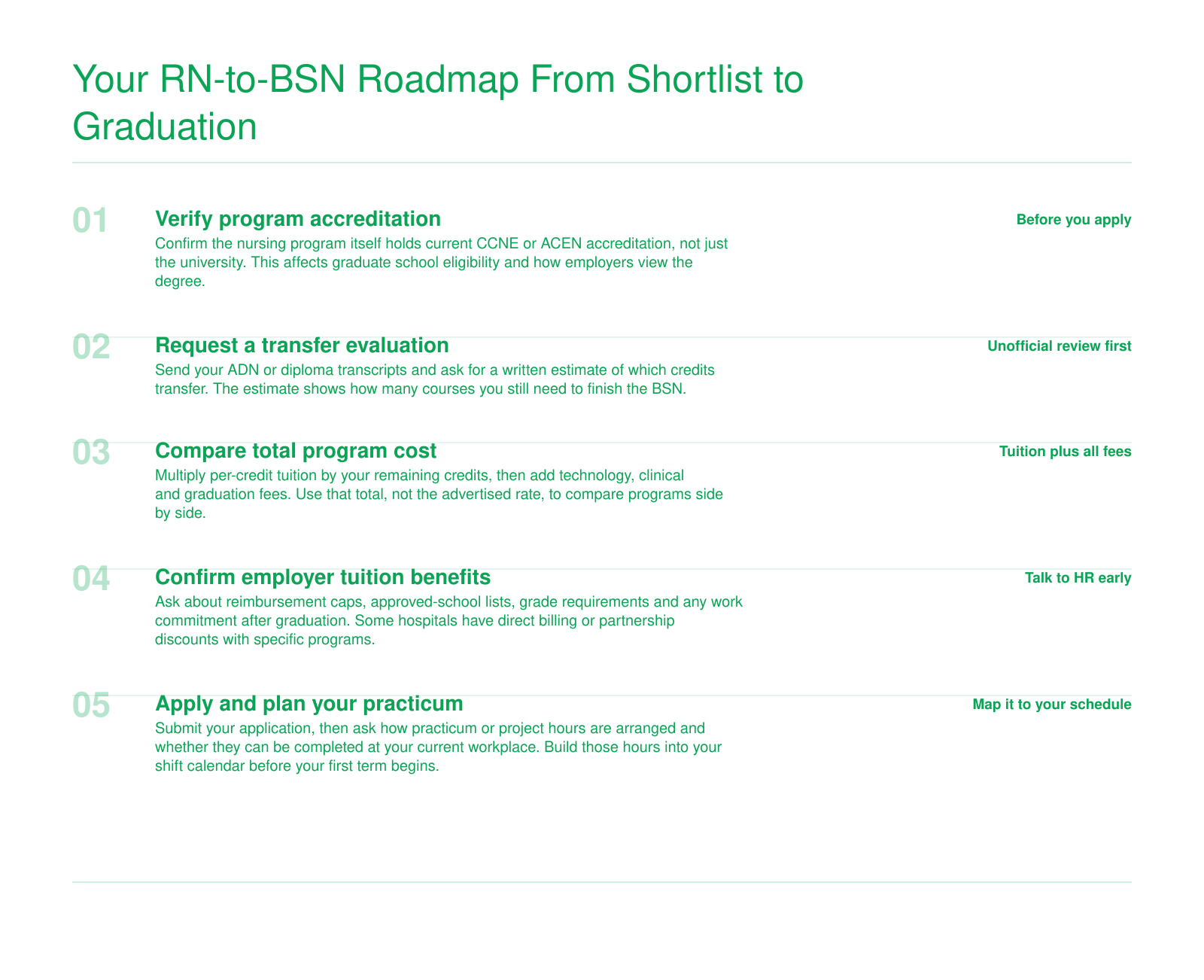
Your RN-to-BSN Roadmap From Shortlist to Graduation
Order matters when you are comparing online RN-to-BSN programs while working shifts. Checking the fundamentals first keeps you from paying application fees or rearranging your schedule for a program that will not count your credits or qualify for your employer's benefits.
Paying for It: Employer Tuition Assistance, Partnerships and Financial Aid
How Employer Reimbursement Usually Works
Under Section 127 of the federal tax code, employers can pay up to $5,250 per employee per calendar year toward education tax-free, and that cap applies for both 2025 and 2026. It covers tuition, fees, books, supplies and equipment, and the coursework does not have to be job-related. Employer payments toward qualified student loan principal and interest count against the same $5,250.
Anything above the cap is normally taxable income, and unused amounts do not roll over. The employer must have a written plan. Meals, lodging, transportation and most non-textbook supplies are excluded. The limit begins adjusting for inflation after 2026.
Employer plans vary widely. Reported reimbursement for nurses commonly runs $3,000 to $10,000 a year, and HCA Healthcare, for example, lists $5,250 annually. Approval often depends on an accredited program, a passing grade, relevance to your role and a commitment to stay employed for a set period.
Health-System Partnerships
Some hospitals go further by partnering with a university. SSM Health named Saint Louis University its preferred online RN-to-BSN provider. Eligible SSM nurses with an ADN, a passing NCLEX-RN result and an active license can apply SSM reimbursement and finish in about 12 months.
Pitt-Bradford has extended its online RN-BSN to UPMC nurses, who can earn the degree with no out-of-pocket cost. Pitt-UPMC grants cover any tuition not paid by UPMC benefits or financial aid. Spring starters may draw on two UPMC benefit cycles, one before August 1 and one after. Pitt-Bradford directs UPMC employees to HR Direct to confirm their exact coverage and eligibility.
Federal Aid and the Questions for HR
File the FAFSA even if you plan to study part time. Your enrollment status affects what you qualify for, and federal loans generally require at least half-time enrollment. Then ask HR:
- Coverage: Which costs count, and is there a per-credit or annual cap?
- Timing: Does the employer bill the school directly, or do you pay upfront and wait for reimbursement after grades post?
- Leaving: How long must you stay, and do you repay benefits if you leave early?
Compare Net Cost, Not Sticker Price
Pitt-Bradford lists $580 per credit for 2026-2027, yet a UPMC nurse may pay nothing. Subtract employer benefits, grants and aid from each program's total before you rank your options.
Compare programs by the total cost and the number of credits you will still owe after your transfer review, not by the advertised per-credit price or the length of the program.
degreecompletion.com
What a BSN Typically Unlocks: Career Mobility, Leadership and Graduate Study
A BSN rarely transforms a nurse's next paycheck overnight, but it reliably makes available roles that an associate-level credential rules out: leadership tracks, informatics roles and graduate school.
Where the Degree Changes the Job Description
Employer preference has shifted decisively. AACN's survey of 643 nursing schools found that 25.0% of hospitals and healthcare settings required new hires to hold a BSN, while 69.8% strongly preferred BSN graduates.1 That preference shapes hiring for charge nurse, unit educator, quality improvement and nurse informatics positions, which frequently list a baccalaureate as a minimum rather than a bonus. Magnet-recognized hospitals push in the same direction: ANCC, which administers Magnet, expects nurse managers and leaders to hold at least a baccalaureate or graduate degree, and the widely cited national workforce goal calls for 80% of RNs to hold a baccalaureate2. About 72.9% of the RN workforce already held a BSN or higher in 20243, so the degree increasingly reads as the baseline for advancement rather than a distinction.
The Graduate School Gateway
If you are thinking beyond bedside practice, the BSN is the usual entry point to MSN and DNP programs, including nurse practitioner and CRNA tracks. Many of those programs will not consider an applicant whose highest credential is an associate degree, no matter how strong the clinical record. Completing an RN-to-BSN while you keep working preserves that option without pressing pause on your career or your income.
Honest Math on the Pay Bump
Pay is where the marketing outruns the evidence. The Bureau of Labor Statistics put the median RN wage at $97,550 in May 2025 and projects 5% growth from 2024 to 2034, with roughly 189,100 openings a year4, but it does not break wages out by ADN versus BSN. Published comparisons conflict: one puts the annual gap near $18,000, another near $8,300 when calculated from hourly averages5. Many hospital systems pay a formal BSN differential of $2 to $4 an hour6; some pay nothing at all. The defensible framing is access, not arithmetic: the degree qualifies you for roles that pay more, and the size of the raise depends on your employer, specialty and geography.
That is the honest case for finishing. Not a guaranteed percentage, but a wider set of roles and fewer eligibility screens between you and the next step.
- New Graduate Employment DataAmerican Association of Colleges of Nursing
- Impact of Education on Nursing Practice Fact SheetAmerican Association of Colleges of Nursing
- Nursing Shortage Fact SheetAmerican Association of Colleges of Nursing
- Occupational Outlook Handbook: Registered NursesBureau of Labor Statistics
- RN to BSN FAQSt. Thomas University Online
- BSN Requirement and Employer MandateArkansas State University Online
Median Pay for Registered Nurses
Before weighing tuition against payoff, it helps to know the baseline for the profession you already work in.
$97,550National median annual wage for registered nurses
This figure reflects all registered nurses nationwide, regardless of whether they hold an associate degree, diploma or BSN, so it describes the occupation as a whole rather than the pay attached to any single credential.
Source: Bureau of Labor Statistics, Occupational Outlook Handbook: Registered Nurses · May 2025
- Occupational Outlook Handbook: Registered NursesBureau of Labor Statistics
Questions to Ask an Admissions Advisor Before You Enroll
A short call with an advisor can confirm what a program's marketing page leaves out. Ask for answers in writing whenever possible.
- Is the BSN program accredited by CCNE or ACEN?Ask which body accredits the nursing program itself, not just the university, and where to find the listing in that accreditor's public directory so you can check it yourself.
- How many of my credits will transfer?Request a written, unofficial transcript evaluation before you apply or pay a deposit. It should show which ADN, diploma or general education courses count and how many credits remain.
- What is the all-in cost?Ask for per-credit tuition plus technology, clinical, graduation and other fees. Also ask whether the school offers discounts for employees of partner hospitals or health systems.
- Who arranges my practicum, and can I complete it at my workplace?Find out whether the school secures sites and preceptors or leaves that to you, and whether your current employer can serve as a site.
- How much time does a typical week take?Ask how many hours students usually spend per course and whether coursework is fully asynchronous or includes scheduled live sessions that could conflict with your shifts.
- What are the completion rates, and can I pause a term?Ask what share of RN-to-BSN students finish and how stop-out, leave and re-entry policies work if your schedule or family needs change.