Should You Start College in January? A Decision Guide for Working Adults
Weigh aid timing, transfer credits, workload and time to finish before you enroll

Key Points
- Some-college workers earned $1,062 weekly in 2025; bachelor's holders earned $1,578.
- A January start qualifies for the same federal aid as fall.
- American Public University and Adelphi each accept up to 90 transfer credits.
Why January Is a Real Option for Working Adults
Waiting for fall and enrolling in January lead to the same degree, but the calendars differ. Adults with earned credits and no diploma have roughly two months to decide, and aid and transfer deadlines often fall before spring classes begin.
Full-time workers with some college but no degree earned a median $1,062 a week in 2025, against $1,578 for bachelor's holders, according to the Bureau of Labor Statistics. Those figures come through a Saint Elizabeth University post on Patch. What matters is a decision framework, not a program promotion.
The same group's unemployment rate was 3.8%, a full point above the 2.8% for bachelor's holders, so delay has a cost.
Is January a Good Time to Start College as an Adult?
Starting college in January means enrolling in the spring term instead of waiting for the traditional August or September intake. For many working adults the answer is yes, especially if you already hold transferable credits and know which credential you are chasing. But it is not automatically better. Four factors decide whether it works in your case.
The Four Things That Actually Decide It
- Credit transfer timing: evaluation of past transcripts and any prior learning portfolio takes weeks, so ask how late in the fall a January applicant can submit records.
- Financial aid and funding: spring disbursements follow a separate calendar, and employer tuition assistance often runs on a calendar-year or fiscal-year budget.
- Realistic course load: a spring start layered onto an existing job may mean one or two courses, not four.
- Spring entry point: confirm that the program you want admits new students in January at all.
Degree Seeking, Not Just Single Courses
Usually you can enroll as a degree-seeking student, not just take an isolated class. Many colleges admit degree-seeking students in spring alongside fall, though some competitive or cohort-based tracks, particularly in nursing, education and health fields, restrict entry to one intake per year. Read the admissions page for the specific major, not just the college's general "we accept spring applications" statement. If your target program only starts in fall, a January course or two can still keep you moving, as long as those credits count toward the degree later.
Adults Are Not Tied to the Fall Cohort
The fall-only rhythm assumes a traditional residential student. Adult-focused programs increasingly run rolling admissions with 8-week terms that begin in January, March and beyond, so a January start is often no more disruptive than September. What matters is whether the sequence of required courses lines up: ask for a term-by-term plan ending in a completion date before you pay a deposit.
What Stopping Short of a Degree Costs: Earnings and Unemployment Gaps
The case for finishing a degree has shifted from inspiration to arithmetic.
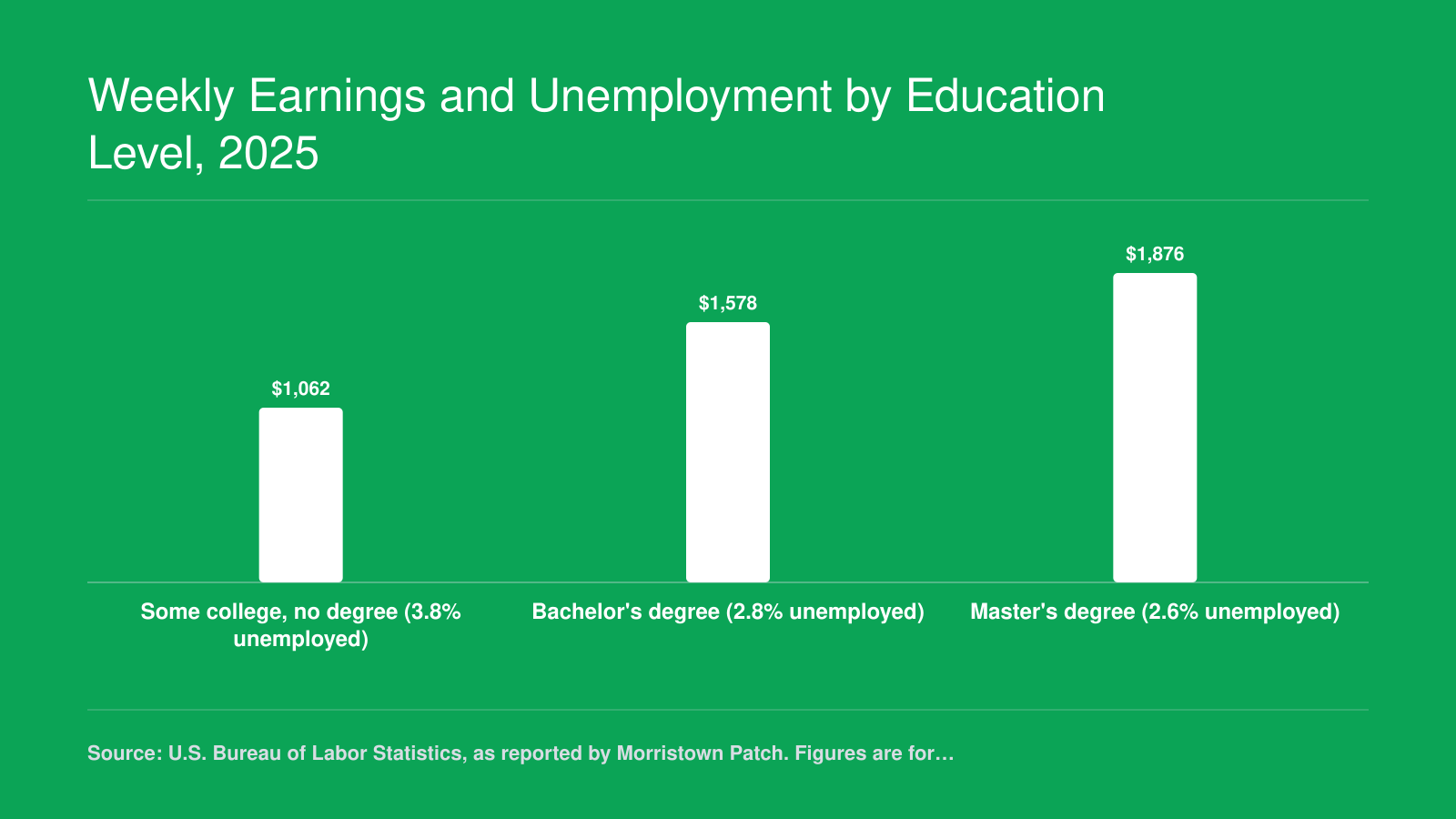
The U.S. Bureau of Labor Statistics reports median usual weekly earnings of $1,062 in 2025 for full-time wage and salary workers age 25 and older with some college but no degree, $1,578 for bachelor's degree holders, and $1,876 for those with a master's. These are medians from the Current Population Survey, and BLS cautions that its 2025 annual estimates average 11 months because October data were not collected during the federal shutdown, so they are not strictly comparable with other years.
The Gap in Annual Terms
The bachelor's figure sits about $516 a week above the some-college figure, which comes to roughly $26,800 a year before taxes.1 Treat that as a median comparison between two large groups, not a forecast for any one person. Major, occupation, geography, experience and hours worked all move the number, and the credential is only one input.
Unemployment Runs Parallel
The 2025 unemployment rate was 3.8% for workers with some college but no degree, against 2.8% for bachelor's holders and 2.6% for master's holders.1 A full percentage point of difference means more interrupted income and a weaker hand at the offer stage.
Check the Primary Table
The figures circulating in news posts, including the Patch community piece from Saint Elizabeth University that frames this topic, trace back to the BLS education-and-earnings table. Read that table directly before you build a budget around it, and remember that a degree changes earnings odds rather than guaranteeing an outcome. For an adult with credits already banked, the question is narrower than "college or not." It is how many credits stand between you and the next credential, and whether the coursework fits around a job.
- Unemployment rates and earnings by educational attainmentBureau of Labor Statistics
Weekly Earnings by Education Level, 2026
Among full-time workers age 25 and older, bachelor's degree holders earned a median of $1,578 a week in 2025, about 49% more than the $1,062 earned by those with some college but no degree. A master's degree added roughly another 19%, to $1,876 a week. Unemployment also fell at each step: 3.8% with some college and no degree, 2.8% with a bachelor's and 2.6% with a master's.
Financial Aid and FAFSA Timing for Spring Starts
Yes, a January start qualifies for the same federal aid programs as a fall start. What changes is the paperwork clock, how much of your annual eligibility is still unspent, and the smaller print on state, institutional and employer funding. For a Spring 2027 start, the sequence runs in a fixed order.
Which FAFSA Covers a January 2027 Start
Spring 2027 falls inside the 2026-27 award year, so you file the 2026-27 FAFSA, which opened no earlier than October 1, 2025. The federal submission deadline is 11:59 p.m. Central on June 30, 2027, but that is the outer limit, not a target. Your college must have a correct, complete FAFSA by your last day of enrollment, and for Pell, Federal Work-Study, FSEOG and Direct Subsidized Loans, a valid record generally has to reach the school by the earlier of that last enrollment date or September 18, 2027.2 Processing takes time, so file well before the term bill comes due.
What Actually Changes for a Spring Entrant
A January start does not create a separate or smaller federal pot. Your package depends on enrollment status, cost of attendance, program eligibility, remaining annual and lifetime eligibility, and prior borrowing. If you drew Pell or loans in the fall, only the remainder is available in spring. Enrollment intensity matters too: part-time study usually produces a smaller award than full-time. Campus-based funds such as Federal Work-Study and FSEOG come from limited school allocations, so a timely FAFSA does not guarantee they will be there.
State and Institutional Deadlines Differ
State grant agencies run their own calendars, which vary by state and program and may be earlier than the federal date or set a separate spring deadline. Institutional priority dates can fall months before classes begin, and missing one can shrink or eliminate a college grant even when your FAFSA was federally on time. Some scholarships are fall-only, so ask directly whether an award can be applied to a January start.
Employer Tuition Assistance
The IRS lets employers exclude up to $5,250 per year in education assistance from your taxable income. Ask HR about pre-approval before you register, whether the school is paid directly or you are reimbursed, and what documentation and grade requirements apply. Reimbursement timing matters if you need the money to cover the term bill.
Do These Three Things in Order
- File the 2026-27 FAFSA and list every school you are considering.
- Request a written aid estimate from each financial aid office.
- Then talk to HR about tuition benefits and any spring deadline for pre-approval.
- FAFSA DeadlinesFederal Student Aid (U.S. Department of Education)
- 2026-2027 Award Year Deadline Dates for Reports and Other Records Associated with the FAFSAFederal Register
Transfer Credits for Adult Learners Starting in January: Limits, Age Rules and Deadlines
American Public University accepts up to 90 semester hours of transfer credit toward a bachelor's degree1, and Adelphi University caps transfer credit at 90 as well.2 That answers the first question January applicants ask: yes, old credits usually travel with you, but in part. A cap is only one of three rules that decide how much of your prior work actually counts.
The Cap, the Residency Rule, and Applicability
A 90-credit ceiling is common but not universal; institutions and state systems set their own limits, and a bachelor's degree generally leaves at least 30 credits to be earned at the receiving school. A course can be accepted and still not count. The University of South Carolina Aiken states plainly that transferred credit may not satisfy major, general education, or residency requirements.3 A transcript full of courses can still leave you short in the subjects your new major demands.
Age-of-Credit Rules Hit Lab and Technology Courses Hardest
Adelphi evaluates comparable coursework from the past 10 years and considers older courses case by case2; Purdue generally excludes work older than 10 years unless the department approves it.4 American Public University notes that certain disciplines limit how old credit can be without imposing one institution-wide rule.1 Science, computing, and nursing courses age fastest because the content moves. Grade minimums matter too: Adelphi looks for at least a C- in coursework it evaluates, while individual programs often set stricter thresholds for courses counting toward the major.
Deadlines: Start the Transcript Request Now
Estimates vary widely. USC Aiken reports one to two weeks when no equivalency is established3, American Public University about two weeks after the application and documents are complete1, George Mason about a week after acceptance with longer waits in January, Purdue at least two weeks4, and Tacoma Community College eight to twelve weeks when evaluations are in queue5. In the University of North Carolina System, preliminary evaluations for a spring term were due within 15 business days of admission and final ones no later than 24 hours before the add/drop deadline.6 Request official transcripts as soon as final grades post, and ask whether an unofficial read is available before your application deadline.
Ask for a Course-by-Course Map, Not a Count
Ask the evaluator to map each course to a specific requirement in your intended program and to list what remains. That list, not the total, tells you how many terms you really need.
- Transfer Credit FAQsAmerican Public University
- Transfer Evaluation SystemAdelphi University
- Transfer Articulation for Accepted StudentsUniversity of South Carolina Aiken
- Transfer CreditPurdue University
- Transfer Credits to TCCTacoma Community College
- Transfer Credit Evaluation PolicyUniversity of North Carolina System
Can Work Experience Reduce the Credits You Need? Prior Learning Assessment
Prior learning assessment can strip real credits off your degree, but only for learning you can document at the college level, never for years served on the job.
How Credit for Prior Learning Gets Awarded
Colleges use several routes: standardized exams, faculty-approved challenge exams, credit recommendations for military or corporate training, and portfolio assessment. A portfolio is a written narrative that maps what you know onto specific course outcomes, backed by evidence, and trained faculty decide whether it clears the bar. Holding a license or an occupation title does not automatically produce credit. Saint Elizabeth University, for example, lets eligible students pursue credit through a faculty-reviewed portfolio, and that review model is common.
What Caps and Fees Look Like
In CAEL's 48-institution study, 94% of schools allowed prior learning credit for electives, 88% for general education, and 79% for major requirements, with all of it recorded at the lower division.1 Eighty percent capped the total, usually near half the degree: about 30 to 32 credits for an associate, 64 for a bachelor's.1 Fees vary widely and have no national standard. A 2026 sample of Michigan community colleges found three-credit portfolio fees from $0 to $429, with $60 common, far less than the same course taken for tuition.2
Does It Pay Off?
After controlling for student characteristics, adults who earned credit for prior learning were 17% more likely to finish a credential.3 Those with 12 or more such credits saved an average of 9 to 14 months, with estimated tuition savings of roughly $1,500 to $10,200 depending on institution and sector, before fees and living costs.4
Start Early and Ask Two Questions
Portfolio credit takes weeks of writing plus faculty review, so begin well before the term starts. Confirm whether the credit counts toward residency requirements and how it affects your enrollment status for financial aid. The rule of thumb: pursue it when your experience is clearly college-level and documentable in the subject, not simply long.
- In the Clear: Credit for Prior LearningCAEL
- Credit for Prior Learning PresentationMichigan Community College Association
- Recognition of LearningWICHE
- PLA: Fueling the Race to Postsecondary SuccessCAEL
Accelerated Terms, Winter Sessions and What They Mean for Your Weekly Hours
January enrollment has quietly stopped being a single date on the calendar and become a cluster of formats, each with its own weekly rhythm. A spring semester at most U.S. colleges runs 15 to 16 weeks1, an accelerated term runs 8, and a winter session can run as few as 3 to 5.
Three Formats, Three Rhythms
The academic work does not shrink when the calendar compresses. At the University of Delaware, a credit carries 45 to 60 hours of instruction and preparation across a 15-week semester, which puts a 3-credit course at roughly 9 to 12 hours a week.2 Compress that same 135-hour course into eight weeks and you are looking at about 17 hours weekly; two concurrent 3-credit courses land near 34.3
Winter sessions are tighter still. A 3-credit course in Delaware's 5-week winter term implies roughly 27 to 36 hours a week2, and Sacramento State caps winter enrollment at 3 credits.4
What a Working Adult Can Actually Carry
Old Dominion treats 6 credits in an 8-week term as full-time and recommends 6 to 7.5 for most students.5 In practice, one course per 8-week block is the load that survives a full-time job and a family. In a 15-week semester, two courses is a comparable commitment. Alamance Community College's rule of thumb, roughly half the normal semester load in each 8-week block,6 points the same direction.
The Honest Tradeoff
Accelerated terms trade slack for speed. You finish sooner and juggle fewer subjects, but an 8-week course leaves almost no room for a missed week, a hospital stay, or a crunch at work. A 15-week semester absorbs one bad fortnight. An 8-week term does not.
Before You Commit, Ask How Aid Counts You
Half-time status drives Pell awards, loan deferment, and veterans benefits, and schools count it differently. One university counts 6 credits spread across two 8-week terms as half-time; another bases aid on the aggregated semester total7; a third recalculates eligibility session by session, so awards can shift between blocks. Confirm the method with the financial aid office before the first day, and check what the published academic calendar says about how consecutive terms combine.
- Degree and Credit GuidelinesRochester Institute of Technology
- Academic Regulations: Credit HoursUniversity of Delaware
- Accelerated Online Degree OverviewDegreeSources
- Credit Hour PolicyCalifornia State University, Sacramento
- 8-Week Asynchronous Online Courses FAQOld Dominion University
- Eight-Week ClassesAlamance Community College
- Accelerated ClassesNorthwestern Michigan College
Accredited Colleges With January Start Dates: How Their Structures Compare
Before comparing dates, run a three-step check: search the school in the U.S. Department of Education's Database of Accredited Postsecondary Institutions and Programs or the CHEA directory to confirm its institutional accreditor and that its status covers your enrollment period, check programmatic accreditation if your field (nursing, for example) requires it, and confirm that your specific program admits spring entrants. The schools below are a sample of semester, accelerated and rolling-admission structures with Spring 2027 starts, not a ranking or endorsement, and because the admissions information we reviewed did not state each accreditor, those cells point you back to that check. Dates and deadlines reflect what schools published in October 2026 and can change, so confirm every date on the school's own admissions page before you apply.
| College | Accreditor | Start Format | Spring 2027 Start | Application Deadline |
|---|---|---|---|---|
| University of Florida Online | Not confirmed; verify in Department of Education database or CHEA | Semester; fully online degrees | January 11, 2027 | September 14, 2026 (passed) |
| Simmons University Online Degree Completion | Not confirmed; verify in Department of Education database or CHEA | Rolling admission; semester spring term | January 19, 2027 | December 15, 2026 |
| Boston University Metropolitan College Online | Not confirmed; verify in Department of Education database or CHEA | Rolling admission; January, May and September starts, plus additional starts for most online programs | January 12, 2027 | December 15, 2026 |
| Belmont University Adult Degree | Not confirmed; verify in Department of Education database or CHEA | Semester | January 13, 2027 | December 1, 2026 |
| University of Georgia Online | Not confirmed; verify in Department of Education database or CHEA | Semester | January 11, 2027 | Varies by program (published dates include October 1 and October 15, 2026) |
| George Fox University Accelerated Online Degrees | Not confirmed; verify in Department of Education database or CHEA | Accelerated online; next-start model | January 11, 2027 | N/A |
| University of Louisiana at Lafayette Online | Not confirmed; verify in Department of Education database or CHEA | Accelerated sessions (Spring 2027-A and Spring 2027-B) | January 13, 2027 | December 18, 2026 |
| University of Minnesota Crookston Online | Not confirmed; verify in Department of Education database or CHEA | Semester | Spring 2027 semester | December 15, 2026 |
- UF Online Application DeadlinesUniversity of Florida Online
- Online Degree Completion ApplicantsSimmons University
- Apply Now: Graduate Degree & Certificate ProgramsBoston University Metropolitan College
- How to Apply, Adult Degree Admissions & AidBelmont University
- Application DeadlinesUniversity of Georgia Online
- Admissions, Accelerated Online DegreesGeorge Fox University
- How to ApplyUniversity of Louisiana at Lafayette
- Start Your ApplicationUniversity of Minnesota Crookston
How to Check Credentials Before You Enroll: Required vs. Preferred
Do you need a master's degree to become a medical and health services manager, or will a bachelor's get you hired? The answer depends on the employer, and the way to find out is to read the postings before you enroll anywhere.
Collect 5 to 10 listings for the title you want, in your region, at your experience level. Then sort the sentences into two columns: required and preferred. Words like "must," "minimum" and "required" belong in the first column. Words like "preferred," "a plus" and "desired" belong in the second. Note the years of experience and any license named in each posting as well.
A Worked Example: Health Services Management
Medical and health services managers are a useful test case because the demand is documented. The Bureau of Labor Statistics projects 24% growth in the occupation from 2025 to 2035, with about 62,300 openings a year, including replacement needs.1 A bachelor's degree is typically required for entry along with less than five years of related experience, and some employers prefer a master's.1 Median annual pay was $123,860 as of May 2025.1 Read that carefully: the bachelor's is the gate, and the master's is the upgrade, usually for advancement rather than entry.
What Credential Pathways Look Like
The Patch source describes Saint Elizabeth University's RN-to-BSN track and a Healthcare Management specialization inside an M.S. in Management. Treat these as illustrations of how credentials stack: one completes a bachelor's for nurses who already hold a license, the other adds management depth for people already working in health care. Check whether a given track assumes a prior license before you count on it.
Verify Before You Commit
Ask admissions a direct question: which job titles do graduates of this program hold, and in what settings? Then take those titles back to the postings and to your state's licensing rules for the role. If the credential does not line up with the requirement lines in real listings, ask what does, and compare that answer to the cost and the time.
- Occupational Outlook Handbook: Medical and Health Services ManagersBureau of Labor Statistics
Questions to Ask Before You Pick a Start Date
Do my existing credits put me within one or two years of a degree, or am I starting close to zero?
If a transcript evaluation shows you are close to finishing, a January start moves your graduation date up by several months. If you are starting near zero, waiting for fall costs relatively little ground.
Can I carry an extra 10 to 20 weekly study hours without losing work or family time?
Accelerated spring terms pack coursework into fewer weeks, so the weekly load runs heavier than in a standard semester. If January is busy season at work or brings new family duties, a fall start may be easier to sustain.
Will my employer's tuition benefit or my financial aid cover spring, or does the money only arrive in fall?
Some employer tuition plans approve funds on their own calendar, and late aid paperwork can delay spring payments. Get written confirmation of when the money pays out before you commit to January tuition.
Start Now or Wait for Fall? A Decision Checklist
Full-time workers with some college but no degree earned a median of $1,062 a week in 2025, compared with $1,578 for bachelor's degree holders, according to the U.S. Bureau of Labor Statistics. That gap is the backdrop for any start-date decision, but it doesn't make January right for everyone. Run these tests before you commit.
The Go/Wait Checklist
- Credit evaluation in hand: You have a written evaluation showing which prior credits apply to your degree, not just to the college.
- Funding confirmed: Your FAFSA is processed for the spring term, and any employer tuition assistance is approved in writing.
- Spring entry point: The specific program admits students in January, not only the institution as a whole.
- Workable weekly schedule: You can name the hours you'll study each week, and they hold up during your busiest stretch at work.
- Clear credential target: You've read job postings for your goal role and know whether the degree is required or preferred.
How Long Does It Take to Finish After Starting in January?
Divide your remaining credits by the credits you'll complete each term. For an adult with 60 credits left on a 120-credit bachelor's:
- Part-time, fall and spring only: At 6 credits per term, that's 10 terms, or about five years.
- Part-time with summers: Adding a 6-credit summer term gets you to 18 credits a year, roughly three and a half years.
- Accelerated year-round: Taking 6 credits in each of five 8-week sessions yields 30 credits a year, about two years.
Transfer credit and prior learning credit shrink the numerator, which often matters more than the pace you choose.
When Waiting Makes Sense
Hold off if transcripts from a previous college are still missing, if your aid or employer approval hasn't come through, or if your program only admits in fall. Enrolling before your credits are evaluated risks paying for courses you've already completed.
When Starting Makes Sense
If every test passes, waiting until fall simply costs you a semester of progress. The BLS data shows what staying put means beyond pay: unemployment ran 3.8% in 2025 for workers with some college but no degree, versus 2.8% for bachelor's holders. A January start moves your finish line up by months, not weeks.
Your Next Step This Week
Order official transcripts from each school you've attended. File the 2026-27 FAFSA, which covers spring 2027, and the 2027-28 form if you'll continue into next fall. Then email two admissions offices the same three questions:
- How many of my credits will transfer, and when will I have the evaluation?
- Does this program admit in January, and what is the application deadline?
- How many hours per week does a typical course in an accelerated session require?
Comparing identical answers side by side will tell you quickly whether January is realistic or whether fall is the smarter start.