Is Michigan Reconnect Worth It? What Working Adults Can Gain by Finishing
What graduates earn, what Reconnect covers, and how to re-enroll while working

Key Points
- Reconnect graduates' median annualized wages rose about $13,400 within one year.
- Michigan lowered the minimum age from 25 to 21 beginning Fall 2026.
- Reconnect pays in-district tuition left after Pell and other grants.
Why Finishing a Degree as an Adult Is a Financial Decision, Not Just a Personal One
Michigan Reconnect has produced nearly 17,000 adult graduates, and the state's own analysis points to what happened next: employment rose 12 percentage points within a year, and median annualized wages climbed about $13,400.
For a parent or full-time worker, the question is rarely whether a credential has value. It is whether the math holds once tuition, books, childcare, and lost hours are counted. Reconnect pays tuition as a last-dollar award, but it does not cover everything, and the gap is where many returning students stall.
Michigan also faces an aging population and a shrinking projected labor force, which is why employers in health care and education keep recruiting adult completers.
What Reconnect Graduates Gain: Higher Employment and Higher Wages Within a Year
A new analysis from the Michigan Center for Data and Analytics, highlighted by the Detroit Regional Chamber, shows Michigan Reconnect graduates saw employment rise by 12 percentage points within one year of finishing a credential. Median annualized wages increased about $13,400 over the same period. The latest figures put total Reconnect graduates at nearly 17,000.
How the State Measured the Gain
State analysts matched Reconnect records with unemployment-insurance wage data. The June 2026 review examined more than 16,800 completed graduate records, although one-year wage outcomes were available for about 9,300 people. "Within a year" compares earnings before Reconnect with earnings roughly 12 months after graduation. The analysis also compared Reconnect graduates with similar workers whose highest attainment was a high school diploma. Median annualized wages convert the earnings observed in that first year into a full-year figure, so the $13,400 gain is not a signing bonus or an entry-level salary quote. It is the midpoint change across the group. Unemployment-insurance wage records capture formal payroll earnings, so the figures reflect reported wages and may not include informal work or periods without reported pay.
What These Numbers Do and Do Not Say
The results are program-wide medians. Individual outcomes vary by field, credential type, and local labor market. An associate degree in nursing usually pays differently than a short certificate in another field, and the analysis does not prove that Reconnect alone caused the gains. Still, one year after graduation, median wages were about $16,500 higher than those of high-school-only peers. Wage gains continued: by the second year after graduation, median wages were about $16,300 higher than before Reconnect, a 48 percent increase overall. Associate degree graduates saw a 51 percent median gain by year two, compared with 37 percent for certificate recipients. Employment gains were nearly identical for associate degree and certificate recipients among graduates who were not still enrolled elsewhere, so even shorter credentials can improve labor-market footing.
Where Those Gains Show Up
Health care and education are the standout destinations. About 38 percent of graduates were working in health care one year after completing, and education showed large gains compared with pre-Reconnect employment. That carries extra weight in Michigan, where an aging population and projected labor-force decline mean communities need more workers in these roles. For a returning adult, those fields often offer credentials that can later stack into a bachelor's degree.
Who Qualifies for Michigan Reconnect, Including the Newer Ages 21–24 Rules
Yes, eligibility expanded: Michigan lowered the minimum age from 25 to 21 in an announcement on August 26, 2026, effective beginning Fall 2026. Older articles and search snippets still cite the 25-and-older rule, so treat the State of Michigan's official Reconnect pages at michigan.gov/reconnect as the authoritative source.
- Age: 21 or older (changed in 2026)You must be at least 21 when you apply, which replaces the previous minimum of 25 and opens the program to adults ages 21 to 24 starting Fall 2026.
- Rules for the new 21–24 groupThe state's announcements describe the change as a lower minimum age, so confirm with the official site or a Navigator whether any other program detail differs for your age group.
- Michigan residency: one continuous yearIndependent students need 12 months of continuous Michigan residency before the program begins and must also meet the FAFSA residency requirement by the start of the semester.
- Residency for dependent studentsIf you file the FAFSA as a dependent, residency follows your FAFSA contributor, who must have established Michigan residency on or before July 1, 2025, for the 2026–27 year.
- High school diploma, GED, or certificate of completionYou need a diploma, a high school equivalency such as the GED, or a certificate of completion before you apply, and applicants without one are directed to Michigan.gov/LearnMoreEarnMore.
- No completed associate or bachelor's degreeYou qualify only if you have not finished an associate or bachelor's degree, though current enrollment in an unfinished associate or skills-certificate program does not disqualify you.
- Enrollment at a participating collegeYou must enroll at a participating Michigan college, so verify your school with the official program site or a Navigator before you register.
How Much Does Michigan Reconnect Pay? Last-Dollar Tuition Explained
How much of my bill will Michigan Reconnect actually pay? The short answer: Reconnect is a last-dollar award, meaning it pays whatever remains of your eligible in-district tuition after Pell and other grant aid has been applied, and it does not stack on top of that aid.
What the Award Is Based On
The payment is built from three pieces: in-district tuition, mandatory fees, and contact hours. If you have no Pell or other tuition-restricted aid, Reconnect covers the full eligible amount, subject to the program's other requirements. If Pell or state aid already covers the whole eligible bill, the Reconnect payment can be $0.
The calculation is anchored to in-district rates. Attend a community college outside your district and Reconnect still pays only the in-district amount. You owe the difference between the two rates unless another scholarship or award covers it.
Which Charges Count
Mandatory fees are those a college charges as a condition of enrolling or completing a program, whether billed per semester or per credit or contact hour. Since the 2023-2024 academic year, online or lab fees can count when the college treats them as mandatory. A fee charged only to certain students or courses is not automatically mandatory, so check how your college classifies it.
Contact hours are also covered, but the rate is set by the college and the program. No single statewide figure applies.
So, does Michigan Reconnect cover books and fees? Only partly. Mandatory fees are included. Books are not part of the payment, and neither are fees such as these:
- Application fees
- Graduation fees
- Parking fees
- Fitness-center fees
- Athletic fees
Reconnect is not a blanket payment of every cost of attending.
How Pell and Other Aid Change the Payout
Pell and state tuition-restricted awards are applied to your bill first, and Reconnect pays what is left. Programs such as TIP and VA benefits are also named as aid applied before Reconnect. Your college's financial aid office decides how a given award is treated, so ask before assuming.
This can look like Pell shrinks your benefit, but receiving Pell does not disqualify you. Your tuition and mandatory fees are covered either way, and any Pell dollars not needed for them can go toward other costs. You still must file the FAFSA, even if you expect Reconnect to cover everything. A FAFSA result showing no federal aid does not make you ineligible.
The table that follows puts dollar figures on these scenarios so you can see how the pieces fit together.
Worked Examples: What You Pay and What Reconnect Covers
Living inside a college's district and living outside it can change your bill more than any other factor. The examples below are illustrative only. Each uses a college's published per-credit rate for the year stated, a six-credit part-time term, and simple multiplication you can repeat with your own school's numbers.
In-District Scenarios at Macomb (2026-27)
Macomb Community College lists in-district tuition at $113 per credit for 2026-27.1 We assume one billable contact hour equals one credit hour, which Macomb's published materials do not guarantee. Six credits: 6 x $113 = $678.
- No Pell: Reconnect pays the full $678 as the last dollar. Tuition due from you: $0.
- Partial Pell: Suppose Pell covers $300 of the term. Reconnect pays the remaining $378 ($678 minus $300). Tuition due from you: $0.
- Full Pell: Pell covers all $678, so Reconnect pays $0 toward tuition. Any Pell money left over can go toward other costs. The federal maximum for 2026-27 is $7,395 for the full year, though your actual award depends on need and enrollment level.3
Out-of-District Scenario at Schoolcraft (2025-26)
Schoolcraft College charges $139 per credit in-district and $200 out-of-district for Fall 2025 through Summer 2026.2 Six credits out-of-district: 6 x $200 = $1,200. Reconnect is generally tied to the in-district rate, so we assume it covers 6 x $139 = $834. You would owe the $366 gap. Confirm this with the college's financial aid office.
How to Read the Math
Tuition is rate times credits, so a heavier load raises both the total and the amount Reconnect or Pell must absorb. Doubling to 12 credits at Macomb makes the in-district bill $1,356. Pell is awarded per year and prorated by enrollment, so part-time students often see smaller awards than the maximum.
Fees sit on top. At Schoolcraft, six credits across two classes would add a $44 registration fee, $29 per credit in service, equipment and infrastructure charges (6 x $29 = $174), and $12 per class for learning management (2 x $12 = $24).2 That totals about $242, and lab fees may add more. Ask whether Reconnect applies to fees before budgeting.
- Macomb Community College 2026-27 Tuition AnnouncementMacomb Community College
- Schoolcraft College Tuition and FeesSchoolcraft College
- Federal Pell GrantsFederal Student Aid (U.S. Department of Education)
What Reconnect Doesn't Cover: Books, Transportation, and the Real Costs of Being a Working Student
Michigan Reconnect's last-dollar tuition award covers tuition and mandatory fees after other grants and scholarships are applied. It does not pay for every expense tied to being a student, and that gap is often where working adults feel the most financial pressure.
Costs That Remain Your Responsibility
Plan for the expenses Reconnect does not cover: - Books and supplies: Textbooks, lab materials, software codes, notebooks, and printing. - Transportation: Gas, parking, public transit, or vehicle maintenance for commuting to campus, work, and clinical sites. - Technology: A reliable laptop, internet access, and backup storage for online coursework. - Childcare: Care during evening classes, labs, or study blocks, which many adult learners arrange around work schedules. - Lost work hours: Shifting to part-time or leaving a shift early for class can reduce take-home pay even before any bill comes due.
Ways to Lower Out-of-Pocket Costs
Start with the lowest-cost course materials. Used and rental textbooks, open educational resources, and library course reserves can cut the books line significantly. Some faculty also list free or low-cost alternatives in the syllabus. For transportation, check whether your college offers discounted transit passes or ride-share partnerships, and consider carpooling with classmates. Campus emergency funds and basic-needs grants can cover a sudden expense such as a laptop repair or a short-term childcare gap. Do not assume you have to absorb every cost alone.
Ask the Financial Aid Office Directly
Before paying anything out of pocket, ask your college's financial aid office about book vouchers, on-campus childcare assistance, food pantries, and emergency aid. Many community colleges keep these resources quiet but actively help students who ask. Reconnect's tuition award is the biggest piece of the college bill, but it is not the whole bill. Budgeting honestly for the costs it leaves behind can keep a manageable semester from becoming a financial setback.
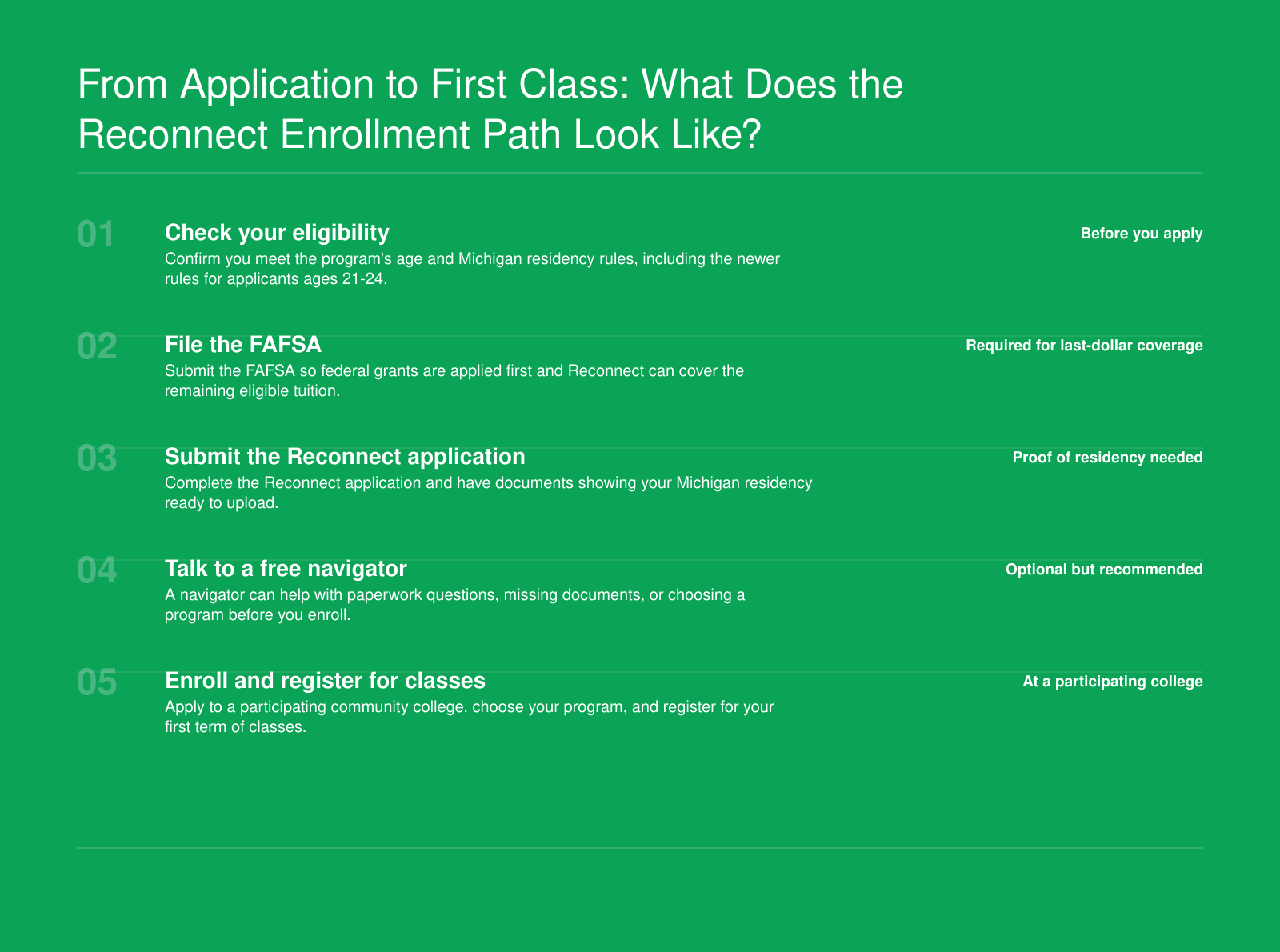
From Application to First Class: The Reconnect Enrollment Path
Getting from "thinking about it" to sitting in your first class follows a predictable order. The steps below follow the same sequence as the application process described above, so you can see where you are and what comes next.
Staying Eligible: Part-Time Enrollment, Renewal, and Academic Progress
Can you attend Michigan Reconnect part time? Yes. Since Summer 2023, you only need to enroll in at least one credit per semester in a Pell-eligible skill certificate or associate program. There is no per-semester maximum, so you can take a single course or a full load depending on your work and family schedule. That flexibility is what makes Reconnect realistic for people who are already employed or raising children.
The one catch to watch: once an academic year begins, you need to earn at least 12 credits in required coursework across that full year to keep the award on track. The one-credit floor governs any single semester; the 12-credit benchmark governs the year.
What Keeps Your Scholarship Active
To stay eligible each term, you need to remain a Michigan resident, stay enrolled in your program, meet your college's satisfactory academic progress (SAP) standard or hold a cumulative 2.0 GPA in your Reconnect coursework, and file the FAFSA every year. Reconnect is a last-dollar award, so the FAFSA is what determines what state aid actually covers after grants.
Withdrawals and failed courses are where adult students most often get tripped up. If you withdraw but the college still charges you tuition, the scholarship can typically still apply to that course. A withdrawal or a failed class can still drag down your GPA or SAP, which is what puts eligibility at risk, so neither is automatically fatal. Reconnect also requires continuous enrollment, but if life forces a pause, you can request a scholarship leave of absence and resume later. Approval and timing follow your college's own policy, so ask before you stop attending.
Three Habits That Protect Your Award
- Check your SAP status every term: Your college posts it; a quick look tells you whether your GPA and completed credits are on track before a problem compounds.
- Talk to an advisor before dropping a class: An advisor can flag how a drop affects your GPA, your annual 12 credits, and whether a leave of absence is the cleaner move.
- File the FAFSA every year: Missing it can interrupt your last-dollar coverage even if your grades are fine.
How Long the Award Lasts
Reconnect eligibility continues until you earn your associate degree or for four years from your first Reconnect semester, whichever comes first. The scholarship covers one program at a time, and once you complete that associate degree, eligibility ends. Plan your pace so your four-year window carries you to completion.
Within a year of graduating, Michigan Reconnect participants saw employment rise by more than 12 percentage points and median annualized wages climb by about $13,400.
Michigan Center for Data and Analytics, as reported by the Detroit Regional Chamber
Where Credentials Lead: Health Care, Education, and the Path From Associate Degree to Bachelor's
A credential is only worth as much as the jobs it opens. Before you pick a program, spend an hour confirming that the certificate or associate degree you're considering actually leads to roles Michigan employers are hiring for, and that your credits will carry forward if you later want a bachelor's. Check Michigan demand, pay, and transfer rules before you enroll.
Check Michigan Demand and Pay Yourself
Start with the broad picture. State projections put education and health services on track to add about 60,200 jobs between 2026 and 2034, a growth rate near 5.6 percent. Within that group, healthcare support occupations are projected to grow fastest (roughly 12.3 percent, about 24,100 jobs), while healthcare practitioner and technical roles grow around 9.3 percent. Educational services, by contrast, is projected to shrink slightly over the same period, so verify demand for a specific teaching or support role before committing.
To research individual roles, use these free, authoritative tools:
- BLS.gov: The Occupational Outlook Handbook and O*NET give you plain-language role descriptions, typical entry education, median pay, and national outlook.
- Michigan labor-market sources: Pure Michigan Talent Connect and the state's labor market information pages show regional demand and current openings.
- Employer job postings and professional associations: These reveal what hiring managers in your area actually expect, including certifications beyond the degree.
One caution: some visible, high-paying health roles are not associate-level. Medical and health services managers, for example, typically require a bachelor's degree and work experience, and healthcare social workers require a master's and licensure. Confirm the real entry requirement for any role before you assume a two-year credential gets you there.
Confirm Your Transfer Path Early
If you might pursue a bachelor's later, plan the handoff now. Two Michigan frameworks matter:
- The Michigan Transfer Agreement (MTA): Complete at least 30 semester hours across the required distribution areas at a participating community college, and those general-education credits transfer as a block, satisfying most, if not all, lower-division general-education requirements at participating four-year schools. It does not guarantee admission or cover major-specific courses.
- MiTransfer pathways: These are statewide associate-to-bachelor's roadmaps in named disciplines, including Business, Biology, Psychology, Criminal Justice, and others, designed to move you into a related major with minimal lost credit.
Verify the current details at MiTransfer.org, through MACRAO, and directly with each school's transfer office. When you talk to an admissions counselor, ask these concrete questions:
- Does my planned associate degree satisfy the MTA, and will you accept it as a block?
- Which of my courses have direct equivalencies in the bachelor's major I want?
- Is there a published associate-to-bachelor's completion plan for this major, and how many credits transfer in?
Asking before you enroll, rather than after, is the single best way to avoid repeating coursework and paying twice.
Finding Your College: Participating Community Colleges and Online Options
Yes, you can often use Michigan Reconnect for online classes, but the course has to be part of an eligible program at a participating college, and availability varies by school. Reconnect pays for a Pell-eligible associate degree or credit-bearing skill certificate. It does not pay for a course just because it is online. Check that your specific program can be completed online, in a hybrid format, or in evening sections before you enroll.
How Many Colleges Participate
Participation is statewide across Michigan's public community colleges and Tribal colleges. The state's college list page shows 31 institutions as of late October 2026, while the state FAQ describes all 28 public community colleges plus 2 Tribal colleges. Treat the exact count as something to verify on the official list.
Colleges by Region
These are examples of participating colleges, not a complete list. In-district boundaries and program offerings are set school by school.
- Southeast Michigan: Wayne County Community College District, Oakland Community College, Macomb Community College, Henry Ford College, Washtenaw Community College, and Schoolcraft College.
- Mid-Michigan and Thumb: Mott Community College, Delta College, Lansing Community College, and Jackson College.
- West and Southwest: Grand Rapids Community College, Muskegon Community College, Lake Michigan College, and Kalamazoo Valley Community College.
- Northern Lower Peninsula and Upper Peninsula: Northwestern Michigan College, North Central Michigan College, Bay College, and Gogebic Community College.
- Tribal colleges: Bay Mills Community College, Saginaw Chippewa Tribal College, and Keweenaw Bay Ojibwa Community College.
Why in-District Status Matters
Reconnect works as a last-dollar scholarship. After other aid is applied, it covers remaining in-district tuition, mandatory fees, and contact hours. Out-of-district students get only a partial discount and pay the difference themselves.
Muskegon Community College defines in-district as living in Muskegon County.1 Its Reconnect coverage is the in-county tuition rate plus mandatory fees, and it leaves out books, course fees, and class materials.1 Mott Community College covers in-district tuition and mandatory fees, tells out-of-district students they pay the difference, and asks for 12 credits per academic year and a 2.0 GPA to stay eligible.2 Other colleges set their own rules, so do not assume these terms carry over.
Confirm Before You Commit
The state's list tool lets you enter a city, ZIP code, or address to see which college considers you in-district. Many colleges also publish their own district descriptions. If your address falls in a gray area, call the college's financial aid or admissions office.
Start with the official college list on Michigan.gov, then ask a Reconnect Navigator to help you compare schools on in-district status, online or evening options, and eligible programs.
- Michigan Reconnect at Muskegon Community CollegeMuskegon Community College
- Michigan Reconnect at Mott Community CollegeMott Community College