Regretting Your First Degree? How to Choose Between a Second Bachelor's and a Master's
Credit transfer, residency rules, aid limits and costs, compared before you enroll

Key Points
- Towson University lets second-bachelor's students transfer up to 90 units.
- A prior bachelor's generally ends Pell eligibility; federal loans may remain.
- Under IRS Section 127, employers can cover $5,250 yearly, tax-free.
Introduction: You Finished a Degree You Now Regret. What Next?
Two routes lead back after a finished degree: rebuild the undergraduate credential with a second bachelor's, or build forward into a master's. Many master's programs list prerequisite courses rather than require an exact major, so the shorter path is often a master's or certificate.
The financial catch is real: a student who already holds a bachelor's degree does not qualify for a federal Pell Grant, leaving loans and employer tuition benefits to carry the plan. Costs and residency rules can make a cheaper master's the faster route or a required second bachelor's the only licensure route.
The real test is the job's entry requirements, not the regret.
When a Second Bachelor's Is Actually Required (and When It Isn't)
The Short Answer
A second bachelor's degree is a full undergraduate degree you earn after already holding one, usually in a new major at the same school or a different one. It is required less often than most career changers assume. The fields where it comes up are mostly gated by licensure or by program prerequisites: nursing, engineering, K-12 teaching and accounting. Even in those fields, a faster route usually exists.
Field by Field
- Nursing: State boards of nursing license registered nurses after they pass the NCLEX-RN, and those boards approve the programs that prepare them. You do not need to start over with a four-year degree. Accelerated second-degree BSN programs admit people who already hold a bachelor's in another field. Montana State asks for a non-nursing bachelor's and a 3.0 GPA.1 Michigan State wants a regionally accredited bachelor's, a 2.75 GPA and some prerequisites completed within five years.2 Penn State Harrisburg's 16-month accelerated second-degree BSN is approved by the Pennsylvania State Board of Nursing, and Northeastern's second-degree track totals 66 credits.3
- Engineering: State engineering boards license professional engineers, and many treat a degree from an ABET-accredited program as the most direct education path. Some states accept other degrees combined with extra work experience, so check your state board before deciding between a new bachelor's and a master's that admits non-majors with leveling courses.
- K-12 teaching: State education departments set certification rules. Many offer alternative certification or post-baccalaureate licensure for people with any bachelor's, though subject testing, student teaching and background checks vary by state and grade level.
- Accounting: State boards of accountancy license CPAs. The traditional standard is 150 semester hours of college credit with specific accounting and business coursework, not a second degree, and several states have recently added alternative pathways. A post-bacc accounting certificate or a Master of Accountancy often fills the gap.
Outside Licensed Fields
For most other pivots, such as data analytics, marketing or public policy, master's programs routinely admit non-majors who complete a few prerequisite courses, and a certificate is sometimes enough to get hired.
A Rule of Thumb
Identify the gate first. If the barrier is a licensure exam or a program prerequisite, look for the cheapest route that clears it, whether that is a prerequisite sequence, a certificate or an accelerated program, instead of defaulting to a full degree. Then confirm the details with your state board, because the answer often changes at the state line.
- Accelerated BSN Admission Requirements – Montana State UniversityMontana State University
- Accelerated BSN – Michigan State University College of NursingMichigan State University
- Accelerated Second-Degree BSN – Northeastern UniversityNortheastern University
A Real-World Case: Returning After a Career Pivot You Regret
The return-to-school conversation increasingly plays out in public, where adult learners trade specifics on credit transfer and financing before they ever contact an admissions office. One recent example comes from a thread in the r/BackToCollege subreddit, where a poster in their mid-20s described leaving a federal scientist role (held straight out of their first degree) for a corporate marketing desk job, then regretting the switch about two years later. The plan under discussion: a second bachelor's in a field closely related to the original science degree, possibly followed by graduate school aimed at academia or fieldwork.
Three Decision Points the Thread Raises
Strip away the personal details and the thread surfaces the same questions most second-degree candidates face:
- Does a niche first degree limit graduate options? The poster worried an extremely specialized science credential wouldn't translate cleanly into a master's elsewhere, which pushed them toward a second bachelor's instead of applying directly to grad school.
- Can prior coursework count toward the new degree? A commenter raised exactly this, and it determines both time and cost; later sections cover those details.
- How rough is the money? The poster called the plan financially difficult but a sacrifice worth making, the central tradeoff for anyone restarting a degree mid-career.
A Timeline Worth Studying
Another commenter offered a concrete arc rather than advice. They left construction management at 28, finished a BA in history by 30, earned an MA at 33 and a PhD at 39, and now teach history full-time at a community college. They report earning about half their former construction-management pay and still describe it as the best decision they ever made.
Treat that timeline as data, not destiny. It shows how long an academic track can run (roughly eleven years here), that a pay cut is a realistic outcome, and that satisfaction and salary don't always move together. Your own numbers depend on how much credit transfers and which route you choose; the next sections take up those subjects directly.
Check Yourself Before Choosing a Route
Does the job you want legally require a specific credential, or just a degree in a related field?
Licensed roles often name a required credential, while many others only ask for a related degree. Confirm which applies before paying for a second bachelor's you may not need.
Could your first degree's science, business or other coursework satisfy a master's program's prerequisites?
If your transcript already covers the prerequisites, a master's may skip the repeat undergraduate years. Ask admissions to review your transcript, since a niche degree may still fit more programs than you expect.
Can you live on reduced income for the length of the program, as the half-pay example in the thread shows is possible?
One commenter earned about half their former pay after changing careers and called it the best decision they made. Budget for the full program length, not just the first year.
How Many Credits Transfer From Your First Bachelor's
Caps Cluster Around Two-Thirds to Three-Quarters of a Degree
There is no national rule, but published policies tend to land in a similar band. Towson University's second bachelor's degree guidelines allow second-bachelor's students to post a maximum of 90 units, and once you enroll, no further transfer credit can be added because you have already hit the ceiling. University of the People accepts up to 90 credits and no more than 75 percent of the credits in the degree.2 National University also stops at 90 semester credit hours, with lower-division work capped at 69.3 The University of Baltimore's published policy allows up to 90 credits from four-year institutions, with no more than 70 at the 100 to 200 level and at least 30 earned in residence.4 Limits are not strictly comparable (some are units, some semester credits, some apply only to second-degree students), so read each one against the specific program you want.
General Education Usually Travels Better Than Your Major
If you already hold a bachelor's from a regionally accredited U.S. institution, several schools simply treat the general education block as satisfied. Meredith College considers all general education requirements met for second-degree students and waives the foreign language and physical education requirements, letting you concentrate on the major.1 The University of Wyoming treats a regionally accredited bachelor's as meeting University Studies, except for the U.S. and Wyoming Constitution requirement.5 Towson applies a similar exemption with one carve-out: its Advanced Writing Seminar, which is not normally transferable.
Major coursework is the harder sell. It is reviewed course by course for content, level and contact hours, and at Wyoming the academic unit, not admissions, decides what counts.5 Age limits bite here too. University of Fairfax's transfer of credit policy accepts a maximum of 84 semester credits, and only work completed within five years of enrollment, graded C or better and not pass/fail. For anyone whose science or technical courses are a decade old, that clause can erase the credits you were counting on most.
Get an Unofficial Evaluation Before You Apply
Ask two or three target schools for an unofficial credit evaluation, which most admissions offices will run from unofficial transcripts at no cost. Ask one more question while you have them: is this a true second bachelor's track with gen-ed waived, or a standard transfer where you re-enter the full curriculum? Residency rules decide the rest. Baltimore requires 30 credits on campus,4 Wyoming requires 30 upper-division credits,5 and Stanford requires 90 units in residence under Stanford's baccalaureate degree requirements. Those minimums set the real floor on your timeline.
- Meredith College Second Degree FAQsMeredith College
- University of the People Transfer Credit PolicyUniversity of the People
- National University Transfer Credit and Prior Learning Credit PoliciesNational University
- University of Baltimore Transfer Credit Policy 2019-2020University of Baltimore
- University of Wyoming Transfer Credit PolicyUniversity of Wyoming
Residency Rules and Second-Degree Admissions
The University of Washington's degree and commencement policy requires 45 of your final 60 credits to be earned as a matriculated student at the campus awarding the degree, and a second bachelor's there means at least 45 additional resident credits on top of your first degree. That single rule illustrates the hard floor every second-degree student runs into: no matter how generous the transfer evaluation, a school will not hand you a diploma without a meaningful block of coursework completed under its own roof.
The Residency Floor
Residency requirements are usually expressed either as a percentage of the degree or as a fixed credit count. UT Arlington's degree requirements and the University of Alabama both set 25 percent of degree hours in residence, with 30 additional hours required beyond the first bachelor's.1 Thirty credits is the most common figure: UMass Boston, Arizona State, SUNY Empire State, and the University at Buffalo all land there.456 The University of New England asks for 30 of your final 45 credits in residence, plus 30 more semester hours for a second degree.2 The University of Tampa sets a lower bar, 24 non-overlapping credit hours between the two degrees.3 Washington allows a dean to waive up to 10 of its 45 resident credits case by case, so ask rather than assume.
Who Qualifies, and What Gets Blocked
Eligibility is generally straightforward: a prior bachelor's from an accredited institution, admission as a second-degree or transfer applicant, and a minimum GPA (2.0 at both UMass Boston and Arizona State).45 The limits tend to sit on what the second degree can be. UMass Boston will not let you repeat first-degree coursework and bars a BS in a major you already hold a BA in.4 Washington declines to award two bachelor's degrees sharing the same degree objective, recording a double major instead. SUNY Empire State's degree credit and residency policy requires the second degree to pursue a significantly different educational objective. Alabama, by contrast, permits a BA and a BS.1
Two bachelor's degrees from different schools are possible, provided the second institution's admission and residency rules are satisfied. Expect tighter screening for competitive majors: Arizona State applies higher admission standards in business, engineering, and nursing.5
- Majors and DegreesUniversity of Alabama
- Academic PolicyUniversity of New England
- Second Bachelors Degree (Post-Baccalaureate)University of Tampa
- Second Bachelor's DegreeUniversity of Massachusetts Boston
- Second Bachelor Degree AdmissionArizona State University
- Undergraduate Catalog - Degree RequirementsUniversity at Buffalo
Time and Cost: Second Bachelor's vs. Master's vs. Certificate
The biggest factor in what a second bachelor's costs is how many credits from your first degree transfer. At the College Board's 2025-26 public in-state average of $11,950 a year (about $398 per credit across a 30-credit year), finishing 30 remaining credits costs roughly $11,950 and finishing 60 costs roughly $23,900. Treat every figure below as an average or a single-school example: undergraduate numbers are published tuition and fees only, master's numbers are broader 2024 program-cost estimates, and certificate prices come from individual schools, so confirm your target program's own per-credit rate and fees before you budget.
| Route | Typical Time to Finish | Typical Cost Range | Cost After Transfer Credits | Best When | Opportunity Cost for Working Adults |
|---|---|---|---|---|---|
| Second bachelor's, public in-state | About 1 year (30 credits left) to 2 years (60 credits left), full time | $11,950 per year in tuition and fees (2025-26) | $11,950 for 30 credits; $23,900 for 60 credits ($11,950 ÷ 30 × credits remaining) | You need an undergraduate credential or prerequisites for a technical or licensed field and can attend in your home state | Full-time study can mean one to two years of reduced or lost income; part-time study lowers this but lengthens the timeline |
| Second bachelor's, public out-of-state | About 1 year (30 credits left) to 2 years (60 credits left), full time | $31,880 per year in tuition and fees (2025-26) | $31,880 for 30 credits; $63,760 for 60 credits ($31,880 ÷ 30 × credits remaining) | The program you need is not offered at a public school in your state | Same income tradeoff as in-state, on top of a much higher tuition bill |
| Second bachelor's, private nonprofit | About 1 year (30 credits left) to 2 years (60 credits left), full time | $45,000 per year in tuition and fees (2025-26) | $45,000 for 30 credits; $90,000 for 60 credits ($45,000 ÷ 30 × credits remaining) | A specific private program offers a pathway or transfer policy you cannot find at a public school | Same income tradeoff, with the highest tuition of the undergraduate options |
| Master's degree | About 2 years | $36,000 to $93,000 total (2024 estimate; average $73,520; public about $61,200, private nonprofit about $87,960) | N/A: priced per program (public graduate tuition and fees averaged $12,116 per year in 2024-25) | Your first degree meets admission requirements, or the program admits career changers who complete a few prerequisites | Two years of full-time study means two years of reduced earnings; part-time study spreads both cost and time |
| Post-baccalaureate certificate (Tufts computer science example) | N/A | $1,140 per undergraduate credit to $1,855 per graduate credit, before university fees (2026-27) | Per-credit price × credits required, plus mandatory fees | You need targeted prerequisites or a skills credential rather than a full degree | Depends on course load; fewer required credits generally means less time away from work |
| Post-baccalaureate teaching certificate (University of Arizona Global Campus example) | N/A | $600 per credit listed; $4,600 total for either the 24-credit secondary or 27-credit elementary certificate | Flat program total rather than a per-credit bill after transfer | You want low-cost teaching preparation and do not need federal aid, since these certificates are not aid-eligible | Lower than a degree route because the program is shorter and priced as a flat total |
Financial Aid Limits for Second Bachelor's Students
Federal aid rules draw a sharp line between grants and loans for people who already hold a bachelor's degree, and that line shapes the budget for any second-degree plan.
Grants Versus Loans
Can you get financial aid for a second bachelor's? Partly. Federal Direct Loans are generally still available, because a second-bachelor's student is classified as an undergraduate.2 Federal Pell Grants generally are not.1 Pell is limited to undergraduates who have not yet earned a bachelor's or professional degree, and it also caps lifetime use at 12 terms.1 Federal sources do not set out a general exception for a second bachelor's.
Loan Limits and Prior Borrowing
Undergraduate loan caps still apply. For 2025-2026, annual limits for dependent students are $5,500 in year one, $6,500 in year two, and $7,500 in the third year and beyond. Independent students can borrow $9,500, $10,500, and then $12,500 across those same stages. Subsidized amounts are lower, at $3,500, $4,500, and $5,500.2
The aggregate ceilings matter most for returning students: $31,000 for dependent undergraduates and $57,500 for independent undergraduates, with no more than $23,000 of that subsidized.2 Money you borrowed for your first degree generally counts against these totals, even if you have repaid some of it. Your remaining room is the aggregate minus what you previously borrowed.2 The 2026 materials show these undergraduate limits unchanged for periods starting July 1, 2026.3
State and School Aid
State grants and institutional scholarships vary widely. Some states limit aid to first-time bachelor's students, and some schools reserve their own awards for first-degree seekers. The research here did not identify specific programs, so check the rules for your state and each school directly.
What to Do Next
- File the FAFSA anyway: It opens the door to federal loans and to any state or school aid that uses it.
- Ask each financial aid office: Ask directly about second-degree eligibility, institutional scholarships, and how your earlier borrowing affects your remaining limit.
- Price the master's alternative: If a graduate program is on the table, compare it against Grad PLUS or unsubsidized graduate loan options, which sit under different rules than undergraduate caps.
Put the answers side by side before you commit. A second bachelor's with capped loans and no Pell can leave a bigger gap than the sticker price suggests.
- Federal Pell GrantsFederal Student Aid (U.S. Department of Education)
- CRS Report R48727: Federal Student Loan LimitsCongressional Research Service
- Loan Limits (RISE Section 685203)U.S. Department of Education
Salary and Employment Outcomes: Second Bachelor's vs. Master's
More career changers are asking whether a degree label or the destination job drives their pay, and the national data only partly answers it.
The BLS Baseline
The Bureau of Labor Statistics reports median usual weekly earnings for full-time workers age 25 and over by education level in its Unemployment Rates and Earnings by Educational Attainment tables. In 2025, bachelor's holders earned $1,578 a week with 2.8% unemployment. Master's holders earned $1,876 with 2.6% unemployment. BLS notes these 2025 figures average 11 months, leaving out October because of the federal shutdown, so they are not strictly comparable with other years.
The larger caveat is that BLS does not separate people holding a second bachelor's. They are counted as bachelor's holders. Nothing in these tables tells you what a second bachelor's earns compared with a master's in the same field.
The Target Job Matters More
Pay after a switch tracks the occupation you land in. Registered nurses had a 2025 median of $97,550 a year ($46.90 an hour), and the Bureau of Labor Statistics' Occupational Outlook Handbook: Registered Nurses page lists a bachelor's as the typical entry-level education. It also notes people enter through an associate's in nursing or an approved diploma program. High school teachers had a median of $72,040, with a bachelor's again typical in the Occupational Outlook Handbook: High School Teachers profile. In both cases the entry credential is a bachelor's, so a master's is not the default way in. Median pay also describes a whole occupation, not what a new entrant earns in year one.
The Earnings Tradeoff
Some pivots cost income. In the r/BackToCollege thread, one commenter left construction management at 28, finished a history BA at 30, earned an MA at 33 and a PhD at 39, and now teaches at a community college. They report earning about half their old pay and call it the best decision they made. Treat that as one person's data point, not a rule. Your result depends on your field, your location, and how many years you spend out of full-time work.
Check Before You Choose
Look up your target job in the BLS Occupational Outlook Handbook and read three things:
- Typical entry-level education: This shows whether the field expects a bachelor's, a master's, or something else.
- Median pay: Compare it with what you earn now, not with the national average.
- Other entry routes: Some occupations list alternatives, as nursing does, that could shorten your path.
State licensure rules and individual employers can differ from the national summary, so confirm with the licensing board or a few job postings before enrolling.
How to Test a Career Change Before Committing
A second degree can take years and tens of thousands of dollars, so spend a little first. The tests run from cheapest to most expensive, and each answers a different question.
Four Low-Risk Tests, in Order of Cost
- Informational interviews: Free, and a few conversations with people in the target field tell you whether the daily work appeals to you and whether the credential you're planning is the one hiring managers actually want.
- Shadowing: Usually free or nearly so. Watching a full working day answers the question interviews can't: could you do this, repeatedly, for a decade?
- One community college course: Often the cheapest tuition available. It shows whether you can handle the coursework after time away, and the grade and the transcript go straight into your credit picture.
- A short certificate or prerequisite class: Costs more, but it is the first test that produces a real credential and a real answer on whether your first degree's credit counts.
Know When a Certificate Wins
Some employers and graduate programs only require specific courses, not a whole new bachelor's. In that case a prerequisite sequence or certificate can get you to the same destination faster and cheaper. Confirm the requirement with the program or employer in writing before you enroll in anything longer.
Decision Checklist
Before you commit to a full program, you should be able to check off each of these:
- Credential gate identified: You know whether the target job or graduate program requires a second bachelor's, a master's, or only certain courses.
- Three credit evaluations requested: Ask three schools for an unofficial review of your transcript so you can compare how much each one accepts.
- Total cost computed after transfer: Count only the credits you still need, plus fees and any lost work hours.
- Income plan for the duration: Map how you'll cover living costs, including a possible pay cut, for the full length of study.
If any box stays empty, run another test before you enroll.
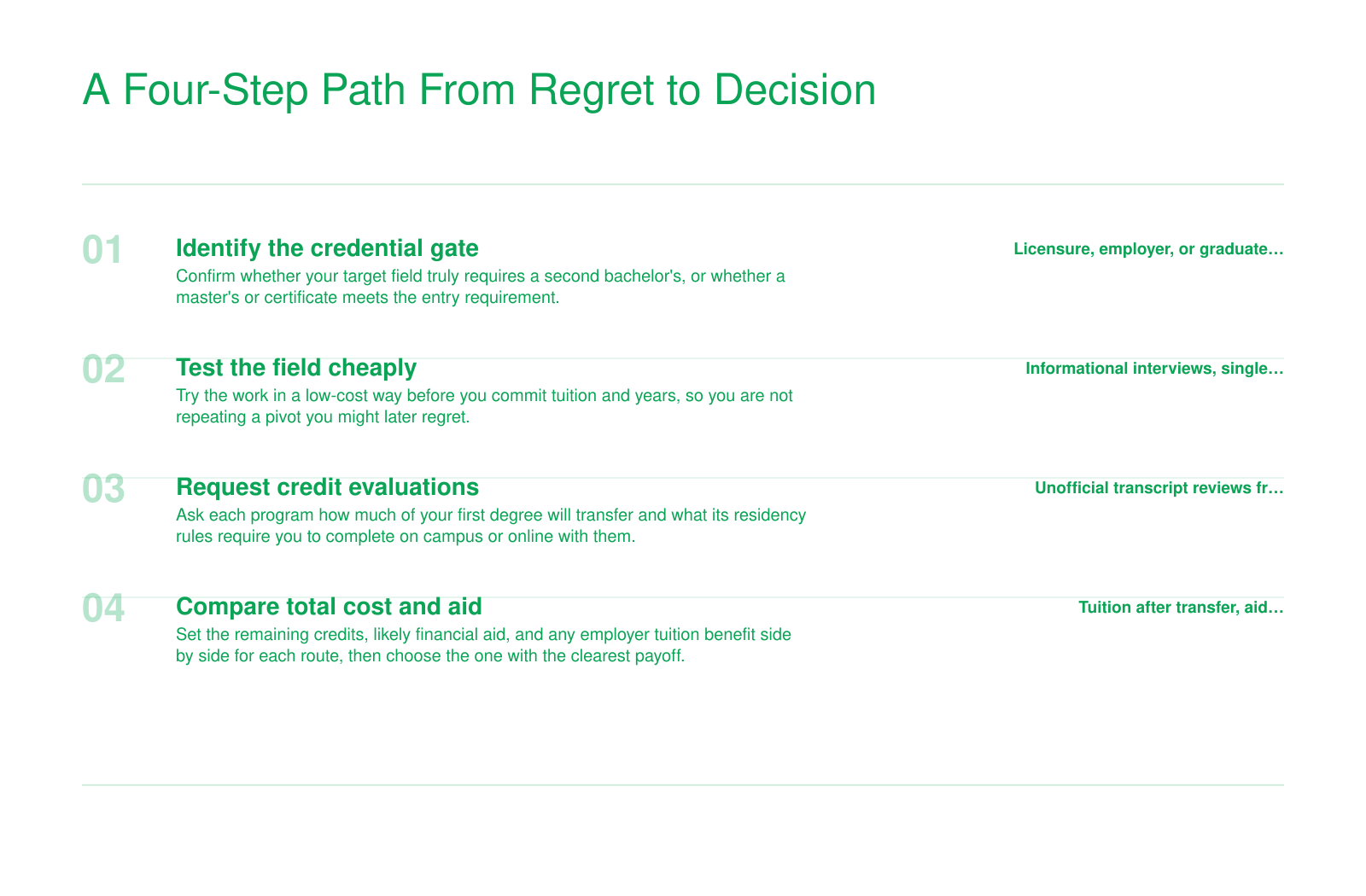
A Four-Step Path From Regret to Decision
Treat the choice between a second bachelor's, a master's, and a certificate as a sequence, not a single leap. Each step settles one question before you spend money on the next.