Nervous About Going Back to Campus? A Practical Guide for Adult Students
Compare housing, commute and family costs, then plan your first weeks on campus

Key Points
- One parent's semester apartment cost under $2,700; nearby rent averaged $1,200 monthly.
- College Board puts 2025-26 public four-year housing and food at $13,900.
- Lost transfer credits left one 37-year-old about two years from graduating.
Moving Your Whole Life for a Degree: What One 37-Year-Old Parent's Story Tells Us
A 37-year-old married parent with a mortgage is moving 8 to 9 hours out of state to finish a bachelor's degree, since the program runs nowhere online or closer to home; about two years remain after credit loss. In the r/BackToCollege post, a semester-billed campus apartment costs just under $2,700 against roughly $1,200 a month off campus.
Three worries drive a move like this: where an adult with a family lives, what a semester costs once a lease and childcare are counted, and how to get through the first weeks. Campus housing bills by semester; leases bill by the year, and that mismatch is where plans break.
Why Returning in Person Feels Different (and Why the Guilt Is Normal)
Online reentry asks you to fit school into the life you already have. Residential reentry asks you to move that life, or at least a large part of it. The difference is bigger than most returning students expect.
You Are Leaving Something, Not Just Adding Something
With an online program, the home, the routine, and often the job stay in place while classes slot in around them. Going on campus can mean leaving all three. That is why in-person reentry tends to stir up more nerves than a login screen ever does.
Consider the 37-year-old parent who posted on r/BackToCollege about moving out of state to finish a bachelor's degree. The program is not offered online, and the home state does not offer it at all. This person is married, has children and a mortgage, and is a first-generation American and a first-generation college student. Family members have described the move as failing parental duties.
That feeling deserves to be taken seriously, not argued away. When your family has never seen anyone leave for school as an adult, leaving can look like abandonment. A more accurate way to see it: a time-limited investment with an end date. In this case, roughly two years of study leads to a finished degree and a stronger income for the whole household.
Communication Routines That Keep Home Close
Guilt shrinks when the family knows what to expect. A few simple habits help:
- Daily check-in: A short call or video chat at a set time, even ten minutes, so children hear from you every day. One commenter on the thread specifically recommended daily contact with spouse and kids.
- Shared family calendar: Put exams, school events, and appointments in one place everyone can see, so nobody is surprised by your schedule.
- Fixed visit schedule: Decide early when you will be home for breaks and summers, and tell the kids the dates. A long drive home is easier to bear when it is on the calendar.
The Age Question
Nerves about being the oldest person in a lecture hall or in the apartment are common among returning students, and they usually ease within the first few weeks. The practical side, housing, costs, credits, and settling in, comes next.
Housing Options for Adult and Nontraditional Students
Housing is usually what decides whether an in-person return works or quietly falls apart, and the right answer depends less on price than on who is coming with you.
Dorms, Transfer Apartments, and Family Housing
Traditional residence halls are built around 18-to-22-year-olds in shared rooms with meal plans, and they rarely accommodate a spouse or children. A commenter in their 30s on the original r/BackToCollege thread described dorm living as "ROUGH" and pointed readers toward other options.
Transfer and nontraditional apartments sit in the middle. The 37-year-old parent who started that thread, returning out of state with about two years left on a bachelor's degree, chose campus apartments designated for transfer and nontraditional students, sharing with three or four people, at just under $2,700 for the semesters.
Married and family housing is the third track, and eligibility rules vary widely. UCLA limits it to married students, single parents, domestic partners, and families, requires full-time enrollment, and asks for a marriage license or birth certificate.1 Stanford's couples housing asks that partners co-occupy at least 50 percent of each week.2 Wisconsin-Madison requires undergraduates with families to carry at least six credits a semester3, and Youngstown State's Weller House is open to graduate, married, or parenting students but was full for 2026-2027.
Can You Live on Campus With a Spouse or Children?
Sometimes, but family units on campus are genuinely scarce. Florida's graduate and family housing quotes a two-to-three-year wait from application4, BYU fills spaces by waitlist position, and offers there can carry acceptance windows measured in hours.5 Apply the moment you are admitted, ask how the waitlist actually moves, and have a backup.
One commenter noted that a transfer school they looked at keeps separate living areas for nontraditional students who are married or have families. Ask your housing office that exact question.
Off-Campus and Short-Term Furnished Rooms
Off-campus rent near the poster's university ran about $1,200 a month, roughly $4,800 plus utilities across a semester, usually on a year-long lease. Furnished Finder came up in the thread as a source of room rentals on flexible terms, which suits a student who goes home for breaks and summer.
A Rule of Thumb
- Solo parent: family housing first, applied for early; a furnished room only if childcare is already settled nearby.
- Married, family staying behind: the cheapest shared campus apartment, since a 12-month lease you barely use is wasted money.
- Relocating with family: family housing if you can clear the waitlist, otherwise a month-to-month rental while you learn the local market.
- Eligibility for Student Family HousingUCLA Housing
- Enrollment Requirements and Eligibility for Graduate HousingStanford Residential & Dining Enterprises
- Apartment Leasing ApplicationUniversity of Wisconsin-Madison Housing
- Graduate and Family Housing ApplicationUniversity of Florida Housing
- Family Housing Waiting List InformationBrigham Young University Housing
On-Campus vs Off-Campus vs Commuting: Running the Real Numbers
The College Board's 2025-26 student budget sets housing and food at $13,900 for in-state and out-of-state students at public four-year colleges, $15,920 at private nonprofit four-year colleges, and $10,850 at public two-year colleges.1 For 2026-27, the public four-year figure rises to $14,430.2 These are budgeting allowances for housing plus food, not room-only bills, so treat them as a rough ceiling check rather than a quote from any one campus.
What the Benchmarks Can and Can't Tell You
No national series cleanly isolates what students pay in off-campus rent, and the College Board numbers blend the two living arrangements. That means your own comparison matters more than any average. Pull the school's posted room rate, then price real listings near campus, including utilities, internet, and a security deposit.
The case from the Reddit thread shows the gap that average hides. A shared transfer-student apartment billed per semester came in under $2,700, while nearby off-campus rent was estimated around $1,200 a month with a year-long lease. Rates and lease terms vary by school and town, so verify both.
Commuting Has Its Own Math
If you live within driving distance, add up the costs that housing allowances leave out:
- Transportation: Fuel, parking permits, maintenance, and the time you spend behind the wheel on class days.
- Lease overlap: Whether you can keep your current home, and what a second residence would add.
- Flexibility: Whether your class schedule allows a few long days on campus instead of five short ones.
Don't Leave Child Care Out
For parents, child care can outweigh the housing decision. Child Care Aware of America puts the 2025 national average for child care at $13,184 a year.3 That figure covers child care generally, not a specific age. The same organization reports that center care for two children, an infant and a 4-year-old, costs more than rent in all 47 states with price data.3 If your spouse or a relative covers care at home, a long-distance setup may cost less than moving the whole family. If you would relocate children, price local care before you sign anything.
Build a one-page budget with three columns (on-campus, off-campus, commute) and fill each with real quotes. The cheapest line is not always the cheapest life.
- Trends in College Pricing and Student Aid ReportCollege Board
- Trends in College Pricing and Student Aid 2026College Board
- Child Care Prices Rival Major Household ExpensesChild Care Aware of America
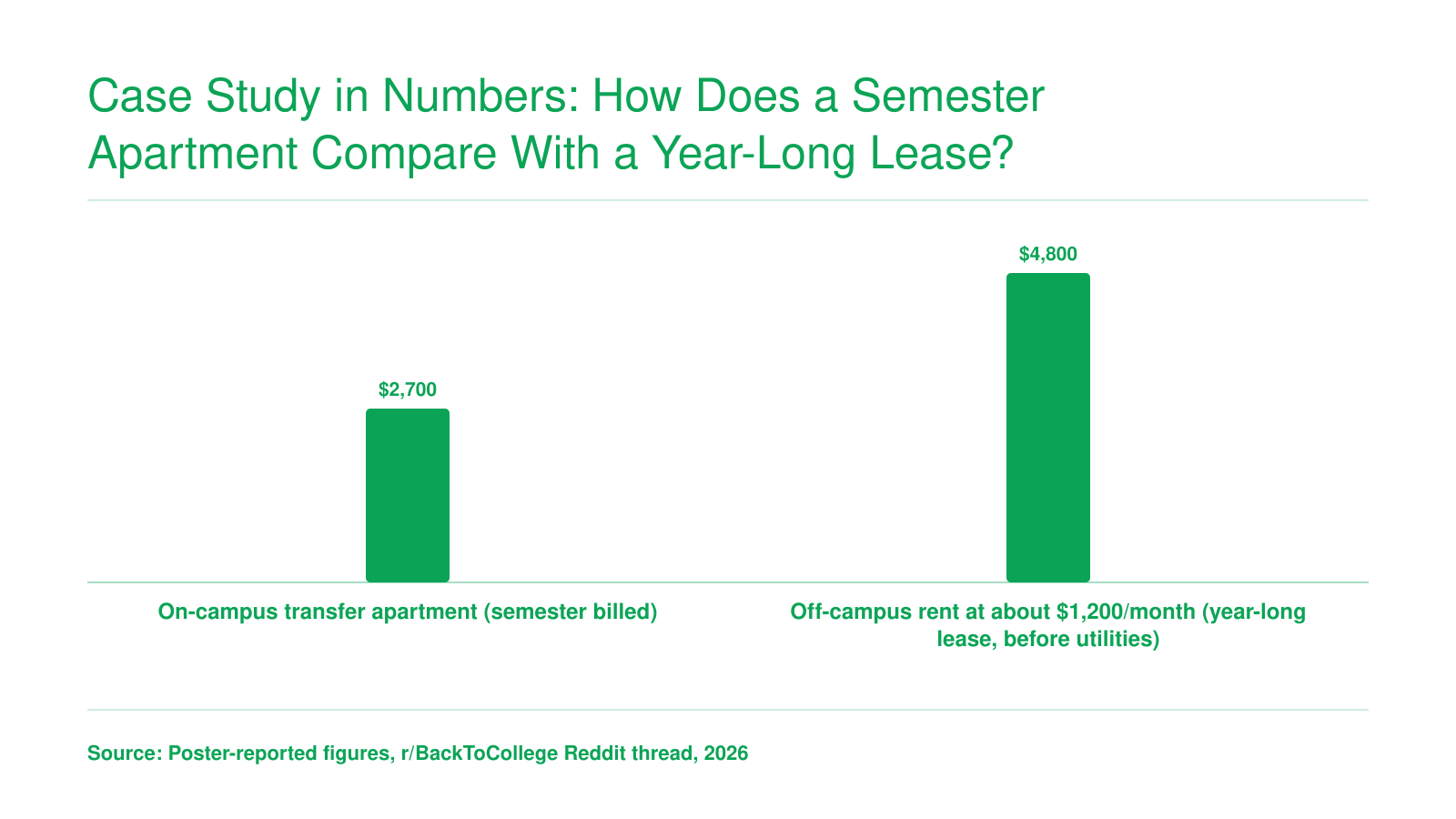
Case Study in Numbers: Semester Apartment vs Year-Long Lease
These are approximate costs reported by one returning student in a Reddit thread, not national averages. The on-campus apartment for transfer and nontraditional students came to just under $2,700 for the semester, while nearby off-campus rent averaged about $1,200 a month, roughly $4,800 for the same stretch before utilities. The chart also leaves out utilities, a year-long lease that keeps charging through summer, trips home 8-9 hours away, and the mortgage still due at home.
What Happens to Your Timeline When Credits Don't Transfer
Transfer credit is the variable that most often decides how long an adult's degree actually takes, and it is the one most families forget to price in. The federal government's most recent nationally representative look at the question found that students who transferred between 2004 and 2009 lost 43 percent of their credits on average, about 13 credits; public-to-public transfers lost roughly 37 percent, and those moving from a private for-profit to a public college lost 94 percent.1 A 2026 registrars' association snapshot puts acceptance from regionally accredited senders at 57 percent on average, though its methods differ, so read it as a signal rather than a replacement figure.2
The Two-Year Floor
The Reddit poster's situation is instructive precisely because it was a best case. They picked the program that awarded the most transfer credit and still had about two years left. Every semester added by a rejected course is another semester of rent, another semester away from home, another round of childcare logistics. At under $2,700 per semester for the shared on-campus apartment versus roughly $1,200 a month off campus, each extra term has a number attached.
Why Older Credits Slip Away
No national rule makes coursework expire. Recency and expiration rules come from the receiving college, the program, and sometimes the state system, and the government's own review noted that many schools treat credits as valid for 8 to 10 years.3 Fields that change quickly, licensed ones especially, tend to enforce the tightest windows. A course can be accepted as an elective and still be excluded from your major, which quietly adds semesters even when the transcript looks fine.
Four Questions Before You Commit
- Will I get a written credit evaluation before I enroll or pay a deposit?
- Do you offer prior-learning assessment or credit by exam for what I already know?
- Do required major courses have expiration windows, and will I need substitutions?
- Which credits count toward the major, and which land only as general electives?
Compare programs on credits accepted, not sticker price alone, and get the evaluation in writing.
- GAO-17-574: Transfer of College CreditsU.S. Government Accountability Office
- National Snapshot: Transferring Earned CreditAACRAO/ACE
- GAO Transcript: College Credit Transfer and Credit ValidityU.S. Government Accountability Office
Paying for It: Financial Aid, Independent Status, and Employer Help
For an adult going back to school with little money, the FAFSA is the first move, and independent status is what makes it work in your favor.
Who Counts as Independent on the 2026-27 FAFSA
You need to meet at least one federal criterion.1 The ones returning adults most often meet:
- Age: born before January 1, 2003 (that works out to at least 24 by the end of 20262).
- Marriage: married on the date you apply, and not separated.
- Dependents: you provide more than half the support for children or others (not a spouse), both now and through June 30, 2027.
- Military service: you are a veteran or serving on active duty for purposes other than training.
Independent students generally leave parent information off the form entirely.3 If you were born in 2003 or later and meet no criterion, ask the financial aid office whether a dependency override applies to your situation.1
Housing Is Built Into Your Aid Budget
Federal cost of attendance covers tuition and fees, books and supplies, transportation, and food and housing.4 For independent students, the food and housing allowance generally follows your living arrangement and may include costs for dependents.4 That is why the apartment-versus-lease decision matters beyond rent: ask the aid office what allowance it uses for each housing type before you sign anything.
Ask HR Before You Resign or Relocate
Under Section 127, employers can provide up to $5,250 in educational assistance tax-free for 2026.5 That single cap covers tuition help and payments on qualified student loans combined, not each separately.5 Amounts above it are generally taxable unless another exclusion applies.6 Before leaving a job or moving, ask HR whether the benefit continues if you go part-time or work remotely.
Clear the Past Before You Enroll
If you left school years ago, check three things first:
- Prior aid: log in to StudentAid.gov to see how much federal aid you have already used.
- Academic progress: schools require satisfactory progress (GPA plus credits completed within a maximum timeframe) for federal aid, so ask where your old record stands and whether an appeal is possible.
- Balance holds: an unpaid bill at a former school can stall registration or transcript requests.
- FAFSA Dependency StatusFederal Student Aid
- Student Aid Index (SAI) and Pell Grant Eligibility GuideFederal Student Aid
- Do I Need My Parents' Information?Federal Student Aid
- 2026–27 FSA Handbook: Application and Verification Guide, Chapter 2Federal Student Aid
- Working Families Tax Cuts and BusinessesInternal Revenue Service
- IRS Publication 15-B: Employer's Tax Guide to Fringe BenefitsInternal Revenue Service
Is Moving for a Degree Right for You? Questions to Ask Yourself First
Is this degree truly unavailable online or in your home state, and have you ruled out hybrid options?
Relocating only makes sense if no closer path exists. Check for hybrid formats, nearby transfer-friendly schools, and in-state completion programs first, since moving is the costliest way to finish.
Can your household cover double housing costs for the full time to graduation?
You may carry the mortgage at home while paying for a second place near campus. Add up both bills, plus utilities and travel, and confirm you can sustain them through the last semester.
Can you handle 8-9 hours of distance during emergencies, and what is the plan for breaks and summers?
A sick child or family crisis will not wait for a semester break. Decide in advance who steps in at home, how fast you can travel, and where you will spend each break.
Is this degree needed for a specific raise or career move that pays for the sacrifice?
A concrete payoff, such as a required credential or a defined promotion, makes time away easier to justify. Without one, weigh whether a slower, closer route fits your family better.
Questions to Ask Admissions and Housing Offices Before You Commit
Get clear answers, ideally in writing, before you sign a housing contract, pay a deposit or tell your employer you're leaving.
- Housing eligibility and waitlistDo I qualify for family, nontraditional or transfer-student housing as a married parent or older student? How long is the waitlist, and when should I apply?
- Roommates and occupancyHow many people share each apartment? How are roommates assigned, and can I request to live with other adult or transfer students?
- Lease length and breaksIs housing billed by the semester or the year? Can I stay over winter break and summer? What fees apply if I leave early or move off campus?
- Family, guest and pet policiesCan my spouse and children visit or stay overnight? Are there limits on guests? Are pets allowed?
- Accessibility accommodationsHow do I request housing accommodations for a disability or medical need, and what documentation is required?
- Financial aid impactHow are housing charges counted in the cost of attendance? Will choosing on-campus or off-campus housing change my aid package?
- Transfer credit and graduation dateCan I get a written transfer-credit evaluation before enrolling, along with an expected graduation date?
Your First Weeks on Campus: A Prep and Settling-in Plan
Adult learners now arrive on campus with a lease, a custody calendar, and a job already running, which makes the first month less a fresh start than a logistics project. In a recent r/BackToCollege post, a 37-year-old married parent with a mortgage described moving 8 to 9 hours from home to finish a bachelor's degree in a shared on-campus apartment, heading back to family during breaks. Whether your own move is 90 minutes or a full day's drive, settling in goes better when you plan it in stages instead of improvising.
Before You Move In
Pack for a shared kitchen, not a single. One commenter on that thread suggested bringing your own plates and bowls, thrifted to keep costs down, so you are never waiting on a roommate's dishes. Add labeled food storage, a small lock box for documents and medication, and a few basic cooking tools you actually use. Buy less than you think you need; you can fill gaps once you have seen how the kitchen is actually shared.
Week One: Orient Yourself to Your Own Life
Confirm every login before the first class: learning management system, student email, library access, and the housing portal for maintenance requests. Walk to each classroom building a day ahead so the first morning is not a scavenger hunt. Introduce yourself to each instructor at the end of the first session; one sentence is enough. Then set a standing daily call with your spouse and kids at a fixed time, because a predictable slot beats catching up whenever there is a spare minute.
Weeks Two Through Four
Week two is for a study routine that fits an adult schedule: fixed blocks on the calendar, kept in the library or another quiet space away from the apartment. If the apartment is loud at night, the library becomes your office rather than your backup plan.
Weeks three and four are when the confidence dip usually hits, right around the first exams. That dip is normal and it is not evidence you made a mistake. Two quick tools: a short walk between study blocks, and a weekly call with one peer in your program, which turns a stranger into your first campus contact.
Set House Rules Early
In the first week, ask roommates about quiet hours, cleaning rotation, and kitchen rules before small irritations harden into resentment. A ten-minute conversation now saves a semester of silent friction.
Moving across the country is a time-limited investment. Two years of shared kitchens and long drives is not a permanent life, and every semester brings you closer to coming home with a degree.
degreecompletion.com
Using Adult Learner and Transfer Offices to Build Your Support Network
You can treat campus as a place to attend class and leave, or as a place with people paid to help you finish. For a returning adult living far from home, the second approach is the safer bet.
What These Offices Typically Offer
Services vary by school, and not every campus has a dedicated office. Where one exists, it often provides advising and transfer-credit evaluation, an orientation built for transfers, peer or cohort groups, tutoring, and career or financial aid help. Some coordinate counseling and basic-needs referrals rather than delivering them directly. Evening or flexible hours are common enough to ask about, but they are not guaranteed.
Why It Matters
National Student Clearinghouse Research Center data on the fall 2019 cohort show that six-year completion was 36.6% for students aged 25 or older and 35.6% for ages 21 to 24, against 63.8% for those who started at 20 or younger.1 Part-time starters completed at 34.1% and stopped out at 51.7%, compared with 67.1% and 25.1% for full-time starters.1 The data do not say why the gaps exist, and they do not show that any service closes them. They do show that adults face real attrition risk, which makes early connection worth the effort.
Your First-Month Moves
- Book an advising appointment: Bring your transcript and ask for a written degree plan, so lost credits and timeline surprises surface now.
- Join a nontraditional student group: Many campuses run one, and it is often the quickest route to people with similar schedules.
- Ask about emergency aid and student parent resources: Small grants, childcare referrals, and food support are easier to access before a crisis.
- Ask what happens after hours: Find out whether advising, tutoring, or counseling is offered in the evening or by video.
Find Two Peers in the Same Boat
The r/BackToCollege thread shows the pattern: a 37-year-old parent asked strangers, and others in their 30s and 40s answered with housing leads and practical tips. Aim to know at least two classmates in a similar situation by the end of the first month. Trading notes on professors, rentals, and family guilt with someone who understands is often what keeps a hard semester manageable.
- National Student Clearinghouse Research CenterNational Student Clearinghouse Research Center