Going Back to College in Your Late 30s: How to Plan Around Real-Life Limits
Audit your time, money, and location limits before choosing a program format

Key Points
- Nearly 43.1 million Americans hold college credit but no credential.
- Exclusively part-time bachelor's earners took a median 5.0 years to finish.
- Three class days with a 2-hour one-way drive cost 12 hours weekly.
Going Back at 38: What the Decision Actually Hinges On
Some 43.1 million Americans have college credit and no credential, so the question at 38 is rarely "can I?" It is which path fits a life already full, and how long it will take.
The case here comes from a r/BackToCollege thread: a late-30s poster in British Columbia, two hours by road from the nearest college, weighing a bookkeeping certificate against an accounting credential. The order here runs from age to constraints, format, credential level, credits, timeline, and cost. Taken together, these questions are a way to test your own situation rather than a single recommended route.
For most returning students, the binding limit is a fixed obligation, not ability.
Is 38 Too Old to Go Back to College? What Age Really Changes
No, 38 is not too old to go back to college. Thirty-eight sits comfortably inside the range where adults re-enroll, finish degrees and change fields; what blocks people that age is time and cash flow, not ability.
What the Completion Numbers Really Show
National Student Clearinghouse Research Center figures for the fall 2019 entering cohort, published in December 2025, put six-year completion at 61.1% across more than 2.3 million students.1 Broken out by age at entry, 63.8% of students 20 or younger finished a credential within six years, against 35.6% of those 21 to 24 and 36.6% of those 25 and older.1 The gap is real and worth planning around. It is also not a verdict on your brain: older entrants are far more likely to be working, caregiving, and paying their own way, so one unplanned expense or one semester of cut hours can push a part-time student past the six-year mark the statistic measures.
What Faculty See in the Room
In the thread that prompted all of this, a commenter identifying as a US college professor said many faculty welcome returning students and find them blunter and harder workers than the 18-to-23-year-olds. Treat that as one instructor's read rather than a study, but it tracks with what adult learners report: the habits that make someone good at a job tend to make them good at coursework too.
What Age Does Change
- Flexibility: a two-hour drive each way, as the original poster in British Columbia faced, is a scheduling problem before it becomes a financial one.
- Obligations: caregiving and housing responsibilities narrow the list of workable programs.
- Payoff window: fewer working years remain to recoup tuition, so cost per credential counts for more than it did at 19.
Is it too late at 30? No. Thirty is roughly where returning to school stops being unusual and starts being routine.
- Yearly Progress and CompletionNational Student Clearinghouse Research Center
Audit Your Constraints Before You Pick a Program
Section content unavailable.
Online vs. Commuting to a Distant Campus: What Each Really Costs You
The biggest cost of a distant campus is usually time, not tuition. A 2-hour one-way drive is 4 hours of travel per class day, so three days a week adds about 12 unpaid hours before fuel, vehicle wear, and parking. The ratings below are qualitative, so price out your own program before comparing totals.
| Factor | Fully online | Hybrid or blended | Commuting to a distant campus |
|---|---|---|---|
| Weekly time | Study and class time only, with no travel | Study time plus a smaller block of travel on campus days | Study and class time plus about 12 hours of driving at three days a week on a 2-hour route |
| Out-of-pocket costs | Lowest travel spending; may need a reliable computer and internet | Moderate: occasional fuel, parking, and possibly a meal or overnight stay | Highest: fuel, wear on the car, parking, and possibly lost work hours |
| Schedule flexibility | High, especially with asynchronous courses; live sessions may still fix some times | Medium: online work is flexible, but on-campus dates are fixed | Low: fixed meeting times plus drive time, which is hard to fit around work or caregiving |
| Access to faculty and peers | Depends on the school; relies on email, forums, and video office hours | Good balance of in-person contact and remote convenience | Strongest face-to-face contact, but travel limits time on campus beyond class |
| Risk of dropping out | Can rise when you work alone with little structure; routines and check-ins help | Often lower than either extreme if the on-campus schedule is predictable | Can rise as fatigue, car trouble, and weather pile up over many terms |
| When no fully online version of your program exists | Look for online courses at another accredited school that will transfer, and get written approval before enrolling | Ask about one-day-a-week on-campus formats, plus evening or weekend sections | Check whether a nearer satellite campus offers the same program before committing to the long drive |
- Reviewing My 2025 Higher Ed Predictions: Hits, Misses, and What Actually HappenedEncoura
- 2025 Performance Accountability ReportMontgomery College
- 2025 Fall Enrollment Report: Iowa Community CollegesIowa Department of Education
- Campus Forum: Student Perspectives and Survey SummariesMerced College
- CHLOE 10 - Meeting the Moment: Navigating Growth, Competition, and Change in Online Higher EducationQuality Matters, Eduventures, and EDUCAUSE
- 64 Online Learning Statistics for 2026National University
- Hidden costs of college include, for many, commutingEdSource
Certificate, Associate, or Bachelor's: Matching Credential Level to Your Goal
The Reddit poster wants an entry-level job from a certificate or diploma of up to two years and is weighing an online bookkeeping certificate against an accounting credential. The choice depends on the job: U.S. Bureau of Labor Statistics data lists some college with no degree as typical for bookkeeping and accounting clerks, while accountant, auditor, and CPA-track roles typically expect a bachelor's. A practical rule is to pick the lowest credential that opens the specific entry-level job you want, then confirm in writing that its credits count toward an associate or bachelor's, since not every certificate stacks. Program length varies by school, so get it from each program directly. Doing your own business taxes with high-school accounting, as the poster did, is a useful start, but accounting coursework goes much further than preparing a single return.
| Credential | Typical Time | Typical Entry-Level Roles | Median Pay / Outlook |
|---|---|---|---|
| Bookkeeping certificate (U.S.) | Varies by program | Bookkeeping, accounting, and auditing clerks (typical entry level: some college, no degree) | $50,670 USD per year for clerks (BLS, May 2025) |
| Bookkeeping certificate (British Columbia) | Varies by program | Bookkeeper | $28.00 CAD per hour (Government of Canada Job Bank, 2026) |
| Associate in accounting | Varies by program | Bookkeeping, accounting, and auditing clerks (meets the some-college entry level) | $50,670 USD per year for clerks (BLS, May 2025) |
| Bachelor's in accounting | Varies by program | Accountants and auditors (typical entry level: bachelor's degree) | $83,680 USD per year (BLS, May 2025) |
- Bookkeeping, Accounting, and Auditing ClerksU.S. Bureau of Labor Statistics
- Accountants and Auditors: Occupational Outlook HandbookU.S. Bureau of Labor Statistics
- Accounting Schools, Degrees & Certificate ProgramsTrade-Schools.net
- Bookkeeper in British Columbia | Labour Market Facts and FiguresGovernment of Canada Job Bank
Finishing an Old Major vs. Starting Something New
Finishing an old major means going back to the program you left and completing what remains. Starting something new means applying your past coursework toward a different degree or credential. The Reddit poster behind these questions sits right on that line. They left college partway through a science program and, years later, are drawn to bookkeeping or accounting.
Starting Over Rarely Means Starting From Zero
Old courses that don't match a new major usually still count somewhere. Science classes such as biology, chemistry, or physics commonly satisfy general education requirements in the natural sciences, and extra courses can often fill free elective slots. A former science student moving into accounting may find that a meaningful share of the first two years is already covered, even if none of it counts toward accounting coursework itself.
A Quick Test for Which Way to Go
- Finish the old major if: you need fewer than about 30 credits (roughly one year of full-time study) and the degree still leads to work you want and can do.
- Switch if: the old field no longer fits your health, your schedule, or the job market where you live. Lab-heavy science programs, for example, may require in-person hours that a long commute or physical limitations make unrealistic.
- Look harder if: you land in between. A related program, or a degree with a broad elective allowance, can sometimes absorb more of your old credits than either extreme.
Waiting Has a Cost
Indecision is not neutral. Some schools limit how old a credit can be before it stops counting, especially in fast-moving subjects like science and technology, and those policies vary by institution. Every year of delay can shrink what transfers.
The most useful next step is to ask an advisor for a degree audit that maps your transcript against the old major and the new target side by side. Seeing the remaining credits for each option in one view usually settles the question faster than weighing it in the abstract.
How Many Old Credits Will Transfer After 15 Years?
You can treat your old transcript as a clean slate or as an asset worth appraising. The second approach usually pays better, but only if you ask the right questions before you enroll anywhere.
The Honest Answer: It Varies, and Some Credits Vanish
No single rule governs transfer credit, because each school makes its own decision.1 The most-cited benchmark comes from federal auditors who tracked students who began college in 2003-04: those who later transferred lost an estimated 43% of their credits, about 13 on average2, and public-to-public moves ran slightly better at 37%. Students arriving from regionally accredited colleges had roughly 57% of credits accepted, against about 12% from nationally accredited ones. Only 28% had every earned credit applied.3 Those figures describe an older cohort, so treat them as a measure of how much is at stake rather than a current national rate.
Where Age Actually Matters
Nothing voids a transcript automatically. Schools set recency windows instead, and they cluster around fast-changing material: science, technology, math, and computer courses often carry limits of 5 to 10 years, major courses commonly 7, and some nursing programs draw the line at 2.1 Courses older than 10 years frequently need departmental approval, and some schools apply them as general electives even when the content still matches. General education credit tends to survive longest.
Get the Answer in Writing
Request official transcripts from every institution you attended, then ask for a formal credit evaluation before you register, not after. Ask specifically which credits count as equivalent to a required course versus which land as elective hours, since elective acceptance does not fill prerequisites.
Prior learning assessment is the other lever: CLEP exams, departmental challenge exams, portfolio review, and military training can all convert experience into credit. CLEP awards require the institution's own minimum score, and caps vary widely. One sample policy limits CLEP to 60 credits total5, while the University of Maryland caps prior learning at 60 and CLEP at 30.4
Finally, read the registrar's and admissions pages for language like "degree completion" or "adult learner." Schools that use those terms usually have staff who evaluate old transcripts for a living.
- Do College Credits Expire?Mississippi State University
- GAO-17-574 Highlights: Transfer of College CreditsU.S. Government Accountability Office
- Reimagining Transfer for Student SuccessAACRAO
- Prior LearningUniversity of Maryland
- Sample CLEP PolicyCollege Board
Building a Realistic Timeline: Part-Time, Full-Time, and the Worst Case
The National Student Clearinghouse Research Center's 2026 Time to Degree report puts the median for 2024-25 bachelor's earners at 3.7 years overall, but the number shifts sharply with enrollment pattern: 5.0 years for exclusively part-time students and 11.9 years for those who were part-time at least 80% of the time. Treat the 11.9 as a warning about stop-outs and interruptions, not a forecast. It is a median, and elapsed time includes breaks.
The Math Behind Part-Time
A bachelor's degree typically requires 120 credits. Financial aid generally counts 12 credits a term as full-time, so part-time means fewer than that.1 No national source gives a single typical load for part-time students. As an illustration only, 9 credits per semester works out to about 13.3 semesters, or roughly 6.7 years at two semesters a year, before any interruptions.
Remaining credits change everything. With 30 credits left, 9 per semester finishes in about four semesters. With 90 left, the same pace takes ten. Count your credits before you count years.
Planning for a 16-Month Worst Case
Define the worst case as a stretch of reduced capacity from health, caregiving, or work that lasts about 16 months. Then build around it:
- Buffer term: Leave one open term in the schedule so a lost semester delays graduation rather than derailing it.
- Reduced-load fallback: Decide in advance the minimum you would carry, perhaps one course, to keep momentum and aid eligibility.
- Leave policy check: Ask each school how leaves of absence, deferrals, and readmission work, and whether your catalog requirements or transferred credits expire if you pause.
Certificate vs. Degree in a Bad Year
A certificate of up to two years has fewer terms to protect, so a lost year costs less in absolute terms. A multi-year bachelor's has more exposure, but the stakes are different: a paused degree can resume, while a paused certificate may still leave you with nothing portable if you stop partway. Shorter programs generally survive a bad year better, provided they lead to the job you want.
One rule covers both paths: schedule for your worst realistic month, not your best.
Years to Finish at Different Course Loads
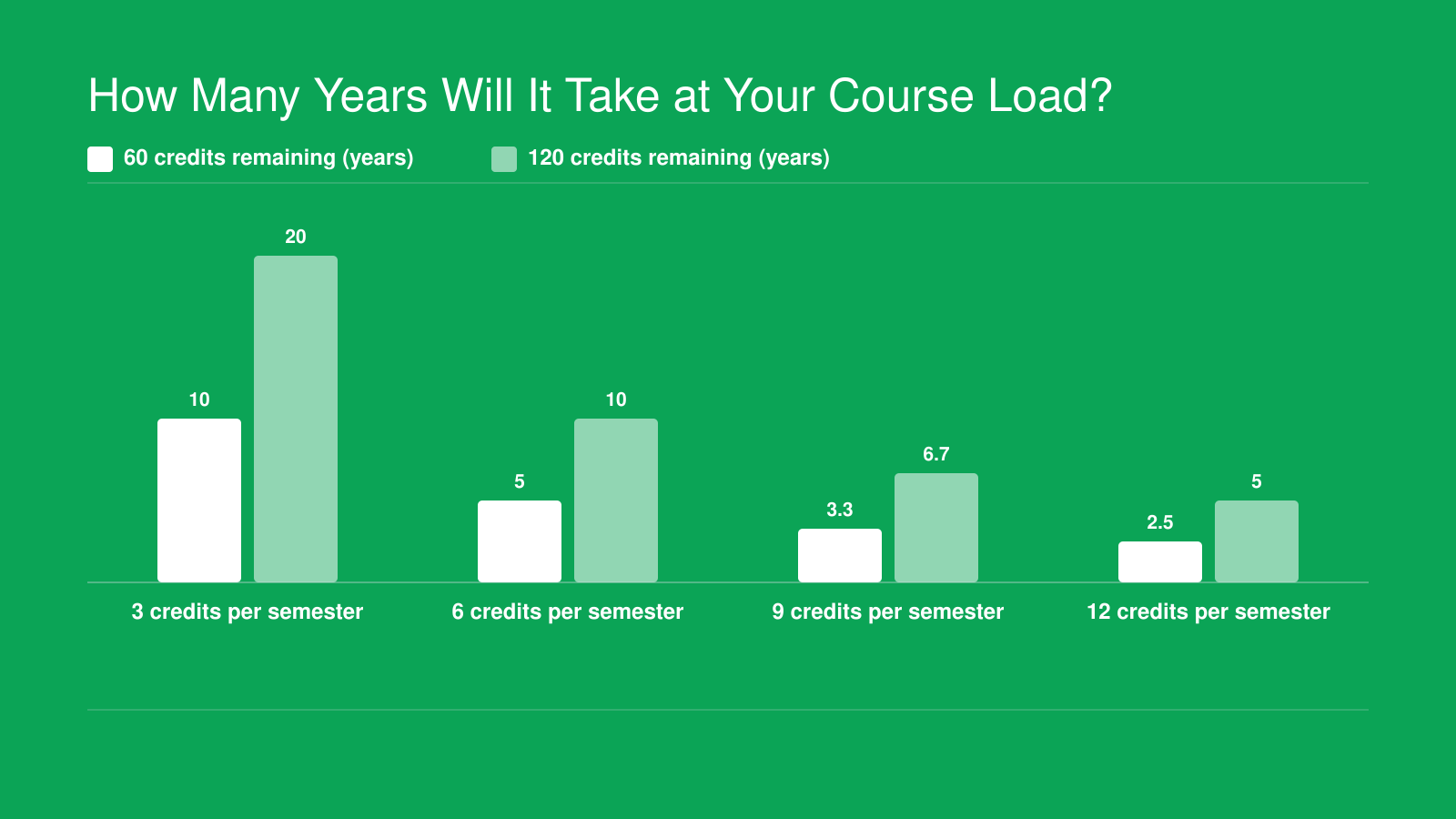
These figures are simple arithmetic: credits remaining divided by credits per year, assuming fall and spring semesters only and no summer terms, so 3 credits a semester equals 6 credits a year. One course a semester stretches 60 remaining credits to 10 years, while a full 12-credit load finishes the same 60 in 2.5 years. Every credit that transfers, and every summer course you add, moves you to a faster row, so treat these as starting points to adjust once your transcripts are evaluated.
Paying for It: Aid, Employer Benefits, and Mid-Career Budget Trade-Offs
A short certificate you can pay for as you go and a full degree financed mostly by loans are different financial bets, even when both end in a better job. Sort out which aid you qualify for before you decide which one to take on.
Federal Aid for Independent Students
At 38 you file the FAFSA as an independent student, so no parental income or signatures are involved. Your own income, household size, and assets drive the result. Pell Grants are the first thing to check, because they do not have to be repaid. The maximum was $7,395 for the 2025-26 award year, but confirm the current figure at studentaid.gov. Most students receive less than the maximum, and enrolling part-time reduces the award because it is prorated by credit load.
Federal Direct Loans come next. Independent undergraduates generally can borrow more than dependent students, and limits rise with year level. Only the subsidized portion depends on financial need. Check the current annual and lifetime limits before you plan around them.
A Note for Canadian Readers
If you live in British Columbia, as the poster in the Reddit thread does, aid runs through StudentAid BC and the federal program. Part-time students need to be at an eligible school, meet the residency rules (generally 12 continuous months in B.C. before study)1, and carry roughly 20% to 39% of a full course load2. Part-time loans cover tuition, books, supplies, transportation, and child care, but not living costs5, and outstanding part-time Canada student loans are capped at $10,0003. The B.C. Access Grant (Part-Time) can provide up to $1,000 a year for eligible lower- and middle-income students.4 The 2026/27 application window runs August 1, 2026 to July 31, 2027.6 Rules change, so verify on the official sites.
Employer Tuition Assistance
Under US tax rules (Section 127), employers can provide up to $5,250 a year in educational assistance tax-free. Many offer less, and some offer nothing. Common strings include staying with the company for a set period after reimbursement or earning a minimum grade, often a B or C. Ask HR for the written policy, and ask whether you pay upfront or are reimbursed afterward.
Trade-Offs Worth Making
- Start cheap: Community college credits cost far less per credit and often transfer toward a bachelor's later.
- Certificate first: A short credential can raise your pay while you decide whether a degree is worth it.
- Protect retirement: Draining retirement accounts at 38 costs you taxes, penalties, and years of compounding.
- Borrow against pay: Avoid loans you cannot repay on an entry-level wage.
A Quick Budget Test
Divide the total program cost by the annual raise you realistically expect. A $12,000 certificate that adds $4,000 a year pays back in about three years. A $40,000 degree with the same raise takes ten. Then look at your household: could you cover the monthly loan payment, plus reduced work hours during study, without missing your obligations to a mortgage, rent, or family members who depend on you? If the answer is shaky, choose the smaller credential or a slower pace.
- StudentAid BC Eligibility RequirementsStudentAid BC
- Part-Time Students – Funding OverviewStudentAid BC
- I Need Part-Time Student Financial AssistanceStudentAid BC
- B.C. Access Grant (Part-Time)StudentAid BC
- Low Income Program TaxonomyStudentAid BC
- StudentAid BC Policy Manual 2026/27StudentAid BC
Audit your constraints before you pick a program: the commute you can actually sustain, the caregiving you can't hand off, and the worst realistic month you'll have to get through. The right format follows from those answers.
degreecompletion.com