How to Build a Study Community When You're an Older Student
Find study partners, pick the right format, and keep a group workable around your job

Key Points
- CCRC research ranks learning communities as the strongest-supported retention strategy it reviewed.
- Study groups build accountability, but tutors and writing centers fix knowledge gaps.
- Groups with one fixed weekly slot outlast "whenever everyone's free" scheduling.
Introduction: The Study Partner Problem No One Warns Returning Students About
How do you find a study group when you're 37, working, and taking classes online?
A third-year bachelor's student put a version of that question to r/BackToCollege this year. She wanted study partners aged 25 and up in her own time zone, and named the actual obstacle plainly: a fear of failure and stalled motivation after switching out of full-time work (thread).
The formats exist. Time-zone-matched groups, free adult learner centers on campus, cohort completion programs, and paid body-doubling services such as Flow Club all answer it. What decides whether any of them holds is narrower than where to look: whether the meeting slot survives a working week.
Why Adult Learners Struggle to Find Study Partners
Returning students trade a fixed classroom for flexibility, and the cost of that trade is often the study partners who used to come with the room. Most adult learners only notice the loss once their motivation starts slipping.
What the Search Looks Like in Practice
A post on r/BackToCollege captures the problem well. A 37-year-old in the third year of her bachelor's degree described a strong fear of failure and low motivation. After full days at work, she kept coming home and crashing instead of studying. Her request was specific: she wanted study support from mature students, 25 and older, in the Eastern time zone.
The replies came from people at very different points. One was a 42-year-old who planned to study fully online and would not start junior-level coursework until May 2027. Another was a psychology major her own age who was finishing her final quarter. Both wanted to connect, but neither shared her timeline. Peer searching often looks like this for adults: scattered, self-organized and pieced together one forum post at a time.
Three Structural Causes
- Evening energy crashes: Study time comes after a full workday, when focus is lowest, and no group is waiting for you to show up.
- Mismatched schedules: Campus study groups tend to form around traditional students' class blocks, not around work shifts, commutes and childcare.
- No shared classroom online: Asynchronous courses remove the hallway chat and after-class conversations where study partnerships usually start.
Why Online Makes It Scarcer, Not Easier
A fully online degree seems like it should connect you with more classmates. In practice, the reverse is common. Classmates may be spread across time zones, log in at different hours and interact mainly through required discussion posts. Nobody forms a cohort by accident in that setting.
The takeaway is practical. Adult learners rarely fall into a study community. They have to build one on purpose, filtering for the same things the poster did: age, time zone and schedule.
What a Peer Learning Community Is (and How It Differs From Tutoring, Advising, and Mentoring)
The Community College Research Center's Paths to Persistence review ranked learning communities as the strongest-supported of the retention strategies it examined.1 A peer learning community is a group of students at a similar stage who study together regularly, share accountability, and support one another.
How It Differs From Other Support
These forms of help overlap, but they do different jobs:
- Tutoring: A trained expert helps you understand course content.
- Advising: A staff member helps you plan your degree, credits, and sequence.
- Mentoring: Someone further along in school or a career offers guidance based on experience.
- Informal study group: An ad hoc meetup with no set schedule, roles, or structure.
A peer learning community sits beside these. It is less about expertise and more about showing up, together, week after week.
What the Research Does and Does Not Show
The CCRC review concluded that most of the studies it examined found learning communities strengthen retention and academic achievement.1 Its summary of Vincent Tinto's Seattle Central study, published in the Journal of Higher Education, points to a higher chance of persisting from one quarter to the next.1 Tinto linked this to supportive peer groups, shared learning, and active knowledge building.
The evidence has limits, though. The summary reports no effect size, and it does not break out results for adult or nontraditional students. Treat it as a pattern, not a guarantee. Other CCRC work is useful context but did not test peer groups directly. Its Florida study of students who first enrolled at 25 or older compared 5,652 older students with 29,421 traditional-age students.2 It found that milestones such as reaching 20 credits or completing half a program mattered for graduation, but it did not examine cohorts or study groups.2 Tennessee figures show that more than a quarter of first-time community college students do not persist past the first semester and about half do not persist past the first year.3 That is a reminder of how fragile early momentum is, not proof that a group fixes it.
Guidance for adult students consistently calls belonging critical. That makes peer connection a plausible reason these models help, not a proven cause of completion.
The Practical Takeaway
Use a community as a supplement, not a substitute. It will not explain a statistics concept or sort out your graduation plan. What it can do is keep you consistent and remind you that other adults are working through the same fatigue and the same schedule.
- Paths to Persistence: An Analysis of Research on Program Effectiveness at Community CollegesCommunity College Research Center (CCRC), Teachers College, Columbia University
- Stepping Stones: Enrollment Pathways and Milestones of Older Community College Students in FloridaCommunity College Research Center (CCRC), Teachers College, Columbia University
- Guided Pathways and Adult Students in Tennessee Community CollegesCommunity College Research Center (CCRC), Teachers College, Columbia University
Where Adult Learners Actually Find Study Partners: Free and Paid Options
Most study partners for returning students come from a handful of places: your own courses, your college, public libraries, and independent online communities on Reddit and Discord. Rather than hunting for the perfect group, pick two or three options from the table below and test them in your first two weeks, for example one college-run space, one live online room, and one discussion forum, then keep whichever you actually show up to. Free and independent spaces cost nothing to try, but they rarely guarantee adult-only or subject-matched members, so judge them on fit, not promises.
| Option | Cost | Run By | Best For | Watch Out For |
|---|---|---|---|---|
| Course discussion boards | Included with enrollment (college-sponsored) | Your college, through its learning platform | Classmates in the same course who share deadlines and assignments | Threads can go quiet outside required posts, so you may need to start the study invite yourself |
| Reddit communities such as r/BackToCollege | Free (independent) | Independent online community with volunteer moderators | Finding other returning students and posting requests by age bracket or time zone | Posts can get little visibility, and members are not screened or matched by course |
| Study Together Discord server | No fee stated (independent) | Study Together, an official Discord community | Live online accountability, study rooms, camera or screen sharing, and chat | Global and open to learners from school through university, so adult-only or subject-specific matching is not guaranteed |
| Study Buddies Discord server | No fee stated (independent) | Students; described as made for students by students | Peer accountability and shared study or work sessions with breaks | Listed as a quiet server with 371 members, so available partners may be limited |
| LoFiPop Discord study server | No fee stated (independent) | LoFiPop community operators | A SFW online study group with study and break roles, chat, and background noise | Open to ages 13 and up, so it is not an adult-only community |
| Discord Student Hubs | No fee stated (run by Discord, tied to your school) | Discord, with access verified through an official student email | Currently enrolled students who want school-specific study or class servers with verified classmates | Requires an eligible current school email, so some adult learners may not qualify |
| College adult learner centers or peer groups | Typically free to enrolled students (college-sponsored) | Your college | Meeting other adult and returning students on your own campus or in your own online program | Availability and format vary by school, so check what your college offers |
| Alumni and cohort groups | Typically free (college-sponsored or student-organized) | Your program, alumni office, or the cohort itself | Ongoing peer support with people on the same course sequence | Built-in cohorts exist mainly in cohort-model programs, not in self-paced ones |
| Public library adult programs (Harris County, Boston, New York, Philadelphia) | Free or no fee stated (library-run) | Public library systems; Philadelphia's conversation group is led by volunteers | Adults seeking conversation groups, technology classes, English learning, and connection with other learners | Focused on adult basic education and English practice rather than college coursework; some sessions are in person only |
| Paid body-doubling services such as Flow Club | Paid (independent); check the service's current pricing | Independent companies | Structured, scheduled sessions where you work on camera alongside others for accountability | Membership costs add up, and sessions provide accountability rather than course help |
- Study Together 🪄 - Official Discord ServerDiscord
- Browse Student Discord ServersDiscords.com
- Adult EducationHarris County Public Library
- Information Session for Adult LearnersBoston Public Library
- AdultsNew York Public Library
- Events: Calendar of EventsFree Library of Philadelphia
- Discord Student Hubs GuidelinesDiscord
Colleges With Adult Learner Centers and Peer Community Access
Colleges are opening and staffing dedicated adult learner centers rather than folding them into general student services, and peer mentoring is often the reason they exist. The University of Wisconsin-Stevens Point opened a Non-Traditional Student Center in 2026 in DUC 065, open to all students, as a physical anchor for exactly this kind of connection.5 Other institutions run the same idea as a named program you have to ask for directly.
Where Peer Mentoring Already Exists
Volunteer State Community College runs Pioneer Connections, which matches adult learners who are new or returning after a "life pause" with peer mentors who are themselves adult learners. Participation can happen virtually or on campus, and the 2025-2026 mentor application cycle carried a May 22 deadline.
Penn State World Campus staffs its Chaiken Center peer guides with experienced online learners who help new World Campus undergraduates, including adult learners and military members, balance coursework with careers and family.1 At University of Maryland Global Campus, CareerQuest peer mentoring was adapted for working adults who may never visit a campus: matched mentors communicate through one-on-one messages and phone or video meetings in an online portal.2 Both are documented as remote options, which matters if you never set foot on campus.
Southern Utah University's nontraditional student office offers a physical space to meet peers, sit with a peer mentor, study, eat, and socialize, but published details do not establish remote access.3 UT Austin's Transfer-Year Interest Group places 10 to 15 new nontraditional transfer students in a weekly group with an NTS peer mentor and a staff facilitator during their first semester, framed around campus transition.4
What to Confirm Before You Count on It
Offerings vary by campus and many are on-campus only. A lounge, evening hours, or a monthly social may not translate into anything a remote student can use.
Four Questions for Admissions
- Is there a dedicated adult learner center or nontraditional student office, and is it staffed year-round?
- Can online students be matched with a peer mentor, or is mentoring campus-only?
- Who runs the peer mentoring (staff, paid student leaders, volunteers), and how are mentors trained?
- When does the group meet, and is there a time-zone or asynchronous alternative?
- World Campus Peer Guides ProgramPenn State
- UMGC Peer Mentorship for Student SuccessUniversity of Maryland Global Campus
- Non-Traditional Student ResourcesSouthern Utah University
- Nontraditional Student Transfer-Year Interest GroupsThe University of Texas at Austin
- UW-Stevens Point Opens Non-Traditional Student CenterUniversities of Wisconsin
Cohort Models in Degree Completion Programs: Built-in Community vs Going It Alone
Program labels tell you less than the weekly calendar does. A cohort-based completion program puts you in a defined group on an institution-set timeline. Students take the same courses, hit shared weekly deadlines1, and follow a structured release schedule, with live class sessions weekly or biweekly. Collaborative assignments and scheduled peer review2 are built in, and discussion boards are typically required, graded, and instructor-moderated.1 Published cohort sizes range from a handful to several hundred, and many descriptions land around 8 to 25 students. The trade-off is flexibility: attendance may be required, and accelerating or pausing often means leaving the group.
Where Self-Paced Paths Leave You Alone
Self-paced programs flip the arrangement. You work on your own schedule, often advancing on mastery, through self-directed lectures, quizzes, and assignments. Required peer interaction is often minimal or absent.1 Live sessions are missing, optional, or recorded, and group projects are few or none, largely because classmates may be working through different units at different times. "Self-paced" also does not mean unlimited time: programs may set maximum completion periods, and fixed exams, clinical placements, or internships can still pin you to a calendar.
Many programs sit in between, with self-paced coursework inside a structure that still has deadlines, optional discussion, or periodic live meetings. The sources behind these patterns describe program types rather than naming specific U.S. completion programs, which is why you should ask admissions for the actual weekly requirements instead of trusting the label.
Questions to Ask Before You Enroll
- Start model: Is entry cohort-based or rolling, and are courses locked into a set sequence?
- Group work: How many graded group projects and peer reviews fall in the first year?
- Live sessions: Are they required, how often, and at what times?
- Peer mentors: Are mentors or student organizations part of the program, and how are they assigned?
- Cohort size: How many students are in each group, and is that number capped?
- How to Choose an Online Graduate ProgramUniversity of Mississippi
- Cohort vs. Self-Paced LearningWharton Online
Online Body-Doubling, Discussion Boards, and Study Apps: Using Them Without Wasting Time
Body doubling means working alongside another person, in the same room or on a video call, so their presence nudges you to start and keep going. When a 37-year-old student in r/BackToCollege asked for study partners, one commenter's first suggestion was Flow Club, an online body-doubling community.
How Flow Club and Focusmate Sessions Work
Flow Club runs live, hosted group coworking sessions that last anywhere from 30 minutes to 3 hours. Sixty minutes is the most popular length. Membership is $40 a month or $400 a year, which works out to about $33.33 a month and saves $80. The company advertises a 50% student discount, but it isn't clear whether part-time students qualify or what proof is needed. Reviews also disagree on how long the free trial runs. Secondary reviews report that hosting 10 public sessions in a month can drop the next month's price to $20.1
Focusmate is one-to-one rather than group. You book 25, 50, or 75 minutes, greet your partner and state your goal.2 Then you both work with cameras on and check in at the end. The free tier allows three sessions a week with no credit card. Plus costs $8 a month billed annually ($96 a year) or $12 month to month.3
What the Evidence Actually Shows
The case for body doubling is mostly anecdotal. Writers describe plausible mechanisms: accountability, structure, companionship and less overwhelm. No controlled study shows that Flow Club or Focusmate raises grades or study time. Treat body doubling as a tool worth testing, not a proven fix.
Live Sessions vs. Async Channels for Evening Workers
Synchronous formats, such as a booked session or a time-zone-matched study group, give you a fixed start time. That helps when motivation dips after a shift. Their weakness is scheduling: miss the 7 p.m. slot and the support is gone.
Asynchronous channels, like course discussion boards or Discord threads, work the other way. You can post a question at 11 p.m. and read replies over lunch. The catch is that nothing makes you show up.
Privacy, Moderation, and a Two-Week Rule
- Identity: Use your first name only on public platforms.
- Moderation: Before you join, check who runs the space and how problems get reported.
- Boundaries: Don't share graded work, login details, or personal information like your employer or home address.
- The rule: Pick one live accountability format and one async channel. After two weeks, drop whichever one you aren't actually using.
- Flow Club ReviewToolGPA
- Focusmate ReviewAppBreakup
- Focusmate PricingFocusmate
Live Body-Doubling vs Time-Zone Study Group vs Discussion Board
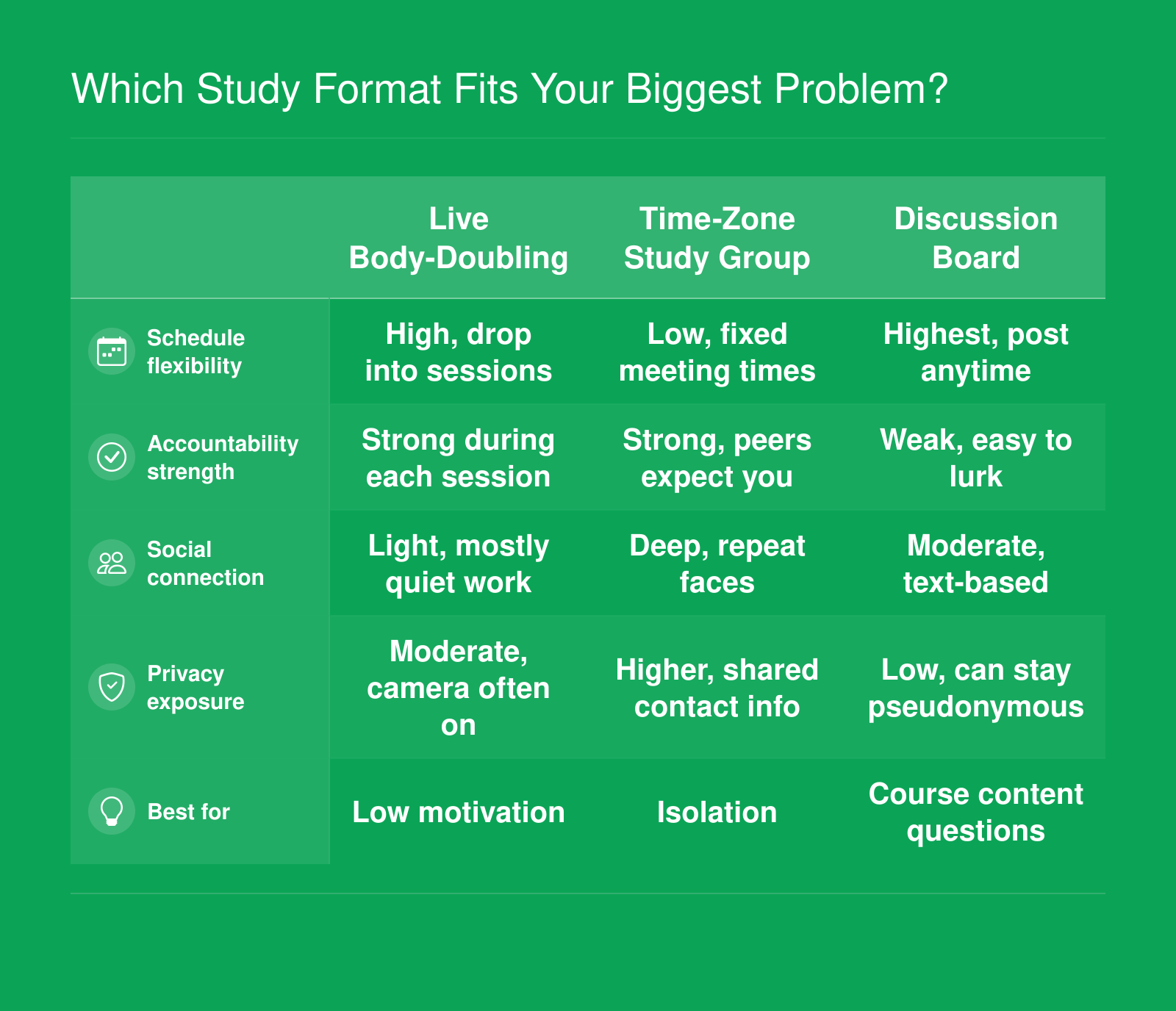
Each format solves a different problem. Live body-doubling helps most when motivation is low, a time-zone study group helps with isolation, and a discussion board is best for questions about course content. Pick the one that matches what is getting in your way right now.
When to Lean on Tutoring and Writing Centers Instead
Academic support has quietly gone hybrid, and that shift matters most to students who cannot drive to campus at 3 p.m. on a Tuesday. Most of the help adult learners need is now free to enrolled students, offered by video and email, and scheduled in the evenings and on weekends, but you have to know which service to contact.
The Rule of Thumb
If the problem is understanding the content or fixing the writing, use tutoring or a writing center. If the problem is motivation, isolation, or the sense that nobody would notice if you quit, use a peer group. A tutor can explain a regression model; a tutor cannot sit with you at 9 p.m. on a Thursday when you would rather do anything else. Matching the remedy to the problem saves weeks.
What Access Actually Looks Like in 2026
Cost is usually zero. Peninsula College runs in-person and Zoom writing support, with paper feedback back within 24 to 48 hours. Temple College offers free 45-minute consultations by Teams or email, though weekend email answers can run slower than the weekday turnaround. San Bernardino Valley College's fall writing schedule runs Sunday through Friday3, while the University of North Texas has Sunday evening online appointments and caps undergraduates at an hour of tutoring a day.4 Ask about limits before you plan around them: Orange Coast College caps tutoring at four hours a week and requires registration first5, and CSU Channel Islands allows two appointments weekly plus a short daily drop-in.6
Check your college's academic support page in the first two weeks of the term, not after a bad midterm. Then close the loop: bring tutor-vetted questions back to your study group so its time goes on thinking rather than guessing.
- Tutoring & Writing CenterPeninsula College
- Writing CenterTemple College
- Online TutoringSan Bernardino Valley College
- Writing Center ServicesUniversity of North Texas
- Writing Tutoring Center ServicesOrange Coast College
- Writing Center Student Services ResourcesCalifornia State University Channel Islands
Peer Group or Professional Help? Questions to Ask Yourself
Am I falling behind because I do not understand the material, or because I cannot make myself sit down and study?
The fix differs sharply. Confusion calls for tutoring or a professor's office hours; avoidance calls for accountability and a scheduled block with other people expecting you.
Would a weekly deadline with other people help me more than another study guide?
Adults who stalled after leaving full-time work often already own the guides. A recurring session with peers adds a deadline and a witness, which changes behavior in ways a PDF cannot.
Does my course load include writing-heavy work where I need feedback from a trained reader?
Peer groups keep you moving and quiz you on concepts, but they rarely diagnose argument structure or citation errors. Writing-intensive terms are when a campus writing center earns its place alongside your group.
Setting Boundaries so a Study Group Fits a Working Schedule
An open-ended group that meets "whenever everyone's free" sounds flexible and usually dissolves by the third week. A bounded group with one fixed slot, a small roster, and a short written agenda survives a working semester. The difference is rarely discipline; it is structure that holds up during a bad month.
The Rules That Keep a Group Alive
- Size: three to five people. Below three, a single absence cancels the session. Above five, the hour turns into a chat.
- Cadence: once a week for 45 to 60 minutes. Long enough to do real work, short enough to protect a shift or a bedtime routine.
- Ownership: rotate who sets the agenda, so nobody carries the group alone and burns out by midterms.
A 45-Minute Agenda That Actually Fits
Spend five minutes on check-in: what is due, what is blocking people. Give 30 to 40 minutes to the focused work or question-and-answer block that the agenda-setter named in advance. Close with five minutes on next steps, meaning what each person commits to before the next meeting and who runs it. Post the agenda in the shared channel the day before; people arrive ready instead of spending ten minutes deciding what to do.
When Work and Caregiving Collide
Agree at the start that missing a week is fine, and mean it. Keep a backup async channel, a group chat or shared document, where absence gets logged and questions still get answered. Ask whoever does attend to post a three-line summary of what was decided. Rotate that duty rather than assigning a permanent note-taker, since the person who misses this week is often the recorder the next.
Run a Trial, and Know How to Exit
Commit to two or three sessions before deciding anything. That is enough to learn whether people actually show up and whether the format fits your schedule. If it does not, give a brief heads-up ("I'm going to step back, this slot isn't working with my shifts"), skip the long explanation, and try another format: a body-doubling session, a different time zone, or a tutoring appointment.
A small study group that meets consistently will do more for a working adult than a perfect group that never gets off the ground. Show up weekly, even if it's only two of you.
degreecompletion.com